


In 2026, the Amazon Brand Store Quality Score (brand rating) is crucial, now relying on sales attributed to the storefront rather than just dwell time. Amazon rates stores as High, Medium, or Low, indicating to brands whether their Amazon brand stores drive purchases. This score reflects a brand store's effectiveness in supporting shopper engagement and sales. For brands using Sponsored Brands, Video, DSP, or off-Amazon ads, this is key. A poor store experience at the post-click destination can weaken ad conversion.
What Is Amazon Brand Store Quality Score?
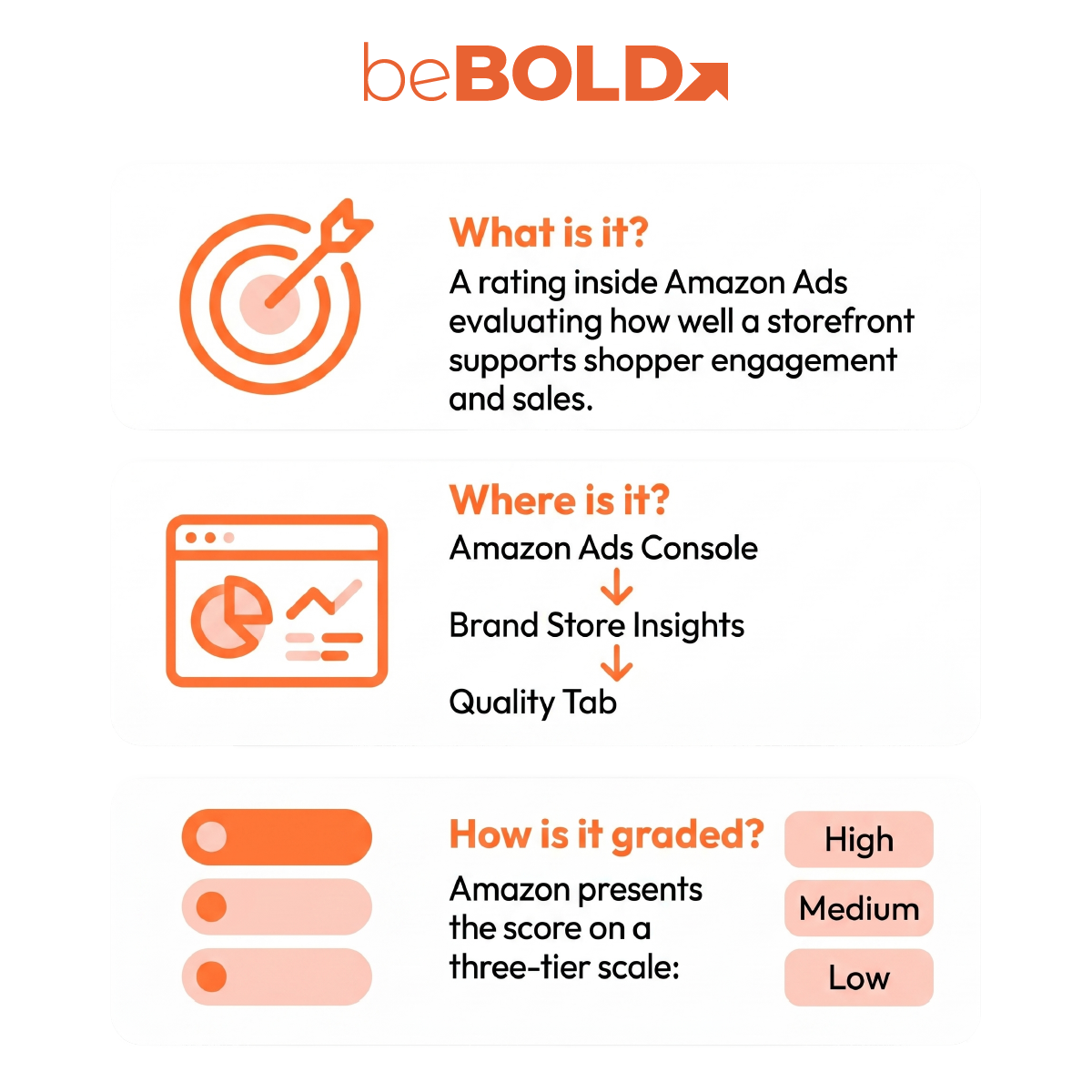
Amazon Brand Store Quality Score is a rating inside Amazon Ads that helps brands evaluate the quality and performance of their Brand Store.
Amazon originally introduced the Brand Store quality rating to help advertisers compare store engagement against similar brands and receive optimization recommendations. Earlier versions focused more heavily on engagement signals, including how much time shoppers spent in the store.
Where can you find it?
You can usually find it in:
- Amazon Ads console
- Brand Store Insights dashboard
- Brand Store quality tab
Amazon presents the score as high, medium, or low. High-quality Amazon stores can see up to 97% more sales than low-quality stores, and 39% more than medium-quality stores.
What does it help brands evaluate?
The score helps answer practical questions like:
- Is store traffic converting into sales?
- Are shoppers finding the right products quickly?
- Is the store useful as a landing page for Amazon Ads?
- Are product categories, bundles, and best sellers easy to navigate?
- Is the store helping the brand compete against similar brands?
For brands still building their storefront foundation, beBOLD Digital’s guide to creating an effective Amazon Brand Store is a useful reference.
An Amazon brand store is not just a digital brochure. It is often the bridge between paid traffic and conversion.
A shopper may arrive from:
- Sponsored Brands ads
- Sponsored Brands Video
- Amazon DSP
- Organic brand searches
- Influencer traffic
- Email or social campaigns
- External landing pages
If the store does not guide that shopper toward the right product, the brand may lose the sale.
Amazon’s own Stores best practices guide states that new-to-brand shoppers who visited a Brand Store were 62.7% more likely to purchase than those who did not visit a Brand Store. When those shoppers purchased, they spent 72.3% more on average.
Why it matters from an ad strategy standpoint
A stronger Brand Store can help brands:
- Improve post-click conversion paths.
- Reduce wasted ad traffic.
- Introduce shoppers to more products.
- Support cross-selling and bundling.
- Build trust before the shopper reaches the PDP
- Make Sponsored Brands campaigns more useful.
For reporting, brands should connect Store performance with Amazon sales reporting workflows and learn how to download Amazon summary reports.
What Changed in 2026: From Dwell Time to Sales Performance
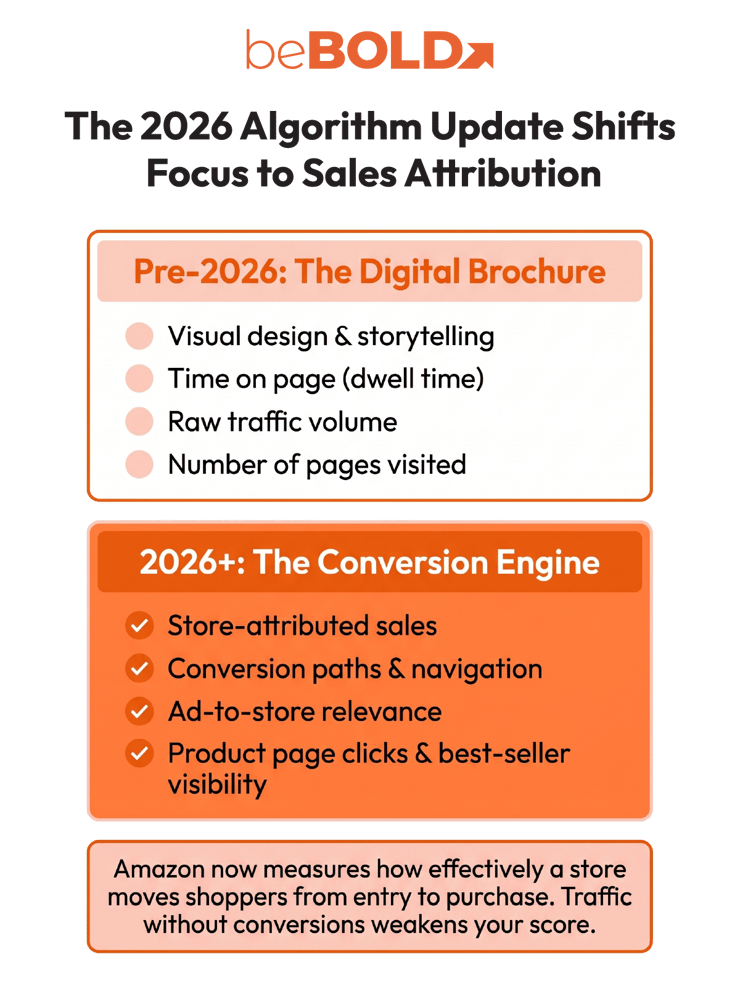
Amazon’s biggest update is the shift from engagement-based evaluation to sales-based evaluation.
Previously, a Brand Store could look successful if shoppers spent time browsing. Now, Amazon’s quality rating focuses more directly on whether the store helps generate sales.
Amazon says the updated Brand Store quality rating is based on sales attributed to your storefront rather than visitor engagement time. It also lets brands compare their sales performance with similar brands in their category.
What this means for brands
The shift changes how brands should optimize their Amazon storefront.
A store should no longer be judged solely by visual design, time on page, brand storytelling, number of pages, or traffic. It should also be judged by:
- Store-attributed sales (primary)
- Conversion rate from Store traffic
- Product selection & merchandising
- Supporting signals (dwell time, CTR)
- Best-seller visibility
- Ad-to-store relevance
In practice, this means your Amazon brand storefront should work more like a sales funnel than a static brand page.
Industry analysis also supports this interpretation. eStore Factory notes that Amazon now measures how effectively a store moves shoppers from entry to purchase, meaning traffic without conversions can weaken store quality signals.

What Affects Your Brand Store Quality Score?
Amazon does not publicly disclose every factor behind the rating. However, based on Amazon’s update, several performance drivers are clear.
Key factors that can influence performance
- Store-attributed sales
Your store needs to contribute to actual purchases, not just traffic. - Conversion efficiency
If many shoppers visit but few buy, the store may need stronger merchandising or clearer page paths. - Navigation and page structure
Shoppers should quickly find best sellers, product categories, bundles, and use-case pages. - Product selection & merchandising
The store should feature relevant SKUs, hero products, seasonal items, and complementary products. - Merchandising quality
Product tiles, category banners, and collections should guide buying decisions. - Ad and landing page relevance
A Sponsored Brands ad for “hydrating skincare” should not send shoppers to a broad, unfocused homepage. - Product detail page strength
Even a strong store can underperform if shoppers click into weak PDPs.
Amazon’s section-level Brand Store insights now make this easier to diagnose. As of January 2026, advertisers can access metrics like renders, viewable impressions, clicks, and click-through rate for each store section in their Amazon sales reports. These metrics help brands identify which store sections are driving engagement.
For brands focused on better shopper paths, these insights should be paired with Amazon customer engagement strategies.
How to Improve Your Brand Store Quality Score
Improving Brand Store Quality Score requires more than redesigning the store. The goal is to make the storefront easier to navigate, easier to shop, and more aligned with traffic intent.
1. Build Store Pages Around Shopper Intent
Every store page should answer a specific shopper's needs.
For example:
- A branded search visitor may need a broad overview of the brand.
- A category shopper may need product comparisons.
- A shopper from a Sponsored Brands Video ad may need a focused product page or collection.
- A repeat shopper may need new arrivals, bundles, or Subscribe & Save options.
beBOLD Digital Expert Tip:
Do not send every campaign to the Brand Store homepage. Match the destination to the shopper’s intent, campaign keyword, and product stage.
2. Improve Merchandising
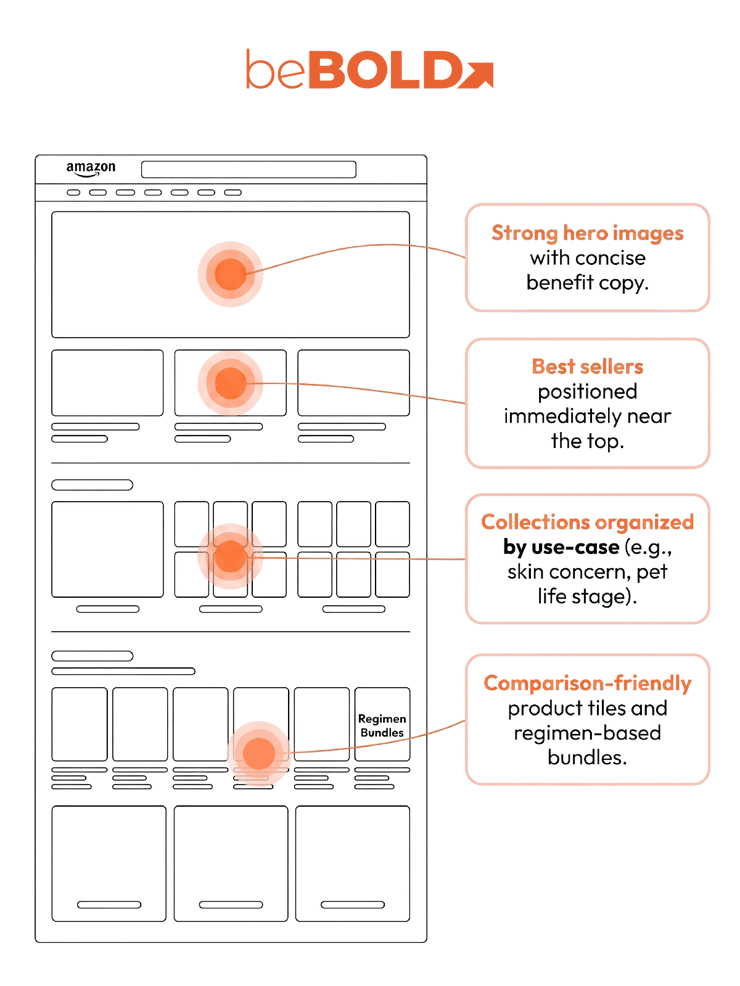
A high-performing Amazon brand store should make product selection easier.
Strong merchandising can include:
- Best sellers near the top of the page
- Product collections by use case
- Bundles or regimen-based groupings
- Seasonal product placements
- Comparison-friendly product tiles
- Clear category navigation
- Strong hero images and concise benefit copy
For beauty brands, this may mean organizing by skin concern, routine step, ingredient, or product line. For pet brands, it may mean grouping by pet type, size, life stage, or problem-solution category.
Brands can also study top-performing beauty brands to understand how stronger positioning, visual consistency, and product education can shape the shopper journey.
3. Strengthen Store Structure
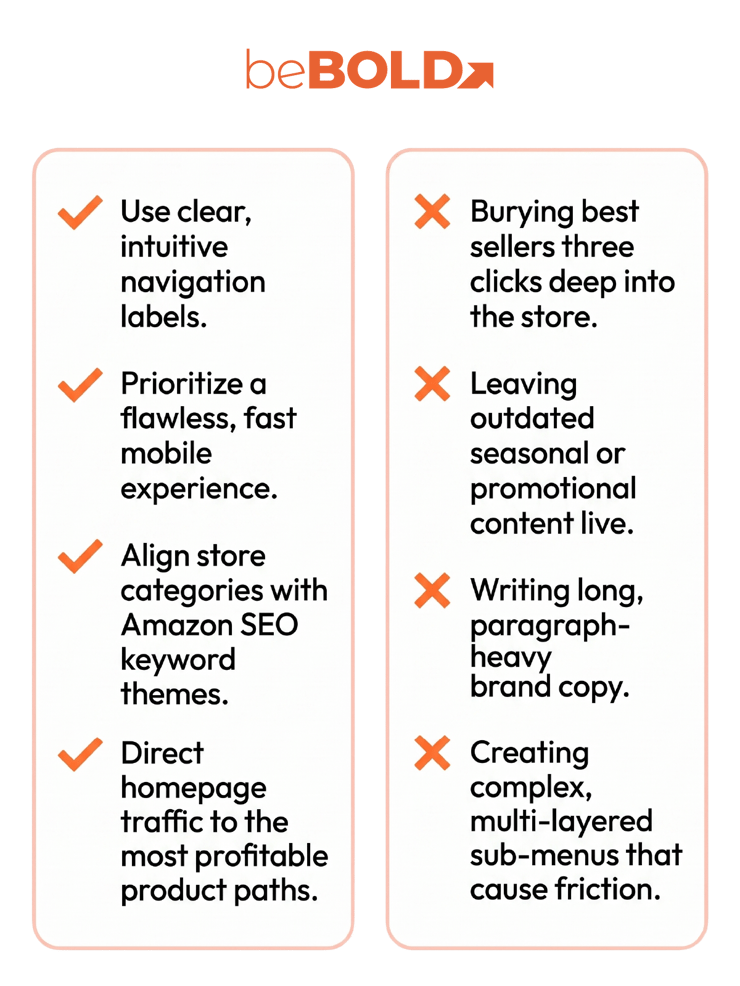
A strong store should be easy to scan and easy to shop.
Keep the structure simple:
- Use clear navigation labels.
- Avoid burying best sellers too deep.
- Create pages around real shopper needs.
- Keep copy short and useful.
- Make the mobile experience a priority.
- Remove outdated seasonal or promotional content.
- Make sure the homepage directs shoppers to the most important product paths.
From an Amazon SEO standpoint, the store should also align with product listings, A+ Content, keyword themes, and category positioning.
For broader optimization, brands can reference this Amazon SEO checklist or explore beBOLD Digital’s Amazon SEO services.
4. Align Ad Traffic With the Right Destination
Ad traffic should land on the page most likely to help the shopper take the next step.
|
Campaign Type |
Better Store Destination |
|
Branded search campaign |
Store homepage or best-seller page |
|
Non-branded category campaign |
Category-specific store page |
|
Product launch campaign |
New product or collection page |
|
Seasonal campaign |
Seasonal landing page |
|
Sponsored Brands Video |
Product-focused page or routine page |
|
Cross-sell campaign |
Bundle or complementary product page |
This matters because the wrong destination can create friction. A shopper who clicks an ad for one specific product type should not have to search through the entire store to find it.
beBOLD Client Scenario
A mid-market beauty brand had strong Sponsored Brands traffic but weak Store-attributed sales. The issue was not traffic volume. The problem was that most ads were sending shoppers to a broad Amazon brand page with too many product lines and no clear next step.
In this scenario, beBOLD Digital would typically review Amazon storefront analytics, segment campaigns by shopper intent, match ad groups to better landing pages, rebuild store sections around best sellers and product concerns.
This type of workflow helps identify whether the performance issue is caused by traffic quality, store structure, merchandising, product detail page quality, or a mix of all four.
Brands should also protect the storefront experience from unauthorized sellers, inconsistent catalog content, and brand control issues. Strong Amazon brand protection helps keep the customer journey cleaner and more credible.
How IDQ Score Supports Brand Store Performance
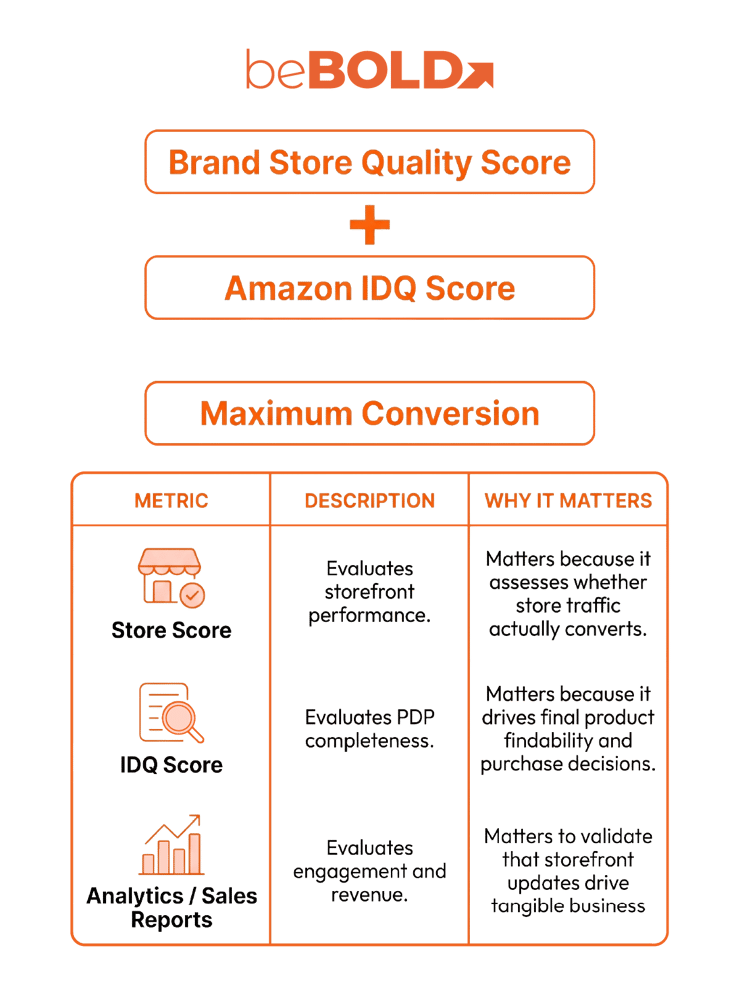
Item Data Quality (IDQ) plays a supporting role in Brand Store performance. While it does not directly determine Store quality, it impacts conversion once users reach product detail pages (PDPs).
Poor PDP content (images, titles, reviews) can limit the effectiveness of Store traffic, reducing overall sales performance.
How IDQ connects to Brand Store performance
A store can send shoppers to the right product, but the PDP still has to close the sale.
Weak PDPs can reduce store performance when they have:
- Poor main images
- Missing A+ Content
- Thin bullet points
- Weak titles
- Incomplete product attributes
- Low review count or poor review average
- Confusing variation structure
- Poor keyword targeting
- Missing product claims or benefit explanations
Brand Store Optimization Checklist
- Align traffic sources (e.g., Sponsored Brands) to the most relevant Store page
- Feature best-selling or high-converting products above the fold
- Simplify navigation with clear category paths
- Ensure PDP readiness (reviews, A+ Content, pricing competitiveness)
- Monitor Store-attributed sales in Amazon reports
For a more in-depth guide for Amazon storefront optimization, head over to our guide How to Boost Your Brand with Amazon Storefront Optimization.
What Sellers Need to Do Today
Amazon Brand Store Quality is no longer just a measure of engagement—it’s a reflection of how well your Store converts traffic into sales. Brands that optimize for conversion, merchandising, and traffic alignment will see stronger performance and higher Store ratings.
Contact beBOLD Digital today to build an Amazon Brand Store that supports visibility, conversion, and long-term growth.
FAQ
What is a good Amazon Brand Store Quality Score?
A good Amazon Brand Store Quality Score is typically a High rating.
Amazon presents the rating as High, Medium, or Low, so brands should aim to move from Low or Medium toward High by improving sales-attributed store performance.
How often does Amazon update it?
Amazon has not publicly shared one universal update frequency for every advertiser.
Brands should check the Brand Store quality tab regularly, especially after:
- Store redesigns
- Major campaign changes
- Product launches
- Seasonal updates
- Large merchandising updates
- Changes to ad landing pages
Does Brand Store Quality Score affect ad performance?
Amazon has not stated that Brand Store Quality Score directly changes auction rank or CPC.
However, it can affect ad efficiency in practice. If paid traffic lands on a weak store, shoppers may not convert. If the store is structured well, Sponsored Brands and upper-funnel campaigns can become more useful post-click destinations.
What is the difference between Brand Store Quality Score and IDQ Score?
Brand Store Quality Score measures storefront performance, especially sales attributed to the Amazon brand store.
Amazon IDQ Score measures product detail page quality and completeness.



Comments