


Setting the right price is one of the most powerful levers a beauty brand can pull. With the global beauty and personal care market expected to reach $756B by 2035, brands are under more pressure than ever to build pricing strategies that balance profitability, consumer psychology, and channel-specific constraints. Beauty brands that win today use pricing as a growth engine, not a guesswork exercise.
To help you do the same, this guide breaks down the hidden formula behind high-performing pricing, from luxury psychology to Amazon-specific optimization.
Story-at-a-Glance
- Beauty is a $756B global market, making strategic pricing a critical profit driver. 💄
- Luxury pricing leverages perceived value, storytelling, and emotional triggers to increase willingness to pay. ✨
- Retailers like Sephora, Ulta, and Amazon can take 50 to 70% margins, making smart channel pricing essential. 🛍️
- Masstige (affordable luxury) brands convert better by balancing accessibility and aspiration. 🌟
- Omnichannel consistency prevents brand dilution and protects retailer relationships. 🔗
- Amazon-specific pricing requires data-led testing, elasticity modeling, and SKU-level profitability analysis. 📊
- Premium visuals and ingredient storytelling significantly increase perceived value and justify higher RRPs. 📸
- Bundles and discovery kits boost AOV without lowering core pricing. 🎁
- Prices should be reevaluated every 6–12 months based on demand, costs, and competition. 🔄
- beBOLD Digital helps beauty brands scale profitably with dynamic pricing, A+ optimization, and brand storytelling support. 🚀
The Psychology Behind Luxury Beauty Pricing
Beauty pricing is emotional, not logical. Consumers don’t just “buy” skincare and cosmetics. They buy an identity, a story, and the belief that the product will work. This is why pricing psychology is one of the most important foundations of any beauty brand's pricing strategy.
Perceived Value and the Placebo Effect
In beauty, higher prices are often associated with higher quality. Consumers use price as a shortcut to judge effectiveness, especially when results are subjective. Luxury and masstige brands intentionally leverage this behavior by positioning products as premium, but still attainable, to drive stronger conversion and loyalty.
beBOLD Digital Insight: On Amazon, we often see brands underprice in an attempt to boost conversion, only to hurt perceived value. In many categories, slightly higher prices paired with stronger visuals and A+ Content outperform cheaper competitors on both conversion and profitability.
Why “Affordable Luxury” Converts Better Than Budget Positioning
Masstige brands outperform pure budget players because they balance aspiration with accessibility. This positioning typically delivers higher margins, lower price sensitivity, and more room for brand storytelling and innovation.
Scarcity, Exclusivity, and Emotional Triggers

Limited editions, seasonal launches, and exclusives trigger urgency and justify premium pricing. At the same time, packaging design, ingredient transparency, and educational content reinforce perceived value, making shoppers more confident that the product is worth the price.
With pricing psychology in place, the next challenge is translating that value across retail, DTC, and marketplace channels without eroding margins.
Navigating Retail and Online Pricing Challenges
Pricing beauty products is uniquely challenging because each sales channel requires different margin structures and pricing rules. Retail-ready beauty brands must protect margins while keeping prices consistent across retail, DTC, and marketplaces.
Accounting for Retailer Margins and Channel Markups
Retailers can take a significant cut of every sale. For example, these platforms take the following cut percentages:
- Sephora or Ulta: Around 50 to 65%
- Department stores: Around 45 to 55%
- Amazon (FBA + referral + ads): 30 to 70% depending on category and ad spend
Research shows that legacy beauty brands report margin erosion due to rising customer acquisition costs on DTC and increasing promotional pressure in ecommerce. Many brands even step back from DTC because it is less profitable than expected, especially compared to wholesale.
This makes it essential to model prices backwards from profitability, account for each retailer’s margin requirements, and set channel-specific price floors.
Setting Tiered Pricing for DTC vs. Retail vs. Marketplaces
Most high-growth beauty brands use a tiered pricing ladder:
- Retail (Sephora, Ulta): anchors RRP/MSRP
- DTC: may include bundles, loyalty tiers, or subscription discounts
- Amazon/Walmart: competitive pricing, search-driven bundles, and promotional elasticity testing
The key is maintaining price integrity, while adjusting structure, bundle types, and promotional strategy by channel.
beBOLD Digital tip: We help brands protect MSRP by using exclusive Amazon bundles and pack sizes instead of direct price cuts, preserving brand value while staying competitive in search.
Tailoring Pricing Strategies for Different Retail Environments
Each channel influences pricing strategy differently:
|
Amazon |
Walmart |
Sephora/Ulta |
|
Need to navigate Amazon’s competitive environment requiring monitoring and elasticity testing |
Mass‑market pricing with value bundling |
Premium and masstige brands maintain higher RRPs |
|
Bundles and value sets perform extremely well |
Shoppers are highly price‑sensitive. Competitive pricing is essential. |
Strong expectation for seasonal value sets: Value sets are especially important during holiday and VIB events due to strong expectations for seasonal events. |
|
Discovery kits help reach lower entry price points while increasing AOV |
Across beauty brands, omnichannel consistency is mentioned as a top challenge. Brands must prevent Amazon from becoming the “cheapest place to buy” or risk brand dilution and retailer backlash. In addition, these platforms also entail their own selling costs and fees, which sellers should also keep in mind during their pricing decision-making process.
With these challenges in mind, many beauty brands partner with Amazon Beauty agencies to not only protect margins but accelerate growth. This is where beBOLD Digital creates an advantage.

How to Price Your Beauty Brand Products
Pricing beauty products requires a careful balance between cost coverage, consumer perception, and competitive positioning. Unlike other consumer goods, beauty product pricing is deeply tied to trust, efficacy, and brand credibility, making it essential to price with both data and psychology in mind.
Start With the Total Cost Per Unit
Before setting a price, brands must calculate the true cost of each product, including:
- Formulation and ingredient sourcing
- Packaging and labeling
- Manufacturing and quality contArol
- Certifications and compliance
- Fulfillment, shipping, and marketplace fees
- Marketing and overhead expenses
Most successful skincare brands target 40 to 60%+ gross margins, depending on channel and positioning, to ensure long-term scalability.
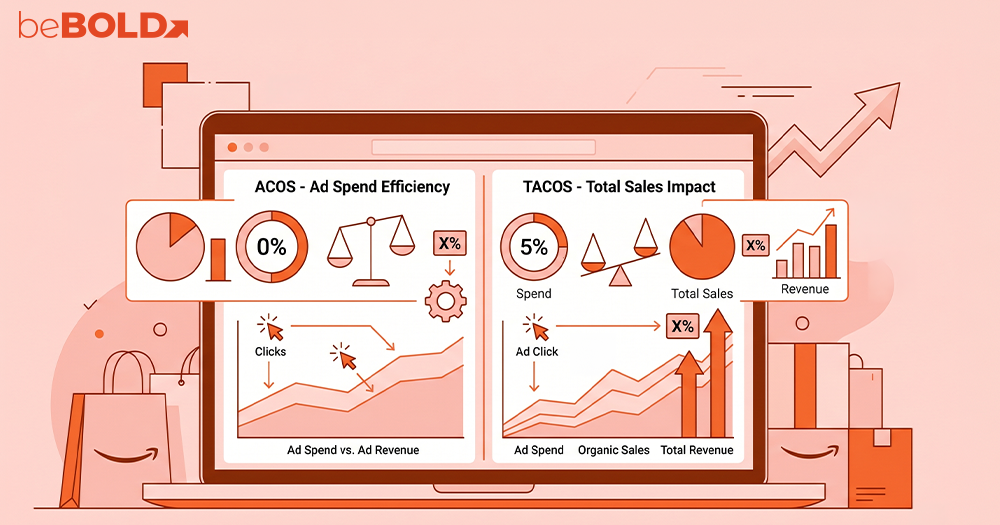
beBOLD Digital insight: On Amazon, we factor in ad-attributed costs (TACOS) early in pricing decisions. This prevents brands from launching at price points that look profitable on paper but fail once ads scale.
Choose a Pricing Strategy That Matches Your Brand
Skincare brands typically use one of the following approaches:
- Cost-plus pricing: Adding a markup (often 2 to 3×) on top of total costs to ensure margin coverage
- Value-based pricing: Pricing based on perceived results, ingredients, and brand story rather than cost alone
- Competitive pricing: Benchmarking against similar SKUs in the category to stay within expected price ranges
- Premium pricing: Using luxury packaging, advanced actives, or clinical positioning to justify higher prices
Your chosen strategy should align with your target customer, channel mix, and long-term brand vision.
Because Amazon has its own fee structure, shopper expectations, and competitive dynamics, selling beauty products on Amazon requires pricing decisions that protect both conversion and profitability.
Use Bundles and Entry Points to Reduce Price Resistance
Rather than lowering core prices, many skincare brands increase conversion by:
- Offering starter kits or discovery sizes
- Creating bundles that increase perceived value
- Introducing subscriptions or replenishment discounts
These tactics raise average order value while protecting your flagship product’s price integrity.
Review and Adjust Pricing Regularly
Skincare pricing should not be static. Brands should reassess prices every 6 to 12 months to account for:
- Rising ingredient and logistics costs
- Amazon tariffs and import cost changes
- Competitive price shifts
- Changes in demand or seasonality
Regular reviews help maintain profitability without surprising loyal customers. This is where beBOLD Digital creates an advantage.
How beBOLD Digital Optimizes Beauty Pricing on Amazon
Amazon is one of the fastest-growing beauty channels, which means brands must optimize pricing with data, speed, and precision. beBOLD Digital simplifies this by helping beauty brands find profitable price points while strengthening conversion and brand value.
Profit-First Amazon Strategy
beBOLD uses a streamlined, profit-first approach to help beauty brands find pricing that maximizes margin without hurting conversion. By reviewing only the most impactful data, including competitor prices, category demand shifts, listing quality, and SKU-level margins, we quickly pinpoint where a product should sit to stay competitive on Amazon while protecting profitability.
beBOLD also takes into account which platform you use, whether you use Vendor Central or Seller Central, to make sure you don’t cut through your profits to accommodate the platform’s fees and costs.
Beyond positioning and margins, Amazon Brand Protection Strategies addresses how pricing consistency and enforcement help protect perceived value.
Smarter Testing, Stronger Perception
To confirm the ideal price, beBOLD runs simple but effective tests such as small-scale A/B pricing trials, monitoring conversion changes, and making light seasonal adjustments. At the same time, we strengthen perceived value through premium A+ Content, focused storytelling, and clean visual design, making shoppers more confident in paying a higher price.
Client Scenario: Premium Beauty Brand Increasing Profitability
A premium beauty brand was struggling with severe pricing erosion on Amazon due to unauthorized third-party sellers heavily discounting products, including professional-only SKUs. This undercut agreed retail pricing with salons and prestige partners, weakened brand perception, and diverted paid traffic away from the brand’s own listings—turning Amazon into a margin drain rather than a growth channel.
beBOLD Digital restored pricing control by removing unauthorized sellers, reestablishing consistent price architecture across channels, and upgrading listings to better justify premium price points.
Results: With pricing integrity protected and perceived value reinforced, the brand achieved 262% year-over-year Amazon sales growth and reduced ACOS by roughly 40%, proving that strong pricing governance is a critical driver of both profitability and brand equity.
If you're ready to build a pricing strategy that protects your margins and accelerates growth on Amazon, partner with beBOLD Digital. Our team specializes in helping beauty brands strengthen their value perception, optimize pricing architecture, and scale sustainably across Amazon and Walmart.
Frequently Asked Questions
What is Sephora’s pricing strategy?
Sephora positions itself as a premium beauty retailer. Their strategy relies on prestige price anchors, premium packaging expectations, ingredient transparency, and limited-edition value sets. Brands selling through Sephora typically maintain higher RRPs and avoid constant discounting.
How do you determine the best price for a new beauty product?
Start with COGS and operational costs, then benchmark against competitors, evaluate consumer willingness to pay, and use value-based storytelling to determine your pricing tier. Most beauty brands aim for 50 to 70% gross margins on average.
What’s the difference between luxury and mass-market pricing?
Luxury pricing relies heavily on perceived value, storytelling, exclusivity, and premium ingredients. Mass-market pricing is driven by accessibility, high volume, and streamlined packaging. Clean or niche brands often sit between the two.
How often should I update my pricing on Amazon?
Most brands reevaluate every 6 to 12 months to account for cost increases, competitor shifts, and changing consumer behavior. This is consistent with recommendations across several uploaded reports.
How do discounts and bundles affect perceived value?
Short-term promotions can boost conversions but excessive discounting erodes brand value. Bundles and discovery kits increase AOV and allow brands to offer “value” without lowering RRP. Many reports warn against conditioning customers to wait for discounts.
What tools can I use to track competitor pricing?
Most brands use a mix of:
- Amazon Price Tracker tools
- Helium 10 / Jungle Scout
- Internal BI dashboards
- Retailer price monitoring software
- Manual category audits
With the right pricing strategy in place and consistent optimization across channels, you can increase margins, strengthen brand loyalty, and win more market share.






Comments