


To get the best results from Amazon beauty listings in 2026, brands need to do more than just add keywords. Focus on making product pages that are easy to find, build trust with shoppers, and encourage purchases. Map keywords to what beauty shoppers are really looking for, write mobile-friendly titles and use clear main images, and use bullet points to explain benefits and ingredients. Add visuals that show texture and how to use the product, and make A+ Content stronger with comparison charts, routine tips, and your brand story.
The 2026 Beauty Listing Optimization Framework

An effective Amazon listing optimization process starts by making your product easy to find, then works to increase clicks, conversions, content quality, and repeat purchases. In the beauty category, trust is key. Brands that do not clearly explain their product’s value and what makes it different will lose out to competitors who answer shopper questions openly and honestly.
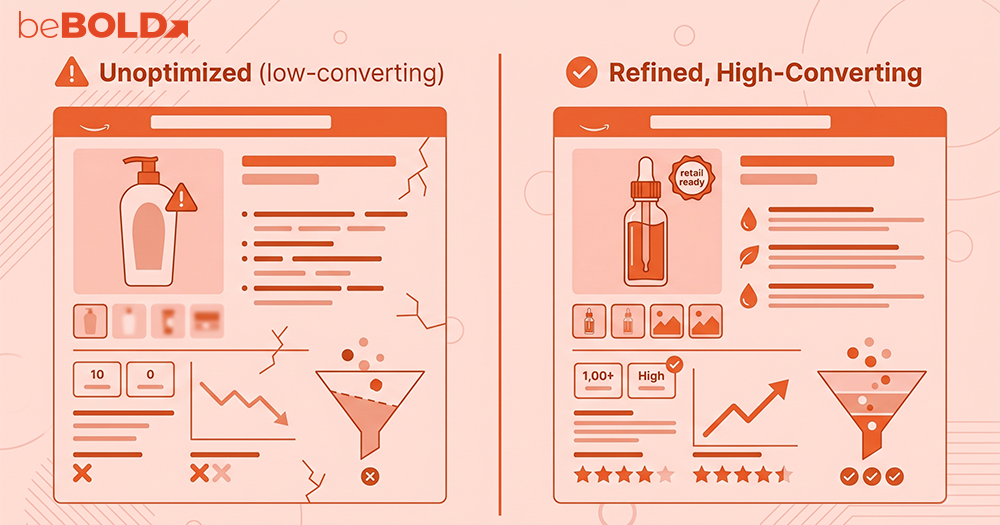
Before scaling ads or driving more traffic, brands need retail-ready beauty product listings that clearly communicate benefits, ingredients, imagery, reviews, and conversion signals.
1. Discoverability: Keyword and Intent Mapping

At beBOLD Digital, we begin with keyword research that reflects how beauty shoppers search, including by product type, ingredients, concerns, skin or hair type, and routine use.
When we refresh a listing, we place the main keyword in the title, integrate relevant secondary terms into the bullet points and A+ Content, and reserve additional variations for backend search terms. We also optimize product attributes so Amazon can accurately understand the product’s ingredients, form, size, scent, and intended use.
beBOLD Digital Expert Tip: Use PPC search term reports to identify queries that generate sales. Converting terms can help guide your listing copy, image messaging, and A+ Content.
2. Click Optimization: Title and Main Image

Once your product is discoverable, the title and main image must earn the click. Under Amazon’s 2026 product title update, titles in non-media categories must stay within 75 characters. Prioritize the brand, product type, primary keyword, and strongest differentiator, moving secondary details into Item Highlights, bullets, or A+ Content. For additional guidance, see our guide to optimizing Amazon product titles.
Use a clear main image that makes the product and packaging easy to recognize on mobile. Any visual claims should be substantiated, particularly as the injectable skincare trend raises expectations around visible beauty outcomes.
3. Conversion Optimization: Bullets and Messaging

Your bullet points should quickly explain the product’s main benefits, key ingredients, intended skin or hair type, and how to use it. Include details such as texture, scent, or finish when they help shoppers decide. Any claims, including dermatologist-tested, vegan, or suitable for sensitive skin, must be accurate and verifiable.
Example:
LIGHTWEIGHT DAILY HYDRATION: This gel moisturizer helps dry skin feel soft and refreshed without a heavy or greasy finish, making it suitable for daily use under sunscreen or makeup.
To strengthen performance beyond the listing itself, explore our guide to improving your Amazon conversion rate. Beauty brands seeking category-specific support can also learn about beBOLD Digital’s approach as an Amazon premium beauty marketing agency.

4. Visual Optimization: The Primary Growth Lever

Images help beauty shoppers evaluate qualities they cannot test online, such as texture, shade, finish, and product size. Effective visual branding optimization uses clear, professional visuals to show the product, key ingredients, application, scale, and place in a beauty routine.
A strong beauty image stack may include:
|
Image Type |
Purpose |
|
Main image |
Shows the product clearly on a white background |
|
Texture image |
Shows serum, cream, oil, balm, powder, or gel consistency |
|
Ingredient image |
Explains hero ingredients and their purpose |
|
Routine image |
Shows when and how to use the product |
|
Scale image |
Clarifies product size and volume |
|
Lifestyle image |
Shows the product in a real beauty routine |
|
Comparison image |
Helps shoppers choose between variants |
Each image should answer a purchase question without making unsupported claims. Before-and-after visuals, in particular, should not imply medical or unverified results. For guidance on improving image visibility beyond Amazon, see our image SEO optimization guide.
5. Content Depth: A+ Content and Brand Story

A+ Content helps beauty brands explain ingredients, product use, suitability, and differences between products through enhanced visuals and supporting copy. It should educate shoppers, address common concerns, and reinforce the brand, not simply decorate the listing.
Unlike titles and backend keywords, A+ Content is primarily a conversion tool. Clear, useful modules can give shoppers greater confidence in their purchase decisions.
Useful A+ modules include:
- Ingredient education
- Routine placement
- Product comparison charts
- Brand story
- Skin or hair type guidance
- Texture and finish explanations
- FAQ-style objection handling
Before investing more in traffic or advertising, it's worth determining whether the problem is limited to your product listing or reflects a broader Amazon strategy issue. These signs your beauty brand needs Amazon help can help you identify when it's time to look beyond listing optimization.
Beyond conventional keyword optimization, brands should prepare for AI-ready Amazon beauty listings that answer conversational questions about ingredients, suitability, routine placement, and expected results.
What’s Changed in Amazon Beauty Listing Optimization in 2026?

Optimizing Amazon listings now depends more on AI-powered discovery, stronger engagement signals, and shoppers who do more research. Here are the main changes:
- AI-driven discovery is more important. Rufus, semantic search, AI Shopping Guides, and review summaries reward listings with clear product data, specific use cases, and structured content.
- Engagement signals are now more important. Click-through rate, conversion rate, and how long shoppers stay on your page all help Amazon decide if your listing is relevant and helpful.
- Competition remains intense. Third-party sellers accounted for 61% of worldwide Amazon units sold in Q4 2025, so beauty brands cannot rely on vague copy, incomplete attributes, or weak images.
- Beauty shoppers now care more about trust. They look at ingredients, claims, reviews, creator recommendations, and brand values before buying. Younger shoppers, like Gen Alpha, are changing how people research beauty products.
Listing optimization is only one part of selling beauty products on Amazon; brands also need the right category setup, pricing, compliance, and advertising strategy to scale profitably.
This framework is reflected in K-beauty’s routine-based content strategy, where ingredients, usage order, and benefits are explained consistently across product images, A+ Content, Storefronts, and social channels.
What Are Advanced Strategies Most Beauty Brands Miss?
Most brands know how to use titles, bullet points, and images, but not as many set up a system to keep improving their listings over time.
- Review mining: Look at customer reviews and Q&A to find out how buyers talk about your product. If shoppers often mention things like “sticky,” “strong scent,” “smaller than expected,” or “great under makeup,” make sure to address these points in your listing.
- Listing-to-ads alignment: Make sure your product page matches the messages in your Sponsored Products, Sponsored Brands, TikTok videos, and influencer content. If your ad says the product is lightweight, your product page should confirm that.
- Attribute optimization: Backend attributes help Amazon know your product’s form, benefits, ingredients, scent, size, and target audience. This is even more important now that AI shopping tools use structured catalog data.
- Retention optimization: Since beauty products are often bought again and again, your listings should encourage repeat purchases. Use options like Subscribe & Save, multipacks, bundles, and routine-based merchandising when it makes sense.
For brands expanding beyond Amazon, similar optimization principles apply to Walmart. See beBOLD Digital’s guide to Walmart beauty listing quality optimization for cross-marketplace quality considerations.
How beBOLD Digital Optimizes Beauty Listings at Scale
Optimizing one beauty listing is manageable, but scaling across a full catalog requires data, creative direction, and marketplace expertise. beBOLD Digital helps beauty brands prioritize the right ASINs, improve Amazon SEO strategy, align PPC insights with listing copy, strengthen A+ Content, and build storefront experiences that support the full buying journey. For more on the broader brand experience, read beBOLD Digital’s guide to Amazon beauty brand store fronts.
If your beauty catalog is live but performance has plateaued, beBOLD Digital can help turn product pages into stronger search, conversion, and brand-building assets. For proof of how this works in practice, explore the K18 Premium Beauty Amazon success case study, the Henkel Professional Beauty growth case study, and the Amazon Premium Beauty Brand case study.
FAQs About Amazon Beauty Listing Optimization
What is Amazon beauty listing optimization?
Amazon beauty listing optimization is the process of improving a beauty product detail page so it ranks for relevant searches, earns more clicks, and converts more shoppers. It includes titles, bullets, images, infographics, A+ Content, backend search terms, attributes, reviews, and ongoing testing.
How does Amazon Rufus affect listings?
Rufus and AI-led shopping experiences make clear product information more important. Listings should answer natural shopper questions about ingredients, benefits, usage, skin type, hair type, texture, scent, and product comparisons.
Do images impact Amazon SEO?
Images may not work like keyword fields, but they strongly affect click-through, conversion, and engagement. In practice, better images can support stronger sales performance, which can indirectly support organic growth.
How often should you update a listing?
Review high-priority listings at least quarterly. Update sooner if you launch new ads, receive repeated review complaints, see conversion decline, introduce new packaging, or find new high-converting search terms.
Does A+ Content improve rankings?
A+ Content is not mainly a direct ranking field, but it can improve conversion by helping shoppers understand the product and brand. Better conversion can support stronger marketplace performance over time.






Comments