

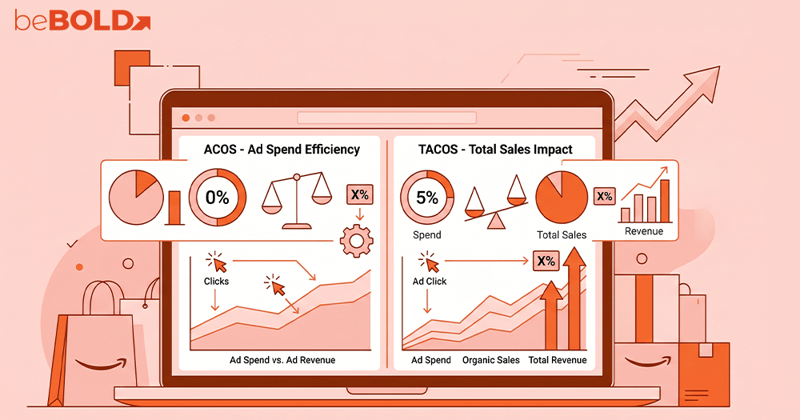
ACOS and TACOS do not answer the same question. ACOS shows whether your Amazon ads are efficient. TACOS shows whether your ad spend is helping grow the business overall, including organic sales. Sellers need both to judge performance correctly.
What Is ACOS on Amazon?

ACOS stands for Advertising Cost of Sales. Amazon defines it as ad spend divided by ad revenue, expressed as a percentage. In simple terms, it shows how much you spent on ads to generate directly attributed sales. Amazon also notes ROAS is the inverse of ACOS. While ACOS shows how much of ad-driven revenue is spent on ads, ROAS shows how much revenue is earned for each dollar spent.
For a fuller breakdown of the math, see calculating ACOS and seller metrics optimization.
Formula: ACOS = Ad Spend / Ad Sales x 100
For example, if a skincare brand spends $300 on ads for a vitamin C serum and those ads generate $1,500 in attributed sales, ACOS is 20%. Amazon is clear that there is no universal “good” ACOS because the right target depends on margin, category, and business goal.

What Is TACOS on Amazon?

TACOS means Total Advertising Cost of Sales. Unlike ACOS, it uses total sales as the denominator rather than just ad-attributed sales. That makes it a broader metric for understanding how advertising affects the overall business, including organic sales growth.
For related context, see the retail analytics glossary.
Formula: TACOS = Ad Spend / Total Sales x 100
TACOS is useful because it captures whether advertising is supporting the broader business, not just attributed ad sales. If ads improve visibility, ranking, and conversion, that impact can show up in total sales even when ACOS alone looks less efficient.
Using the same beauty example, if that serum brand spends $300 on ads and generates $5,000 in total sales, TACOS is 6%. This is why TACOS is tied more closely to overall business health than to ad efficiency alone.

A lower TACoS can suggest that paid campaigns are contributing to more organic sales over time, making organic growth from Amazon Ads an important signal to monitor.
ACOS vs. TACOS: What’s the Real Difference?
ACOS isolates paid performance. TACOS connects paid performance to total revenue and organic momentum.
|
Metric |
ACOS |
TACOS |
|
What it measures |
Ad spend vs. ad-attributed sales |
Ad spend vs. total sales |
|
Sales included |
Only ad-attributed revenue |
Paid + organic sales |
|
Best use case |
Campaign, keyword, and bid optimization |
Growth efficiency and ad reliance |
|
What it can miss |
Organic halo and total business impact |
Which exact campaign or keyword drove the result |
Before deciding whether ACoS or TACoS matters more, sellers should understand how Amazon ACOS is calculated and what it reveals about ad efficiency.
What ACOS and TACOS trends actually tell you
ACOS and TACOS trends give a clearer view of how ads are affecting both efficiency and overall account growth. Looking at them together helps you understand whether your campaigns are only spending well or actually supporting stronger total sales.
- ACOS improving, TACOS worsening: ad efficiency may be improving while total growth slows
- ACOS rising, TACOS improving: acceptable during launch or discovery if total sales are expanding
- TACOS declining over time: ads may be supporting stronger organic sales and lower ad reliance
- Low ACOS, flat sales: efficient ads do not always mean meaningful business growth

When Does ACOS or TACOS Matter More?

Both metrics matter, but they serve different purposes.
Use ACOS for tactical PPC decisions, such as:
- bid changes
- search term cleanup
- keyword expansion
- campaign-level spend allocation
If your goal is cleaner campaign efficiency, ACOS is the sharper tool.
Use TACOS for broader business evaluation, especially when you are:
- launching a product
- trying to improve ranking
- defending market share
- measuring total revenue growth
TACOS is especially useful because it reflects the organic halo effect.
For broader strategy, see Amazon PPC and DSP insights.
Why Sellers Shouldn’t Judge Performance by ACOS Alone
A low ACOS can still hide weak overall growth. Sellers who focus too heavily on ACOS often shift spend toward branded or bottom-funnel traffic, which may protect efficiency while limiting discovery.
This is where TACOS becomes more useful. A higher ACOS may still be acceptable during:
- Product launches
- Seasonal pushes
- Ranking campaigns
If total sales are rising and TACOS is trending down, the ad investment may still be working. Amazon also notes that break-even ACOS depends on profit margin, so a healthy ACOS should always be tied to contribution margin.
To make that practical, consider a beBOLD Digital client scenario. A beauty brand launching a new peptide moisturizer saw ACOS rise during the first month of non-branded acquisition. At first glance, the ads looked too expensive. But after reviewing TACOS, total sales, and search term movement together, the team found that ACOS rose from 28% to 42%, but TACOS dropped from 18% to 11% as organic sales grew. In practice, beBOLD Digital used that broader view to keep profitable discovery campaigns live instead of cutting spend too early.
Before following AI bid recommendations, sellers should understand how TACoS and ACoS affect the bigger profitability picture.
How to Improve Both Metrics
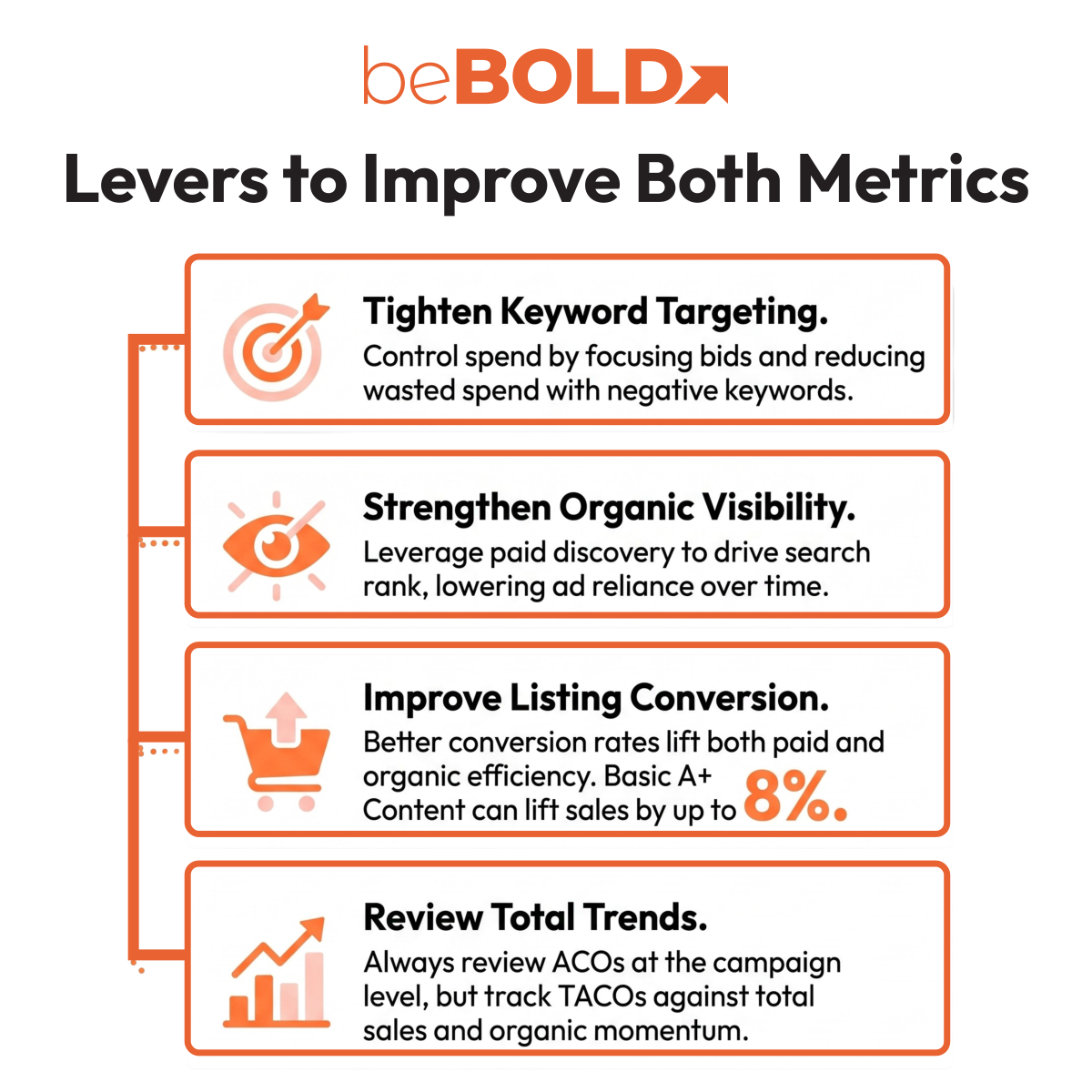
Improving ACOS and TACOS usually comes down to a few core actions:
- Improve listing conversion rates
- Tighten keyword targeting
- Reduce wasted spend with negatives
- Strengthen organic visibility
- Review total sales trends alongside ad data
Amazon notes that Basic A+ Content can lift sales by up to 8%, which is one reason listing quality matters. Better targeting also helps control spend while supporting broader growth.
For related PPC guidance, see how to analyze Amazon PPC data, how to become an Amazon PPC expert, and Amazon PPC cost benchmarks.
beBOLD Digital Expert Tip: review ACOS at the campaign level, but track TACOS against total sales and organic momentum. That gives a clearer view of whether ads are driving efficient growth.
Work With beBOLD Digital
If your team needs help improving ACOS without losing sight of total sales growth, beBOLD Digital helps Amazon brands connect PPC performance to the bigger retail picture. We support sellers with campaign optimization, retail readiness, listing improvements, and data-backed growth strategy so ACOS and TACOS become practical decision-making tools. Schedule a call with us today.
FAQ
What is the difference between ACOS and TACOS on Amazon?
ACOS measures ad spend against ad-attributed sales. TACOS measures ad spend against total sales, including organic revenue.
Is a lower TACOS always better?
Not always. A lower TACOS is often positive, but newer brands may accept a higher TACOS while building rank and share.
Can ACOS be high and still be acceptable?
Yes. Acceptable ACOS depends on margin, growth stage, and campaign goal.
Should Amazon sellers track both ACOS and TACOS?
Yes. ACOS helps optimize ads, while TACOS shows whether advertising is improving the full business.
How is Advertising Cost of Sales calculated?
Advertising Cost of Sales, or ACOS, is calculated as ad spend divided by ad revenue, multiplied by 100.
What is a good Advertising Cost of Sales percentage?
There is no universal benchmark. Amazon recommends comparing ACOS to profit margin and break-even ACOS first.
In the end, TACOS vs ACOS is not a choice between competing metrics. ACOS tells you whether ads are efficient. TACOS tells you whether the business is actually moving forward.







Comments