


Beauty brands should use Amazon A+ modules to explain product benefits, ingredients, texture or finish, application, routine placement, and differences between related products. Premium A+ is worth considering when video or interactive modules can resolve questions that static content leaves unanswered, and the expected return justifies the additional production cost. Through its Amazon beauty marketing services, beBOLD Digital helps brands prioritize clear product education and choose the format that best supports the shopper’s decision. 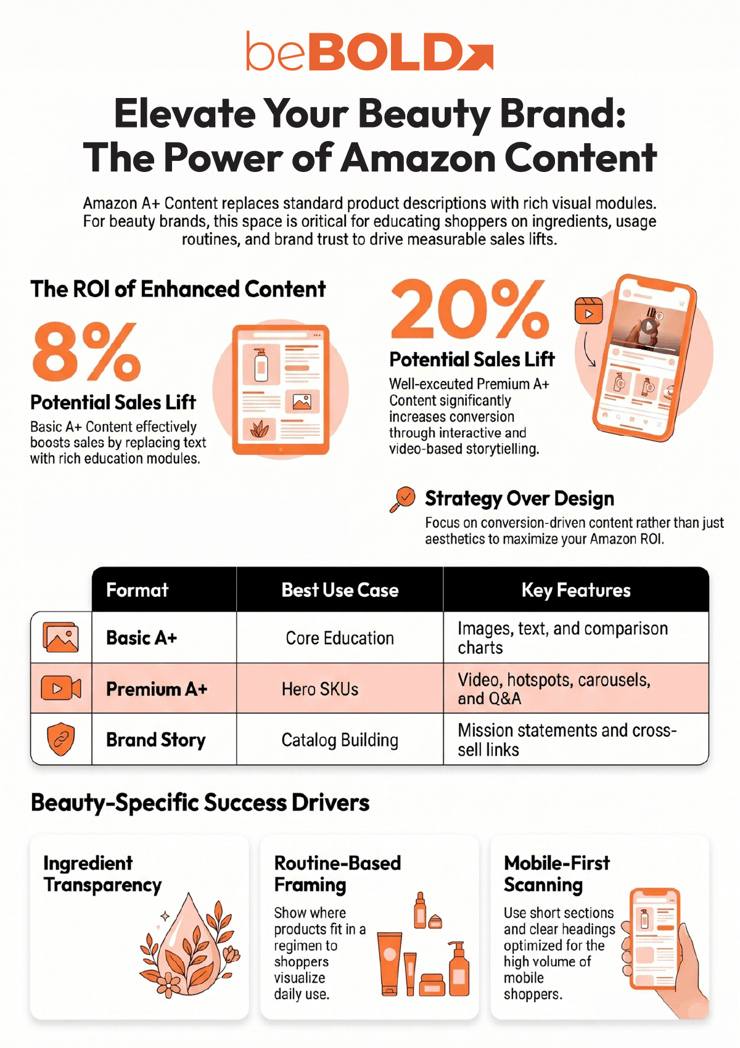
What Is Amazon A+ Content for Beauty Brands?
Amazon A+ Content is enhanced product page content available through Amazon Brand Registry. It replaces or expands the standard product description with visual modules that help explain product benefits, brand story, comparison points, and usage details.
Sellers can use Basic A+ Content, Premium A+ Content, and Brand Story modules depending on eligibility. For beauty brands, these modules are useful for explaining formulas, routines, skin or hair concerns, product claims, and cross-sell opportunities, such as Amazon virtual product bundles, in a more visual way.
Who Can Use Amazon A+ Content?
Amazon says sellers generally need:
-
a Professional selling account
-
a Brand Representative or Reseller role
-
a brand enrolled in Amazon Brand Registry
-
or eligible generic products in the catalog
Vendors also use A+ as part of their product-page strategy, but sellers and vendors often approach it differently:
-
Sellers usually build around Brand Registry and A+ Content Manager.
-
Vendors often align A+ more closely with broader retail content programs.
Just having access to A+ Content does not guarantee better results. Brands still need to follow Amazon’s module limits, image guidelines, and moderation rules. Premium A+ may only be available to certain accounts, depending on eligibility and past approved A+ content. It is best to check your access in A+ Content Manager rather than assume all accounts have the same options.
Why Amazon A+ Content Matters More in Beauty

Beauty is one of the categories where product education directly affects conversion. Ingredient transparency has become a stronger purchase driver in recent years. NielsenIQ notes that consumers are scrutinizing the ingredients in skincare, haircare, and cosmetics more closely, while clean beauty has shifted from a trend to a standard expectation for many shoppers. That context matters on Amazon. Beauty shoppers are often evaluating:
-
High-SKU ranges, which can make it harder for shoppers to quickly tell the difference between similar products within the same brand line
-
Concern-based benefits, such as hydration, brightening, repair, acne support, curl definition, or frizz control, which often drive purchase decisions more than the product name alone
-
Formula details in a compressed shopping environment, where shoppers are expected to make fast decisions without seeing the product in person
-
Active ingredients in skincare, especially when shoppers want to understand what ingredients do, how strong they are, and whether they fit their skin concerns
-
Regimen logic in haircare, since many brands sell systems rather than single products, and need to show how each SKU fits into the routine
-
Trust signals for sensitive-skin products, including dermatologist-developed positioning, fragrance-free notes, allergy considerations, and other cues that reduce hesitation
This is why Amazon A+ Content can boost conversion for beauty brands more than many expect. It gives brands space to explain details that bullet points alone cannot cover.
What Should a Beauty Brand Put in A+ Modules?
Build each module around a question shoppers need answered before buying. Use customer questions, reviews, and return reasons to identify the most important gaps. The following sequence is a starting point; adjust it to the product and available modules.
|
Content focus |
Shopper question |
What to include |
|
Main benefit and product fit |
Is this right for me? |
An image-and-text module explaining the primary benefit, intended skin or hair type, and relevant concern. |
|
Ingredients and supporting evidence |
Why should I trust the benefit? |
Key ingredients, their roles in the formula, and supported product claims. Distinguish ingredient properties from results demonstrated for the finished product. |
|
Texture, finish, and sensory details |
What should I expect? |
Texture close-ups, relevant shade or finish visuals, and accurate scent or fragrance information. |
|
Application and routine placement |
How do I use it? |
Product-specific directions, amount, frequency, and routine order. Use step images; consider Premium video when application technique needs demonstration. |
|
Comparison with related products |
Which version should I choose? |
A comparison chart distinguishing your own related SKUs by concern, texture, finish, or routine role. |
For example, a hydrating serum can lead with its intended user and benefit, explain the formula, show its texture, demonstrate application, and compare it with other serums in the range. Keep broader brand heritage concise and use Brand Story for company context.
For more on how shopper questions influence product discovery, see our guide to AI assistants in beauty.
When Is Premium A+ Worthwhile for Beauty Brands?
Premium A+ is worth considering when its additional capabilities solve a specific product-education problem. Amazon offers Premium features including video, interactive hotspots, carousels, and Q&A modules. For beauty, these can help demonstrate application, explain a multi-step routine, or address recurring product questions. See Amazon’s A+ Content overview for available formats.
Prioritize an upgrade when:
-
A shopper question remains unresolved. A demonstration or interactive explanation would add useful clarity beyond static images and text.
-
The listing fundamentals are strong. Main images, bullets, pricing, and availability already support the purchase decision.
-
The creative assets have a purpose. Your team can produce and maintain useful content rather than simply fill more space.
-
The economics support the investment. The ASIN has enough sales potential for incremental contribution profit to cover production costs.
Real Beauty Brand Examples of Amazon A+ Content
CeraVe

CeraVe is a good example of focusing on ingredients and building trust. On Amazon, CeraVe listings highlight ceramides, hyaluronic acid, niacinamide, and suitability for dry or sensitive skin. This approach works because it links ingredient education to specific concerns.
La Roche-Posay
La Roche-Posay stands out by focus sing on dermatologist recommendations and reassuring shoppers with sensitive skin. On Amazon, the brand highlights ceramides, niacinamide, gentle cleansing, and products suitable for reactive skin. This makes La Roche-Posay a strong example of trust-focused skincare A+ content.
E.l.f.

E.l.f. demonstrates how a clear brand voice and accessible messaging can succeed on Amazon. It is a great example for brands that want to stay on trend while keeping their message clear.
Olaplex

Olaplex is a top example of selling beauty products as part of a system. Its product descriptions focus on repair, strengthening, and how each item fits into a routine. This approach is ideal for Premium A+, especially for haircare brands selling a full regimen instead of just one product.
How A+ Content Is Created and Where Brands Struggle
Adding A+ Content on Amazon is simple in theory. Go to Seller Central, open A+ Content Manager, pick Basic, Premium, or Brand Story, build your modules, apply the content to eligible ASINs, and submit it for review. Once approved, the content appears on the product detail pages.
The real challenge for brands is not the technical steps, but the strategy. Weak A+ Content often just repeats bullet points, uses too much text, overlooks mobile readability, or fills space with generic 'about us' sections that do not help shoppers make a decision.

Beauty-Specific Best Practices for Amazon A+ Content

Strong Amazon A+ Content in beauty should do more than look polished. It should answer product questions quickly, support conversion, and help shoppers understand how the product fits their needs and routine. For beauty brands in particular, the most effective A+ sections combine visual clarity, product education, and compliance-aware messaging.
-
Start by highlighting the main benefit, then back it up with ingredient details. Shoppers want to know the result first, like hydration, repair, brightening, smoothing, or calming. Once that is clear, explain how the ingredients make it possible.
-
Connect every claim to a real shopper concern. A+ Content works best when it matches how people actually shop for beauty products. Rather than using abstract descriptions, link the formula to real needs like acne support, frizz control, barrier care, redness reduction, or curl definition. For brands serving younger shoppers and their parents, these Gen Alpha beauty trends offer additional context for audience-specific product education.
-
Make sure your layout is easy to scan on mobile devices. Many Amazon shoppers use their phones, so avoid long blocks of text and complicated designs. Use short sections, clear headings, and a simple visual structure for the best results.
-
Add comparison charts to help shoppers tell similar SKUs apart. This is especially helpful for brands with several serums, shades, treatments, or hair systems. A clear chart lets shoppers pick the right product and reduces confusion between similar items.
-
Avoid repeating the bullet points exactly. A+ Content should add to the story, not just copy what is already on the listing. Use this space to explain benefits in more detail, show use cases, and answer questions that the bullets only touch on.
-
Show where the product fits in a routine. Beauty shoppers often want to know when to use a product, what step it belongs in, and what to pair it with. Routine-based framing is especially helpful for skincare and haircare brands selling systems rather than one-off items.
-
Make sure your creative direction matches your brand. The images, tone, and design should be consistent with your packaging, beauty storefront, and listing visuals. This consistency makes your product page feel more trustworthy and professional. For practical guidance on aligning packaging, listing images, A+ modules, and Storefront design, see our guide to visual branding optimization for beauty.
-
Always follow Amazon’s A+ content guidelines. Amazon does not allow pricing or promotional language, off-Amazon links, contact details, or unsupported claims. Even the best-looking module can be rejected if it does not meet these rules.
-
Be extra careful with beauty-related claims. Statements about effectiveness, dermatologist recommendations, or before-and-after results can be rejected if they are too strong or not supported. Beauty brands should balance persuasive copy with strict compliance.
-
Check for restricted language before submitting your content. Reviewing Amazon’s restricted keyword list can help you spot risky phrases early and avoid extra revision work.
When Should You Hire an Agency for A+ Content?

Brands often need agency help when their A+ Content is live but not clearly boosting conversion or standing out from competitors.
Signs You’ve Outgrown DIY
You may have outgrown DIY if you are seeing:
- Low CVR despite traffic, which suggests the page is getting visits but not enough confidence-building content.
- Poor storytelling, where benefits, ingredients, and routine fit are still unclear.
- No differentiation, which makes the listing blend in with similar products.
Internal Team vs. Agency Support
Internal teams know the brand well and can access assets quickly. Agencies offer a fresh perspective, more Amazon experience, and better alignment between A+ strategy, listing optimization, and merchandising. Often, the best approach is to combine both.
Cost vs. ROI

Evaluate A+ Content by its contribution to profitable sales, including the cost of copy, design, video production, and future updates. When considering Premium, compare those additional costs with the incremental contribution profit needed to recover them.
Break-even incremental orders = additional production cost ÷ contribution profit per order.
For example, a hypothetical $2,000 upgrade with $10 contribution profit per order would require 200 additional orders to recover its cost. Use a defined evaluation period and your own margins.
Where eligible, use Amazon’s Manage Your Experiments to compare A+ content variations. If you review performance before and after an update, account for changes in price, promotions, advertising, and availability before attributing results to the content.
How beBOLD Digital Builds High-Converting A+ Content
beBOLD Digital takes a strategy-first approach to A+ Content, building it as a conversion asset rather than a design add-on. Its Amazon A+ Content design service works best when paired with a broader Amazon SEO strategy and stronger listing optimization, including category-specific improvements similar to pet product listing optimization. If your A+ Content is live but not clearly improving conversion, differentiation, or shopper clarity, schedule a call with beBOLD Digital to discuss a more strategic approach.
FAQs
Is Premium A+ Content worth it for beauty brands?
Premium A+ can be worthwhile when video, interactive modules, or Q&A content address shopper questions more effectively than Basic A+. Prioritize products with strong listing fundamentals and enough sales potential to justify production costs. A larger brand or catalog does not automatically need Premium.
Who can use Amazon A+ Content?
Eligible Professional sellers with Brand Registry access can use it, and vendors also use A+ within Amazon’s retail ecosystem.
Where does Amazon A+ Content appear on a product page?
It appears in the enhanced product-description area on the PDP, typically below the main listing content.
What is the difference between Amazon A+ Content and Premium A+ Content?
Premium adds larger visuals, video, hotspots, and more immersive modules beyond Basic A+.
How does Amazon A+ Content improve conversion rates?
A+ Content can support conversion by clarifying product fit, benefits, usage, and differences between related products. Amazon reports potential sales increases of up to 8% for Basic A+ and up to 20% for well-implemented Premium A+. These are not guaranteed conversion-rate increases or a forecast of the additional gain from upgrading Basic to Premium. See Amazon’s reported figures.
Can Amazon A+ Content help reduce negative reviews and returns?
It can help by clarifying fit, use, and expectations before purchase, which supports better-informed shoppers.
Does Amazon A+ Content help with Amazon SEO?
Treat A+ Content primarily as a product-education and conversion tool. Use it to answer relevant shopper questions clearly, alongside accurate titles, bullets, and product attributes. Assess its impact through testing and listing performance rather than assuming it will improve keyword rankings.
Is Amazon A+ Content free?
Basic A+ is free for eligible sellers, and Premium A+ is currently available at no additional charge for eligible accounts.
How long does Amazon A+ Content approval take?
A commonly cited moderation window is up to seven business days.
What content is not allowed in Amazon A+ Content?
Pricing, discounts, external links, contact details, and unsupported claims are common rejection triggers.
Can A+ Content be tested or optimized over time?
Yes. Brands should update A+ as catalog structure, shopper objections, and SKU priorities evolve.
Is A+ Content worth it for small brands?
Usually yes, but only after fixing the basics. If the main images, title, bullets, and offer are weak, A+ alone will not solve the problem.






Comments