

Key Summary
- Amazon DSP advertising becomes more flexible after moving to Seller Central, allowing brands to align pricing, inventory, and messaging more tightly 🔄
- Seller Central brands must take a more intentional DSP approach than Vendor brands, especially around audience strategy, creative sequencing, and measurement 🎯
- When executed correctly, DSP complements Sponsored Ads, expands off-Amazon reach, and supports full-funnel growth rather than just last-click ROAS 🚀
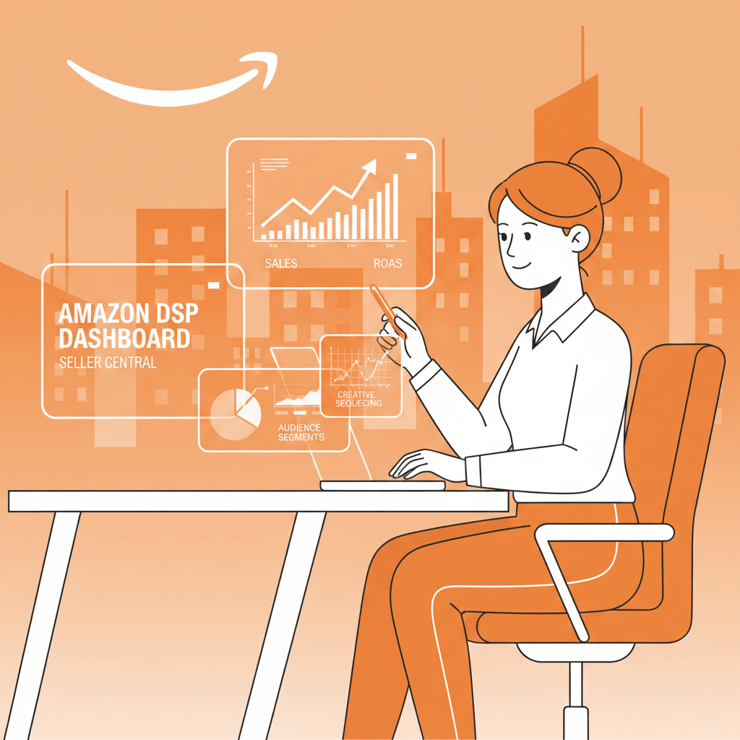
Switching from Vendor Central to Seller Central fundamentally changes how brands control pricing, margins, inventory, and advertising strategy. While Vendor Central often offers built-in retail scale, Seller Central provides greater autonomy, and that autonomy opens new opportunities when paired with Amazon DSP advertising.
For brands that have already made (or are considering) the transition, the question is no longer what is Amazon DSP for sellers, but how Amazon DSP works for Seller Central brands in practice. DSP becomes less of a “nice to have” and more of a strategic lever for brand growth, especially when Sponsored Ads alone can’t sustain scalable results.
For readers who need a foundational overview, beBOLD Digital’s What Is Amazon DSP guide provides a helpful starting point before diving into Seller Central–specific execution.
What Changes When a Brand Moves From Vendor to Seller?

At a structural level, the Vendor-to-Seller transition reshapes how brands operate on Amazon.
Under Vendor Central, Amazon controls retail pricing, purchase orders, and often promotional cadence. Advertising is layered on top of Amazon’s retail decisions. In contrast, Seller Central brands control pricing, inventory flow, promotions, and listing optimization through Amazon Seller Central dashboard controls, which directly affects advertising performance.
This shift matters because advertising no longer exists in isolation. DSP campaigns are now influenced by:
- Real-time price changes
- Promotional timing
- Inventory availability
- Listing conversion rate
From an advertising standpoint, Seller Central brands gain the ability to synchronize DSP audiences with on-site conditions, creating more consistent shopper experiences across the funnel.
Why Amazon DSP Advertising Becomes Strategically Valuable After the Switch
Once a brand moves to Seller Central, DSP must be treated as a deliberate strategy, not a passive extension of retail programs.
Historically, some Vendor brands accessed DSP through bundled retail initiatives. Seller Central brands, however, need a standalone DSP framework aligned with their business goals. This shift forces better discipline, and often better results.
For Seller Central brands, Amazon DSP advertising offers:
- Tighter alignment between pricing and audience targeting
- Greater flexibility in campaign sequencing
- Stronger control over brand storytelling beyond search results
Rather than relying on Amazon to drive visibility, Seller Central brands use DSP to create demand upstream, then convert that demand with Sponsored Ads and optimized listings.
beBOLD Digital Expert Tip 💡
Seller Central brands should treat DSP as a demand-creation engine, not a recovery tactic. At beBOLD Digital, we typically deploy DSP only after Sponsored Ads efficiency plateaus—this ensures DSP is expanding reach rather than masking underlying PPC inefficiencies.
Core Ways Amazon DSP Amplifies Seller Central Success

With the strategic foundation in place, DSP becomes a powerful accelerator across multiple growth levers.
Audience Retargeting Beyond Search Intent
One of DSP’s biggest advantages is its ability to re-engage shoppers who never searched for your product directly. Seller Central brands can:
- Retarget users who viewed Sponsored Products or Sponsored Brands ads
- Re-engage shoppers who visited PDPs but didn’t purchase
- Build audiences based on category browsing behavior
Amazon Ads consistently shows that retargeted audiences convert at higher rates than first-time viewers, making DSP retargeting especially effective for Seller Central brands looking to recover lost PDP traffic.
beBOLD Digital Expert Tip 💡
We recommend sequencing DSP retargeting audiences based on recency (e.g., 7-day, 14-day, 30-day viewers). Shorter windows tend to convert better, while longer windows are ideal for brand reinforcement and replenishment strategies.
Lookalike Audiences Based on Purchase Behavior
DSP allows Seller Central brands to scale beyond retargeting by building lookalike audiences based on:
- Past purchasers
- High-value converters
- Brand store visitors
Because these audiences are powered by Amazon’s first-party shopping data, they tend to outperform third-party prospecting audiences in relevance and efficiency.
beBOLD Digital Expert Tip 💡
Not all purchasers should seed lookalike audiences. We prioritize high-LTV or repeat buyers to avoid scaling low-quality traffic. This approach typically improves New-to-Brand efficiency and reduces wasted impressions.
When brands sell direct, they often have more room to reinvest margin into media, making direct selling on Amazon closely tied to stronger PPC and DSP growth opportunities.
Creative Control and Messaging Alignment
Unlike keyword-based PPC, DSP runs in non-search environments, making creative quality critical.
Seller Central brands can align DSP creatives with:
- Limited-time promotions
- Subscription offers
- Seasonal pricing strategies
This flexibility is especially valuable for brands that want ad messaging to reflect real-time Seller Central conditions rather than static retail messaging.
beBOLD Digital Expert Tip 💡
DSP creatives should never mirror Sponsored Ads. We advise Seller Central brands to use contextual storytelling, lifestyle imagery, benefit-driven messaging, and soft CTAs, to match how shoppers consume content outside of search environments.
Off-Amazon Reach for Scalable Awareness
Amazon DSP advertising extends beyond Amazon.com to placements on:
- Fire TV and Prime Video
- IMDb and Twitch
- Amazon publisher and third-party sites
This off-Amazon reach allows Seller Central brands to build awareness before shoppers ever search, reducing reliance on increasingly competitive Sponsored Ads auctions.
beBOLD Digital Expert Tip 💡
Off-Amazon placements perform best when paired with on-Amazon retargeting. At beBOLD Digital, we often launch awareness campaigns on Fire TV or IMDb first, then retarget exposed users with PDP-focused creatives to drive measurable lift.
Full-Funnel Coordination With Sponsored Ads
DSP performs best when paired with Sponsored Ads:
- DSP supports awareness, consideration, and retargeting
- Sponsored Products and Brands capture high-intent demand
Together, they create a closed-loop system where DSP warms audiences and Sponsored Ads convert them. In fact, Amazon Ads data shows that brands combining Sponsored Ads with Amazon DSP often drive stronger new-to-brand performance, reinforcing DSP’s role as a full-funnel growth lever rather than a standalone tactic.
beBOLD Digital Expert Tip 💡
DSP and Sponsored Ads should share audience insights but not budgets. We monitor DSP-influenced branded search lift and Sponsored Brand CTRs to confirm DSP is lowering acquisition friction rather than competing with PPC spend.

DSP Activation Path for Seller Central Brands
Accessing DSP from Seller Central requires planning, but it’s increasingly accessible.
DSP Access Options for Sellers
Seller Central brands typically access DSP through:
- Amazon-approved DSP agencies
- Amazon managed services (higher minimum spend)
Agency-managed DSP often provides more flexibility for Seller Central brands, especially those testing DSP for the first time.
Setting DSP Goals Post-Transition
After moving from Vendor to Seller, DSP goals should align with business priorities:
- Awareness for brand relaunches
- Retargeting for PDP traffic recovery
- New-to-Brand acquisition for category expansion
Clear goals prevent DSP from being misjudged by short-term PPC metrics.
beBOLD Digital Expert Tip 💡
For Seller Central brands new to DSP, we recommend starting with a single objective per campaign. Multi-goal DSP campaigns often dilute learning signals and slow optimization, especially during the first 30 to 45 days.
Common Strategic Mistakes Seller Central Brands Should Avoid

Even experienced advertisers can struggle with Amazon DSP advertising when they apply PPC logic to a fundamentally different channel. Understanding these common pitfalls helps Seller Central brands avoid wasted spend and unlock DSP’s full-funnel value.
Treating DSP Like PPC
One of the most common mistakes is evaluating DSP using click-based performance expectations. Unlike Sponsored Ads, DSP is impression-based and influence-driven, meaning its impact often occurs after multiple touchpoints and outside of a single session.
Seller Central brands that optimize DSP too early—based solely on short-term ROAS—often pause campaigns before Amazon’s algorithms have enough data to learn. This can limit reach, disrupt delivery, and prevent DSP from contributing to long-term brand lift, retargeting efficiency, and new-to-brand sales.
Over-Segmenting Audiences
While DSP offers advanced audience targeting, over-segmentation can be counterproductive. Creating too many narrow audience groups often results in:
- Higher CPMs due to limited reach
- Slower learning and inconsistent delivery
- Fragmented insights that are difficult to optimize
For Seller Central brands, broader audience groupings with layered signals (such as category interest plus recency) typically outperform overly granular setups, especially during initial DSP testing phases.
Ignoring Creative Optimization
DSP ads appear in non-search, content-driven environments, where shopper intent is passive rather than active. Reusing PPC-style creatives—such as keyword-heavy images or price-only messaging—often leads to poor engagement.
Effective DSP creative focuses on:
- Lifestyle and use-case imagery
- Clear value propositions rather than direct selling
- Messaging aligned with where the shopper is in the funnel
Without ongoing creative testing and refresh cycles, even well-targeted DSP campaigns can underperform, limiting their ability to support Sponsored Ads and overall Seller Central growth.
beBOLD Digital Client Scenario You Can Learn From:
A beauty brand that recently transitioned from Vendor Central to Seller Central launched Amazon DSP advertising with the expectation that performance would mirror their Sponsored Products campaigns. Within the first two weeks, the brand aggressively paused line items based solely on ROAS, narrowed audiences to hyper-specific segments, and reused existing PPC creatives.
As a result, CPMs increased, reach plateaued, and the DSP campaigns failed to exit the learning phase.
After partnering with beBOLD Digital, the DSP strategy was restructured to reflect DSP’s full-funnel role. The team:
- Reset success benchmarks away from short-term ROAS and toward reach, detail page view rate, and New-to-Brand DSP metrics
- Consolidated overlapping audience segments to improve scale and delivery efficiency
- Introduced DSP-specific creative, including lifestyle imagery and benefit-led messaging designed for off-search placements
Within the following optimization cycle, the brand saw improved audience delivery, stronger mid-funnel engagement, and a measurable lift in branded search performance—confirming that DSP performs best when evaluated and optimized differently than PPC.
How Amazon DSP Fits Into a Seller Central Marketing Stack
DSP should never operate alone. High-performing Seller Central brands integrate:
- Sponsored Products, Brands, and Display for demand capture
- DSP for awareness, retargeting, and scale
- Organic SEO for sustainable visibility
- Amazon Marketing Cloud (AMC) for cross-channel insights
This layered approach improves efficiency across the entire funnel.
Turning DSP Into a Seller Central Growth Engine
For brands that have transitioned from Vendor to Seller Central, Amazon DSP advertising is no longer optional. It’s a growth lever. When DSP is aligned with pricing control, creative strategy, and full-funnel objectives, it allows Seller Central brands to move beyond search-only tactics and build scalable, defensible demand.
That’s where beBOLD Digital comes in. Our team helps Seller Central brands design and manage DSP strategies that actually work; connecting audience targeting, creative execution, and Sponsored Ads into one cohesive system. If you’re ready to use DSP to drive new-to-brand growth, stronger retention, and long-term marketplace visibility, let’s talk about how beBOLD Digital can turn DSP into a measurable advantage for your brand.
Frequently Asked Questions
Can sellers access DSP if they never sold on Vendor Central?
Yes. Seller Central brands can access DSP through approved agencies or managed services.
Does moving to Seller Central affect DSP pricing?
DSP pricing is CPM-based and not directly tied to selling model, but access method can affect minimum spend.
Should sellers run DSP and Sponsored Display together?
Yes. DSP and Amazon Sponsored Display ads serve different roles and often perform best when used together.
How does DSP help during peak selling events?
DSP builds awareness and retargeting pools ahead of events like Prime Day, improving Sponsored Ads efficiency during peak periods.

Comments