


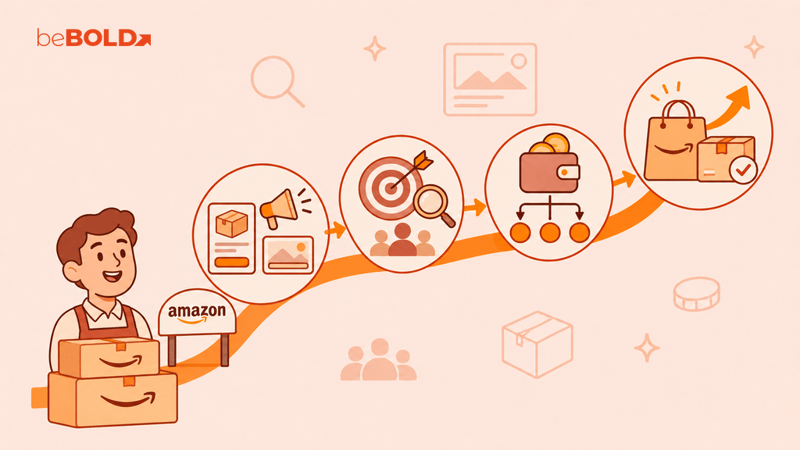
Amazon advertising uses auction-based paid placements to connect eligible products and brand creative with relevant shopping opportunities. This Amazon advertising guide gives established brands a practical framework for deciding when paid traffic can support profitable growth, whether they manage campaigns in-house or work with an Amazon advertising agency like beBOLD Digital. The most useful Amazon advertising basics connect campaign decisions to a product’s conversion potential and financial limits.
What Is Amazon Advertising, and How Does It Work?
Amazon Ads uses paid placements across Amazon properties and, for eligible campaigns, third-party sites and apps. For teams asking “how does Amazon advertising work?”, many formats use auctions. The advertiser selects products or creative, defines targeting, sets bids and budgets, and competes for eligible placements.
Sponsored Products commonly use cost-per-click (CPC) pricing. Other formats may use CPC, viewable cost per thousand impressions (vCPM), or programmatic pricing. Options vary by marketplace, objective, campaign type, and account access.
What Do You Want Amazon Advertising to Achieve?

Brand defense: Maintain visibility when shoppers search for the brand or its products. Strong branded ROAS does not prove that every attributed order was incremental, so assess competitive coverage and total sales trends as well.
Customer acquisition: Reach shoppers through nonbranded keywords, relevant product or category targets, and audience strategies. Immediate ROAS may be lower because these shoppers are still comparing alternatives.
Profitable sales: Selling price alone does not determine affordable ad spend. Include product costs, Amazon fees, fulfillment, discounts, returns, and other variable costs.
Product launch: Use a defined test budget, review date, and stop-or-scale criteria. Awareness should not become an unlimited explanation for unprofitable spending.
Is Your Product Ready for More Advertising Spend?
Advertising can generate traffic, but it cannot reliably compensate for weak positioning, an unavailable offer, or poor economics. Before scaling, confirm:
-
Listings and creative answer the shopper’s main questions. Beauty products may need ingredients, claims, directions, size, texture, and routine placement.
-
Price, bundles, coupons, delivery, reviews, and perceived differentiation create a credible value proposition.
-
Contribution before advertising is calculated for each product or variation.
-
Inventory and replenishment can support additional demand.
-
The account, product, and category meet current eligibility rules. For Sponsored Products, seller offers must be eligible for and hold the Featured Offer for ads to serve. Review Amazon’s Sponsored Products eligibility requirements.
There is no universal review-count or conversion-rate threshold that makes a product ready. Judge readiness against its category, price, competition, offer, and historical performance.
Which Amazon Ad Types Support Your Goal?
Amazon’s advertising platform and product names have evolved. Sponsored Display is now part of Amazon’s broader display ads offering, and existing campaigns continue to run. Amazon Ads Agent brings sponsored ads and programmatic workflows together, with advanced capabilities formerly associated with Amazon DSP available through Display, Video, and Audio options. Choose the format and buying approach that fit your objective, creative resources, and account access.
Sponsored Products
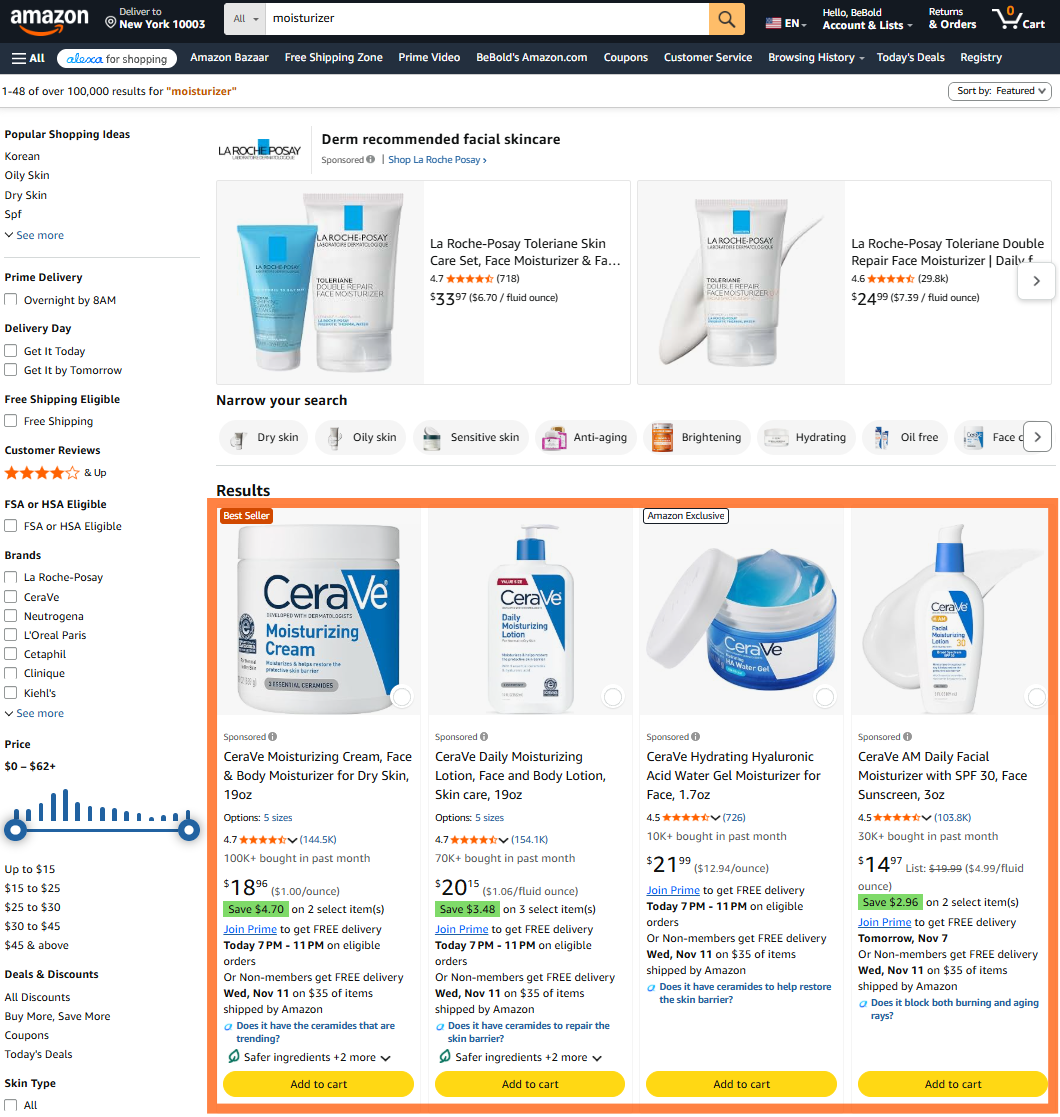
Best Fit: Product discovery and sales through automatic, keyword, or product targeting
Key Constraint: Uses listing content and sends traffic to the detail page; offer eligibility matters.
Sponsored Brands
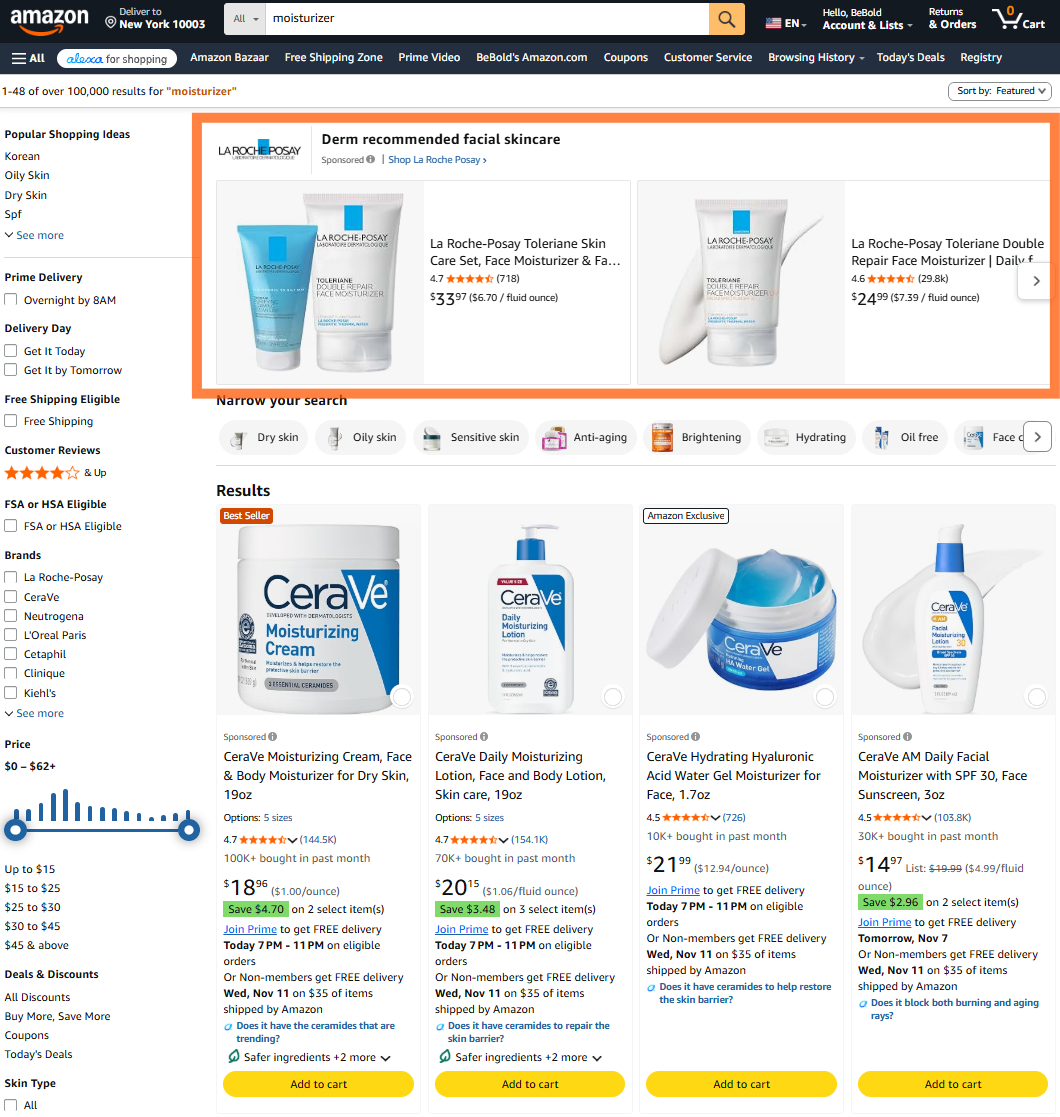
Best Fit: Brand discovery, product education, and Store or product consideration
Key Constraint: Requires appropriate brand eligibility, creative, and a useful destination.
Display Ads
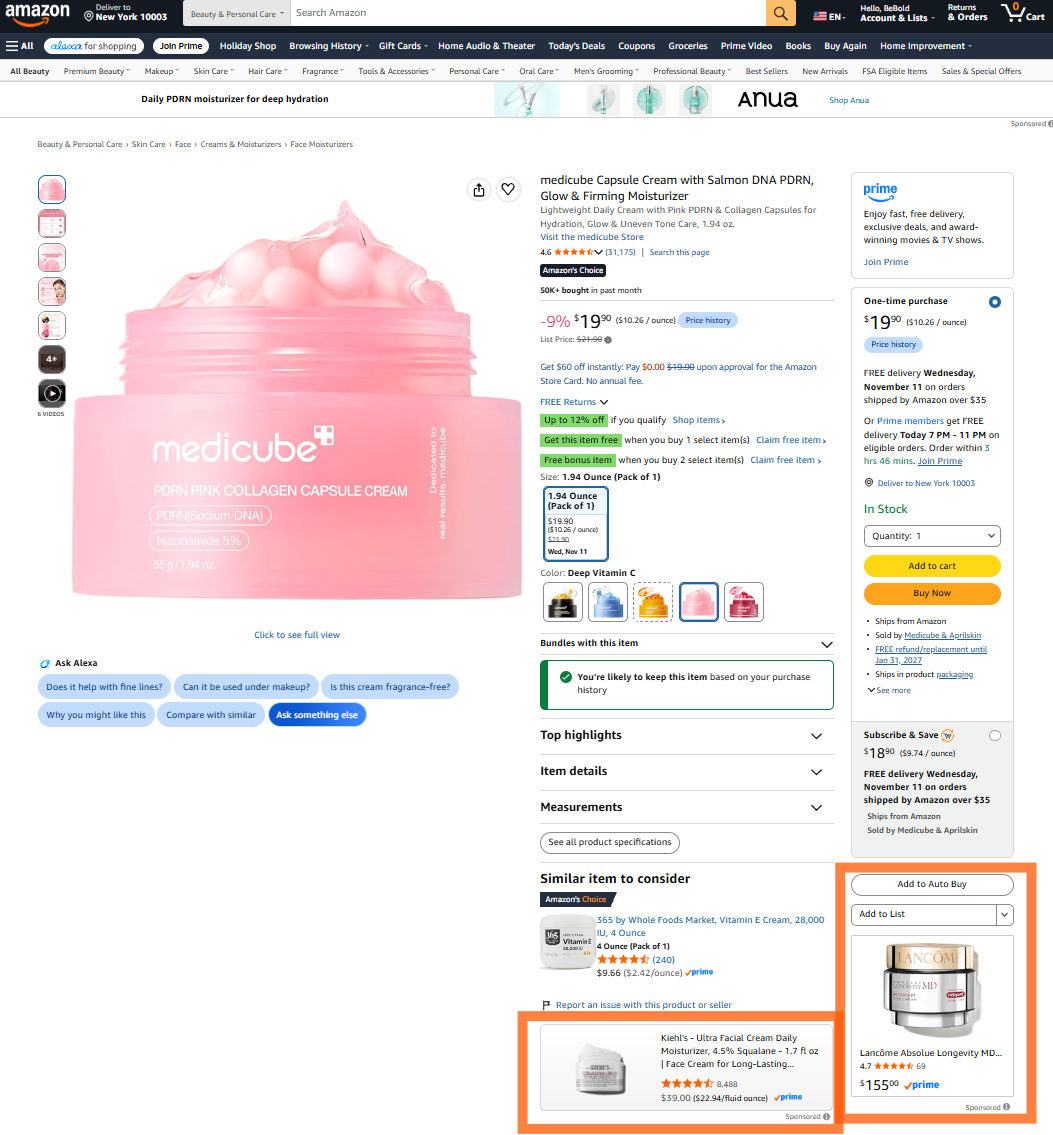
Best Fit: Contextual reach, consideration, and remarketing
Key Constraint: Sponsored Display is the legacy name; options depend on account access.
Amazon DSP (Demand-Side Platform)
Best Fit: Broader audience reach, remarketing, and acquisition across Amazon properties and the open internet
Key Constraint: Requires suitable creative, audience controls, and measurement; available settings depend on the buying workflow and account access.
These types of Amazon ads should be selected by objective, not treated as interchangeable labels.
How Do Automatic and Manual Targeting Work?
For brands learning Amazon PPC basics, Sponsored Products provides two complementary approaches. Amazon advertising targeting determines which shopping queries, products, categories, contexts, or audiences a campaign may reach.
Manual Targeting
A keyword is the advertiser’s selected target; a shopping query is what the shopper enters. Amazon keyword match types control how closely the query must relate to a selected keyword.
|
Match type |
Use |
|---|---|
|
Broad |
Reach eligible variations and related wording. |
|
Phrase |
Keep the targeted phrase in order, with eligible words before or after. |
|
Exact |
Match the keyword and eligible close variations. |
Manual campaigns can also target products or categories. Add negative targets only when evidence shows repeated irrelevant traffic; aggressive exclusions can block useful discovery.
Automatic Targeting
Amazon matches Sponsored Products ads using four groups: close match, loose match, substitutes, and complements. Review search-term and targeting reports, adjust bids by group where available, and build manual targets around opportunities with enough relevant traffic and conversion evidence. Automatic campaigns can remain active when they continue to discover demand.
See the Amazon PPC automatic campaign guide for setup details.
How Should You Set Your Starting Budget and Bids?

An Amazon advertising budget limits campaign spending over the applicable period. A bid is the amount the advertiser is willing to pay for an eligible interaction, modified by bidding and placement settings.
Sponsored Products supports fixed, dynamic, and rule-based bidding. Placement and audience adjustments can change the effective bid, so review those settings alongside your base bid.
A daily budget is an average over a calendar month. Amazon’s current support guidance says campaigns can use leftover budget from lower-traffic days to spend up to 100% above the average daily budget on higher-traffic days by default. Advertisers can change the setting to limit that increase to 25%. Check your campaign settings before estimating daily cash requirements. Under Amazon’s stated monthly control, spending will not exceed the daily budget multiplied by the number of days in the month.
Contribution before advertising is the amount left from an order after product and other variable costs, before advertising is deducted. Advertising cost of sales (ACoS) measures ad spend as a percentage of attributed sales. Conversion rate measures how often ad clicks result in purchases; use it as a decimal in the CPC calculation below, so 10% becomes 0.10.
Use these planning formulas:
Contribution before advertising = selling price − product and variable costs
Break-even ACoS = contribution before advertising ÷ selling price × 100
Break-even CPC = contribution before advertising × conversion rate
|
Product economics |
Moisturizer A |
Moisturizer B |
|---|---|---|
|
Selling price per unit |
$40 |
$25 |
|
Contribution before advertising per order |
$16 |
$5 |
|
Break-even ACoS |
40% |
20% |
|
Click-to-purchase conversion rate |
10% |
10% |
|
Break-even CPC |
$1.60 |
$0.50 |
|
Illustrative CPC |
$1.20 |
$1.20 |
|
Contribution after advertising per order |
$4 |
−$7 |
Illustrative figures only. Actual results vary.
The same CPC and conversion rate support one product but put the other below break-even. These figures are guardrails, not automatic bid recommendations. Read How Much Does Amazon PPC Cost in 2026? for additional planning context. For guidance on allocating spend across products, campaign types, and business objectives, read our guide to Amazon ads budget portfolio management.
How Do You Launch Your First Sponsored Products Campaign?
For brands learning how to advertise on Amazon:
-
Define one primary objective and select eligible products.
-
Record contribution, break-even ACoS, break-even CPC, test budget, and review date.
-
Choose automatic targeting for discovery, manual targeting for deliberate control, or both with separate roles.
-
Set bids, budget, bidding strategy, exclusions, and ownership.
-
Monitor delivery and spend immediately, but wait for enough relevant traffic and attributed data before drawing broad conclusions.
How Can You Improve Sponsored Ads Performance?
Effective optimization starts by identifying the constraint.
|
Finding |
Investigate |
Possible action |
|---|---|---|
|
High spend, few sales |
Relevance and listing conversion |
Refine targets or improve the detail page. |
|
Strong conversion, low impressions |
Eligibility, bids, budget, and demand |
Test increases within economic limits. |
|
High clicks, weak conversion |
Price, reviews, offer, content, and delivery |
Fix retail readiness before buying more traffic. |
|
Expensive top-of-search traffic |
Placement report and multipliers |
Reduce or isolate weak placement adjustments. |
Tie each change to the campaign objective and review window. Record what changed, why you changed it, and what evidence would justify keeping or reversing the decision. Where practical, separate major changes so you can better understand their effect.
For a broader framework, read our guide to Amazon advertising strategy, which explains how established brands coordinate targeting, creative, budgets, and measurement across campaigns.
When Can DSP Support Your Sponsored Ads?
Amazon now describes the former Amazon DSP as part of Amazon Ads Agent. Display, Video, and Audio campaigns can support remarketing and broader acquisition, but they are not mandatory for every advertiser.
Use them when the brand has a defined audience, sufficient inventory and margin, suitable creative, frequency and exclusion rules, and a measurement plan that distinguishes attribution from incrementality.
How Should You Measure Results Against Your Goal?
Use ACoS and ROAS for attributed ad efficiency, TACoS for advertising intensity relative to total sales, and contribution for economic value. New-to-brand metrics, where available, identify attributed purchases from shoppers who have not bought from the brand during the prior 12 months.
Amazon states that conversions can take up to 12 hours to appear and reports remain incomplete until the applicable lookback window closes. Eligible clicks, views, products, and windows vary by campaign type, so review Amazon’s current campaign attribution documentation before combining results.
beBOLD Digital’s Henkel Professional Beauty case study reports:
-
30% total revenue growth
-
34% lower advertising spend
-
40% organic-sales growth
-
44% reduction in ACoS
-
49% reduction in TACoS
The program combined campaign restructuring, targeting, bidding, listing improvements, A+ Content, creative, and measurement. The results should not be attributed to one tactic.
Important Considerations Before Increasing Spend
-
Attribution does not prove incrementality.
-
Reporting delays and lookback windows can make recent results incomplete.
-
Different campaigns may compete for conversion credit.
-
Daily budgets are monthly averages. Review the campaign’s daily-budget increase setting and monitor actual spending against your test-spend ceiling.
-
Inventory and replenishment can cap growth.
-
Beauty claims must be accurate, substantiated where required, and policy compliant.
-
Automation still needs profitability, relevance, and spending guardrails.
Build an Amazon Advertising Plan Around Your Business Goals
Start with the objective, confirm retail readiness, calculate product-specific guardrails, choose the format and targeting, then evaluate results using metrics that fit the campaign’s job.
If spending is rising without proportional business improvement, beBOLD Digital’s Amazon advertising agency can identify where budgets, targeting, retail readiness, or measurement need to be refined. Contact us today and we’ll help you navigate through the different Amazon ads your brand might need!
Frequently Asked Questions
How much should a beginner spend on Amazon advertising?
There is no universal amount. Amazon commonly recommends at least $10 per day for Sponsored Products as an introductory baseline, but brands should budget from expected CPC, conversion rate, contribution margin, and the clicks needed for a meaningful test.
Do you need Amazon Brand Registry to advertise?
Not for every format. Eligible professional sellers can use Sponsored Products without Brand Registry. Sponsored Brands, display, Stores, and brand-focused capabilities have additional eligibility rules.
Is automatic or manual targeting better?
Neither is universally better. Automatic targeting supports discovery; manual targeting provides direct control. Many brands use both with distinct roles.
How long should Amazon ads run before evaluation?
Monitor delivery and spend from launch. Make broader judgments after the campaign has enough relevant traffic and attributed data for the decision, considering the applicable attribution window.
Does every Amazon brand need programmatic advertising?
No. Broader media adds creative, budget, and measurement demands. Use it only when the objective and operating readiness justify the complexity.

Comments