


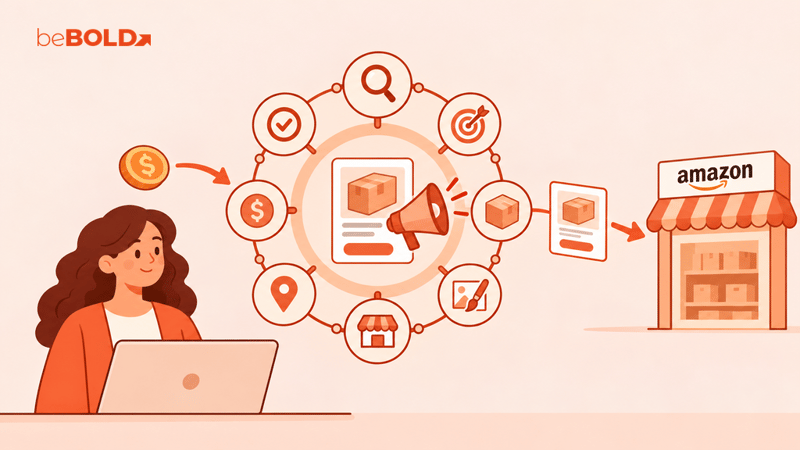
An established beauty brand paying more for each new customer faces a different decision from a pet brand whose ads bring relevant clicks but few orders. Increasing both budgets by the same percentage would overlook what each business needs.
An Amazon advertising strategy connects a business objective with the products, audiences, creative, spending limits, and evidence needed to make an investment decision. This article is for brands already running Amazon Ads that need to decide where to invest next and what to change before spending more.
The seven approaches below focus on demand capture, conversion economics, customer acquisition, creative testing, programmatic discovery, repeat purchasing, and measurement. For ad formats, placements, targeting mechanics, and first campaign setup, start with our Amazon Advertising Basics guide.
At beBOLD Digital, Amazon advertising management connects these decisions with product content and commercial performance. Our Henkel and K18 case studies show why improving efficiency and expanding investment can each be appropriate under different business conditions.
Which Amazon Advertising Strategies Should Your Brand Prioritize?

Start with the constraint that most limits your next profitable sale. Choose one primary test, then define what evidence would justify further investment.
|
Current constraint |
First investment decision |
Evidence to review |
What to defer |
|---|---|---|---|
|
Relevant traffic, weak conversion |
Investigate the offer and product page before adding traffic |
Availability, delivery, price, buying questions, and contribution per order |
Broad traffic expansion |
|
Profitable demand capture is budget-limited |
Test a controlled increase in existing activity |
Cost and contribution of additional purchases after reporting matures |
Assuming historical averages will hold at higher spend |
|
Sales depend heavily on branded demand |
Protect useful coverage while testing acquisition separately |
Available new-to-brand reporting, acquisition cost, and total contribution |
Evaluating acquisition against branded ROAS alone |
|
Strong conversion, limited discovery |
Test a buying-question video or programmatic prospecting hypothesis |
Audience opportunity, creative fit, inventory, and acquisition evidence |
Launching several new formats at once |
|
Missed repeat-purchase opportunities |
Test replenishment or complementary-product messaging |
Observed reorder timing, suitable products, and repeat-order contribution |
Immediate repeat messaging to all purchasers |
|
Results are unclear across formats |
Resolve a specific measurement question before expanding |
Attribution methods, audience overlap, data coverage, and total business results |
Adding spend to activity whose role is unclear |
When this diagnosis identifies a budget change, our Amazon Ads Budget Portfolio guide explains how to organize spending roles and rebalance investment across them. Here, the focus is choosing the next opportunity and the evidence needed to fund it.
Improve Returns From Demand You Already Reach

Fund High-Intent Demand When Additional Purchases Meet Your Economics
Keyword and product targeting deserve more investment when relevant demand remains available and additional purchases meet the product’s commercial limits. If effective activity is genuinely budget-limited, test a controlled increase before assuming a new audience or format is the next priority.
Separate a budget constraint from a performance problem. More funding will not resolve weak product fit, declining conversion, or traffic that becomes too expensive as bids rise. Review the cost and contribution of the additional purchases, rather than relying only on the campaign’s historical average.
In beBOLD Digital’s Henkel Professional Beauty case study, restructuring included refining targeting around customer information and search intent, prioritizing converting keywords, and applying bidding guardrails. That work accompanied listing and creative improvements.
If relevant demand capture is already well covered, test a separate discovery hypothesis instead of raising bids indefinitely. Use the Amazon PPC optimization guide for search-term analysis, negatives, bids, and placements.
Use Conversion Performance to Guide Bids and Spend
Advertising traffic becomes more valuable when the product page helps shoppers make a confident decision.
Before reducing bids across an underperforming campaign, investigate the offer: availability, price, delivery, imagery, product information, and unanswered buying questions. Amazon listing optimization and advertising should address the same shopper expectations.
Consider this hypothetical example. Assume a $36 product, an actual average cost per click (CPC) of $1.20, and one unit per attributed order. Advertising cost of sales (ACoS) is ad spend divided by attributed revenue:
|
Measure |
Initial performance |
Improved conversion |
|---|---|---|
|
Ad clicks |
100 |
100 |
|
Advertising spend |
$120 |
$120 |
|
Orders |
8 |
12 |
|
Click-to-order conversion |
8% |
12% |
|
Cost per order |
$15 |
$10 |
|
Ad-attributed revenue |
$288 |
$432 |
|
ACoS |
41.7% |
27.8% |
The calculation holds traffic cost and price constant. It illustrates why conversion deserves investigation; it does not predict the effect of a listing change.
To assess contribution after advertising, suppose the product contributes $13 per order after product costs, marketplace fees, fulfillment, and other variable costs, before advertising. A $15 advertising cost per order leaves a $2 shortfall; a $10 cost per order leaves $3 toward overhead and profit. ROAS alone cannot show that difference.
In this simplified example, $13 per order is the advertising break-even ceiling before overhead and profit. A target that leaves room for both would need to be lower. Before scaling, check whether additional traffic still meets that target; a stronger average conversion rate does not establish that the next audience or placement will perform equally well.
Henkel paired targeting and bidding changes with rewritten listings, improved imagery, A+ Content, and brand storytelling. For a brand receiving relevant clicks but few orders, investigate the ad and its destination together before deciding whether to change bids, content, or both.
Separate Brand Defense From Customer Acquisition
Give existing-demand capture and customer acquisition distinct budgets and reporting expectations.
Branded searches can help shoppers find the intended product. Non-branded category searches and competitor-product targeting can introduce alternatives. However, a branded searcher may be a first-time buyer, and a category searcher may already know the brand.
Use new-to-brand measurement to evaluate acquisition where available, rather than assuming every non-branded conversion represents a new customer.
Where available, Amazon’s new-to-brand purchase metrics identify shoppers who have not purchased from the brand on Amazon during the preceding 12 months. That does not establish whether someone has bought from the brand elsewhere.
For budget reviews, compare branded and discovery activity within their objectives. Ask whether additional branded spending protects meaningful sales and whether acquisition activity reaches customers at an acceptable cost.
Evaluate the next increase in branded coverage against its likely value to the business, rather than assuming every branded sale requires more defense spending. Give acquisition tests their own cost limit and customer definition. A higher acquisition cost may be acceptable only when observed contribution and repeat purchasing support it.
Test New Demand and Repeat Purchase Opportunities

Test Creative Against a Specific Buying Question
Invest in a creative test when an unanswered buying question may be limiting purchase decisions. The question determines the message and format: application may need a demonstration, while product size or pack contents may need a clearer image. Use video when motion adds useful information.
|
Category |
Buying question |
Creative direction |
|---|---|---|
|
Beauty |
How does the product apply or fit into a routine? |
Demonstrate texture, application, and relevant usage steps. |
|
Pet products |
Is this suitable for my animal and intended use? |
Show scale, handling, and everyday use with an appropriate animal. |
|
Wellness |
What format am I buying, and how is it used? |
Clearly present the product, serving information, and supported benefits. |
Connect the ad to a destination that continues its promise. A single-product demonstration should lead shoppers toward that product’s details; a routine-focused message may suit a relevant Store collection.
For example, a premium hair-treatment brand could test an application demonstration against a product-focused video. Keep the offer and destination comparable, then examine cost per purchase alongside engagement. Henkel’s published case includes creative A/B testing, illustrating creative refinement alongside targeting.
Use AI-assisted production when the cost or speed of asset creation prevents a worthwhile test. Compare an accurate product-in-use concept with a pack-focused alternative while keeping the audience, offer, and destination comparable. Evaluate cost per purchase or contribution alongside engagement and production cost.
Review every generated asset for accurate packaging, scale, use, and claims before launch. Use a controlled experiment where available; otherwise, treat comparisons across periods as directional because demand and delivery may change.
Expand Discovery With DSP and Coordinate Investment With Sponsored Ads
Consider programmatic prospecting when a brand has suitable products, convincing creative, and an audience opportunity beyond shoppers already searching for it.
A demand-side platform (DSP) enables programmatic media buying. Amazon’s display advertising, video, and audio capabilities reach audiences across Amazon properties and third-party publishers. Amazon now places its former DSP capabilities within Amazon Ads Agent. The familiar DSP term is used here for those programmatic capabilities.
Give prospecting and sponsored ads complementary jobs. For example, test product education with a relevant audience while maintaining sponsored campaigns that help interested shoppers find the product.
The K18 case study illustrates staged investment: $60,682 during its June–December 2021 launch period, $314,672 in full-year 2022, and $978,674 in 2023. The program expanded Sponsored Products, Sponsored Brands, and DSP in 2022; reported ACoS improved from 18.9% that year to 11.8% in 2023. Its $19.2 million in 2023 total sales includes revenue beyond ad-attributed purchases. The launch figure is a partial-year baseline, and these historical amounts are specific to K18.
Before adding programmatic prospecting, define what the test should establish. For example: can a relevant audience outside existing demand-capture activity produce customers within an acceptable acquisition cost?
Choose the media cap using expected media costs, plausible purchase volume, and the loss the business can accept while answering that question. Include creative, management, and technology costs in the total test allowance. If an affordable test cannot produce enough useful evidence, narrow the question or defer it.
Record the following before launch:
|
Test input |
What to agree |
|---|---|
|
Business question |
The audience or investment decision the test should resolve |
|
Commercial target |
An acquisition-cost or contribution target appropriate to the objective |
|
Spending and loss limits |
The maximum investment and financial shortfall the business will accept |
|
Evaluation period |
The relevant purchase cycle, conversion-reporting lag, and planned review point |
|
Decision owner |
The person responsible for scaling, holding, or stopping |
Use the agreed criteria to decide what happens next:
|
Decision |
Planning criterion |
|---|---|
|
Scale |
Completed reporting provides sufficient evidence that additional purchases meet the commercial target and inventory can support growth |
|
Hold |
Conversion reporting is incomplete or results remain inconclusive; retain the agreed limits while investigating |
|
Stop or redesign |
The loss cap is reached, product readiness deteriorates, or sufficient evidence fails to support the hypothesis |
These are planning criteria, not universal thresholds. A capped test may still be inconclusive, and attributed sales alone do not establish incremental impact.
Retarget According to Shopping Stage and Purchase Cycle
A shopper considering a premium treatment may need clarification about application or product fit. An existing customer may need a refill or a complementary item. Those situations call for different messages and timing.
K18’s 2023 program included DSP for awareness and retargeting. Henkel also used repeat-order retargeting, Subscribe & Save optimization, and bundles. The transferable lesson is to connect the next message with a relevant purchase opportunity.
A replenishable pet consumable may suit a test window based on observed reorder patterns; a durable accessory may suit a complementary-product message. Choose a campaign experience that supports the required audience controls.
Where supported by the campaign experience:
-
Exclude recent purchasers when another immediate purchase is unlikely.
-
Separate product consideration from replenishment.
-
Review reach and frequency for signs of unnecessary repetition.
Evaluate repeat orders and contribution after discounts and media costs. High retargeting ROAS can include purchases that would have occurred anyway; it does not independently establish additional sales.
Expand a retention test only when observed repeat-order contribution supports the additional media and promotional costs. If the audience is too small, exposure is repetitive, or the message does not match the purchase cycle, reduce spending or redesign the test before expanding reach.
Use AMC Insights to Refine Audiences and Investment
Use Amazon Marketing Cloud (AMC) when standard reporting leaves a specific audience or measurement question unanswered.
AMC supports analysis and custom audience development using pseudonymized signals, with aggregated outputs and privacy safeguards. It can help investigate engagement across advertising activity and develop eligible audiences for activation.
Start with a decision. For example, investigate whether consideration audiences receive repeated ads across campaigns while prospecting reaches too few additional shoppers. Use the overlap and purchase-path evidence to propose a change in exclusions or investment.
Then translate the finding into a bounded test. A higher purchase rate among shoppers exposed to multiple formats is an observation; those shoppers may already have been more interested. Establishing incremental impact requires an appropriate comparison, ideally a controlled test.
Use three levels of measurement:
|
Measurement level |
What to examine |
Decision it supports |
|---|---|---|
|
Campaign delivery |
Reach, frequency, clicks, conversion, and cost per purchase |
Refine delivery, targeting, or creative. |
|
Advertising attribution |
Sales and acquisition credited under each reporting method |
Compare activity after reconciling methodology and overlap. |
|
Business performance |
Total sales, contribution, inventory, and repeat purchasing |
Judge whether investment supports the commercial objective. |
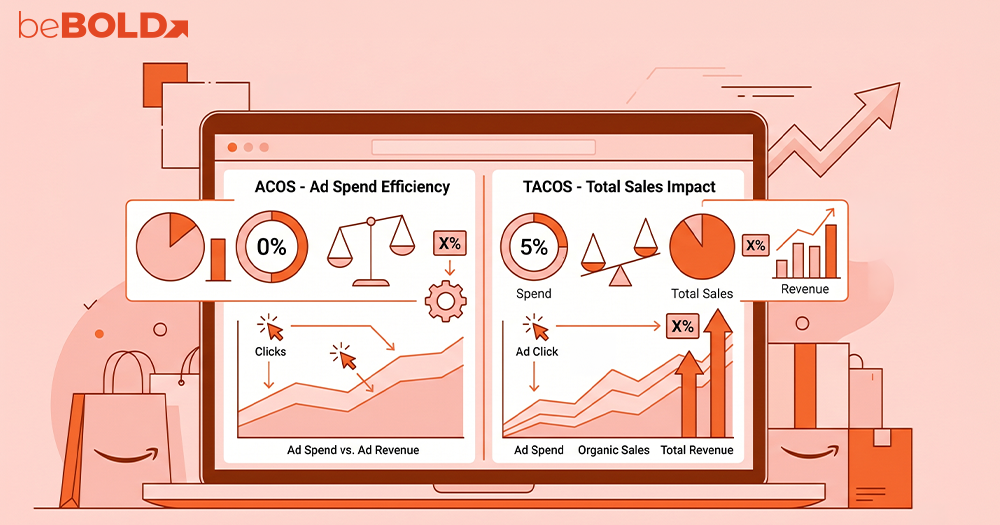
Advertising cost of sales (ACoS) divides ad spend by ad-attributed sales. Total advertising cost of sales (TACoS) divides ad spend by total sales. Neither measures profit or incrementality by itself. Before combining reports, reconcile attribution windows, click versus view credit, and overlapping sales.
Use the Amazon Marketing Cloud guide for implementation detail. For this strategy, the useful output is a decision about audiences or investment that the team can test.
Important Considerations Before Increasing Ad Spend
-
Marginal returns: Judge the cost and contribution of additional purchases. Strong historical averages may conceal declining returns as spend increases.
-
Inventory and cash: Confirm that available stock, replenishment lead times, and cash requirements can support the proposed growth.
-
Reporting maturity: Allow the relevant conversion-reporting periods to complete, reconcile attribution differences, and avoid adding overlapping attributed sales across formats.
-
Opportunity cost: Compare more media with the next useful investment in product content, creative, availability, or retention.
-
Evidence and controls: Use observed repeat purchasing when assessing customer value. Confirm that the account supports the targeting, exclusions, and tests the plan requires, and review product claims and demonstrations against applicable policies.
Frequently Asked Questions
When Should a Brand Reallocate Amazon Ad Spend Instead of Increasing Its Budget?
Reallocate when existing activity no longer meets its objective and a better-supported opportunity is ready to test. Review completed conversion reporting, contribution, and inventory first. Protect useful demand capture, then move a capped amount toward a defined hypothesis. Consider a larger total budget when effective activity is genuinely constrained and the next investment meets the brand’s commercial limits.
What Should a Brand Do When an Advertising Test Is Inconclusive?
First check reporting lag, conversion volume, delivery, and whether the test answered the intended question. Extend it only when additional data is likely to change the decision and the agreed limits allow it. Otherwise, narrow the hypothesis or redesign the test. An inconclusive result is insufficient evidence to scale; it does not automatically establish that the strategy cannot work.
Make Your Amazon Advertising Budget Work Harder
Your next investment should address the clearest opportunity in your business. beBOLD Digital connects Amazon advertising management, DSP management, creative, and marketplace performance to help established brands choose and manage that investment. Build a plan with defined tests, spending limits, and business measures.



Comments