

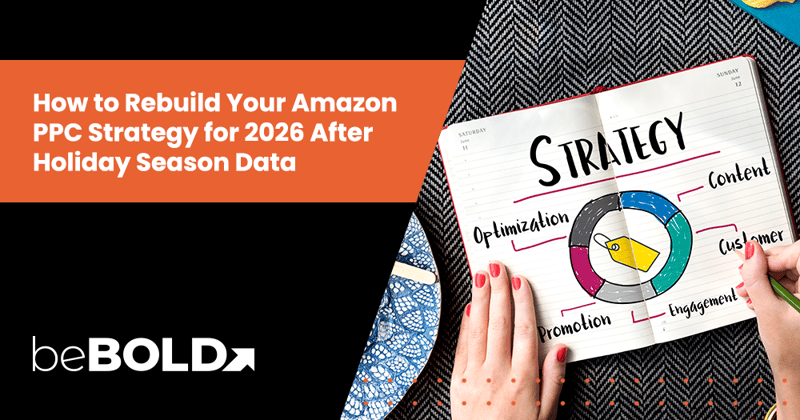
The holiday season generates massive Amazon ad data, but once demand normalizes, many brands either pause spend or keep inefficient Q4-era campaigns running, limiting growth in 2026. A modern Amazon PPC strategy for 2026 uses the post-holiday period as a strategic reset, applying AI-driven insights and behavioral data to transform holiday learnings into scalable, year-round performance.
Key Summary
- Post-holiday PPC resets are essential for protecting margins and unlocking scalable growth in 2026 🔄📈
- Holiday performance data reveals long-term opportunities across keywords, ASINs, and customer behavior 🧠📊
- Amazon’s algorithm now prioritizes behavioral signals, conversion consistency, and intent over raw keyword volume 🤖🎯
- Winning brands rebalance bids, budgets, and campaign structures early to align with year-round demand 🧩💰
- A structured Amazon PPC reset improves ACoS, conversion rate, and lifetime value while strengthening algorithm trust 🚀📦

Why Post-Holiday Is a Strategic Reset Moment
January through early Q1 is one of the most misunderstood periods in Amazon advertising. While demand normalizes, competition remains high, and the Q4 data Amazon collected continues to influence performance.
Key post-holiday realities brands must account for:
- Amazon CPCs often rise 20 to 40% during Q4, making unrecalibrated bids inefficient once demand cools
- Holiday-era bids frequently overpay for traffic that no longer converts at peak-season rates
- Amazon’s AI uses holiday behavior to learn which products convert, for which audiences, and in what buying contexts
- These signals feed Amazon’s recommendation engine well beyond keyword-based search
Understanding this dynamic is what turns post-holiday optimization into a strategic advantage rather than a reactive cost-cutting exercise.
beBOLD Digital Expert Tip 💡
Post-holiday optimization isn’t about cutting spend. It’s about reallocating spend toward campaigns that teach Amazon who your ideal customer is, not just what they searched for.
How to Do a Post-Holiday Data Audit (Step by Step)

Before adjusting bids or budgets, brands need a structured post-holiday data audit. Holiday traffic is often inflated by promotions and gifting behavior, making it critical to separate evergreen performance signals from seasonal noise so your Amazon PPC reset for 2026 is built on data that supports long-term growth.
1. Search Term Report Insights
Your Search Term Report is the most actionable asset post-holiday because it shows exactly how shoppers found and converted on your products.
Post-holiday, focus on three categories:
- High-converting search terms → migrate into Exact-match campaigns to lock in efficiency and give Amazon clearer conversion signals
- Poor performers with spend but no conversions → add as negative keywords to immediately stop budget leakage
- Seasonal or irrelevant spillover terms → block gift-driven, holiday-specific, or time-bound queries that no longer reflect buyer intent
This step is critical in 2026 because Amazon’s algorithm learns from conversion consistency. Cleaning up low-intent traffic improves both ACoS and future ad delivery quality. Consistent search term pruning can reduce wasted spend by 15–25% while improving conversion rate.
beBOLD Digital Expert Tip 💡
We prioritize Exact-match migration for search terms that convert across multiple ASINs, not just one SKU. This helps strengthen account-wide relevance signals and protects long-term efficiency.
2. Auto Campaign Mining
Auto campaigns capture Amazon’s AI-driven discovery behavior, especially during peak periods when shopper intent is broad and exploratory.
After the holidays, auto campaigns should shift from scaling to signal extraction. Key actions include:
- Pulling new long-tail queries that converted during the season but weren’t part of your manual structure
- Identifying complementary or ecosystem-related searches Amazon associated with your ASINs
- Migrating strong auto performers into manual Exact or Phrase campaigns for tighter control and lower CPCs
This process ensures you retain valuable discovery insights without continuing to overspend on broad, uncontrolled traffic.
beBOLD Digital Expert Tip 💡
We treat auto campaigns as research engines post-holiday, capping budgets while systematically transferring winning terms into high-intent manual campaigns.
3. ASIN-Level Performance
Holiday periods reveal which products truly resonate when demand is highest. Beyond total sales, this data highlights momentum, price sensitivity, and conversion efficiency at the ASIN level.
Key post-holiday actions include:
- Identifying top-selling ASINs that drove the majority of revenue
- Flagging breakout SKUs with rising conversion rates or improving click share
- Creating dedicated campaigns for best sellers and high-momentum ASINs
- Grouping products by similar price points to prevent bid volatility and stabilize ACoS
Dedicated ASIN-level campaigns give Amazon clearer signals and allow for more precise budget control. In practice, ASIN-specific campaigns often outperform mixed-product campaigns by 10–20% in conversion rate, especially when paired with listing optimizations informed by holiday behavior.
beBOLD Digital Expert Tip 💡
We isolate high-momentum ASINs early post-holiday and assign protected budgets to them, ensuring they don’t lose impression share to lower-performing SKUs as demand normalizes.

Do These Bid & Budget Optimization Ideas for 2026
Once performance data is cleaned, bid and budget optimization becomes a strategic exercise. In 2026, post-holiday adjustments focus on aligning spend with true conversion probability, margin realities, and long-term customer value, ensuring efficiency while continuing to send Amazon strong growth signals.
Adjust Bids Based on New ACoS Targets
Holiday ACoS targets are rarely sustainable year-round. Post-holiday bidding should reflect normalized conversion rates, updated margins, and long-term acquisition goals.
In 2026, advanced advertisers often allow higher ACoS on discovery campaigns when lifetime value supports it, while tightening efficiency on branded and retargeting campaigns.
Rebuild Your Budget Allocation
Post-holiday budgets should shift toward:
- Evergreen category demand
- Proven ASIN targeting
- Sponsored Display retargeting
Sponsored Display retargeting can drive 2x to 4x higher conversion rates than cold traffic when segmented correctly.
beBOLD Digital Expert Tip 💡
Never reallocate budget before fixing campaign structure. Scaling inefficient campaigns only magnifies waste.
Want to learn more about how to recalibrate your PPC campaigns? Learn more about it here: Amazon PPC Optimization Tips.
How to Tweak Campaign Structure & Employ Growth Tactics

With clean data and optimized listings, campaign structure becomes the primary growth lever. In 2026, Amazon PPC performance is less about individual keyword tweaks and more about how clearly your account architecture communicates intent, relevance, and priority to Amazon’s algorithm. A well-structured account improves delivery efficiency, stabilizes ACoS, and gives you far greater control as you scale spend.
Rebuild Your Campaign Structure for 2026 Efficiency
Rebuilding campaign structure post-holiday is about clarity and segmentation. Instead of stacking multiple goals into the same campaigns, 2026-ready structures isolate performance drivers so Amazon can optimize more accurately.
Rebuild campaigns by:
- Product line → separate campaigns for core SKUs, variations, and bundles to prevent internal competition
- Goal → brand defense, non-branded performance, competitor conquesting, and defensive ASIN targeting should each have dedicated budgets and KPIs
- Match type → isolate Exact, Phrase, Broad, and Auto to control bids and protect high-intent traffic
Best practices include breaking out bestseller campaigns to prioritize budget toward proven revenue drivers, separating branded vs. non-branded traffic to protect efficiency, and tightening ad group themes so each campaign sends Amazon a clear relevance signal.
beBOLD Digital Expert Tip 💡
We regularly see cleaner campaign segmentation improve conversion rate and reduce wasted spend within the first 30 to 45 days after a structural rebuild.
Expand Brand Building & Retargeting
In 2026, growth-focused Amazon PPC strategies extend beyond Sponsored Products. Amazon increasingly rewards brands that support full-funnel engagement, not just last-click conversions.
High-impact formats include:
- Sponsored Brands to capture high-intent category traffic and drive Store visits
- Sponsored Brands Video, which often delivers 30–50% higher CTR than static ads by capturing attention earlier in the buying journey
- Sponsored Display for competitor ASIN targeting, views retargeting, and purchase retargeting to re-engage shoppers who didn’t convert on the first touch
Layering these formats allows brands to reinforce messaging, improve brand recall, and support conversion across multiple touchpoints, especially critical in competitive categories like beauty, wellness, and pet.
Aggressive Negative Keyword Strategy
Negative keywords remain one of the most powerful and underutilized profit levers in Amazon PPC. As accounts scale, unchecked search terms can quietly erode margins.
Best practices include:
- Weekly Search Term Report audits to catch spend leakage early
- Blocking irrelevant competitor, gift-driven, or low-intent queries
- Preventing Exact-match cannibalization by negating winning Exact terms out of Broad and Phrase campaigns
Consistent negative keyword management improves signal quality, protects top-performing campaigns, and helps Amazon deliver ads to shoppers with the highest likelihood of converting.
How to Do a Post-Holiday to Year-Round Strategy Reset
A strong post-holiday reset sets the foundation for sustainable growth, but only if it evolves into a disciplined, year-round strategy. In 2026, Amazon PPC success is defined less by seasonal spikes and more by a brand’s ability to maintain efficient acquisition, consistent conversion signals, and steady algorithm trust over time.
This phase of your Amazon PPC reset is about transitioning from reactive, promotion-driven advertising to a system that compounds results month after month.
Shift From Promotions to Evergreen Strategy
Instead of chasing short-term spikes tied to holidays or discount cycles, 2026 strategies prioritize consistent demand generation. Evergreen campaigns focus on core customer needs, repeat purchase behavior, and stable conversion rates, all of which provide Amazon’s algorithm with cleaner, more reliable signals.
By leaning into evergreen structures, brands benefit from:
- More predictable ACoS and TACoS performance
- Stronger organic ranking support driven by consistent conversions
- Reduced dependency on aggressive discounts to maintain volume
This shift doesn’t eliminate promotions. It simply ensures they enhance performance rather than compensate for weak fundamentals.
beBOLD Digital Client Scenario
A beauty brand working with beBOLD Digital relied heavily on monthly coupons to maintain sales post-Q4. By rebuilding evergreen non-branded campaigns around core skin concerns and reducing discount frequency, the brand stabilized TACoS and improved organic rankings within one quarter.
Use Deals & Coupons Strategically
Deals and coupons remain powerful tools, but in 2026 they must be deployed with intent. Instead of running constant discounts, high-performing brands use promotions to:
- Support product launches and re-launches
- Accelerate velocity for priority ASINs
- Clear aging or overstocked inventory
- Reinforce known seasonal demand windows
When paired with clean campaign structure and optimized listings, promotions amplify results. When used to mask inefficiencies, they erode margins and distort performance data.
beBOLD Digital Client Scenario
A pet supplements brand partnered with beBOLD Digital to reallocate deal spend toward launch-focused windows only. By pairing limited-time coupons with protected ASIN-level campaigns, the brand increased launch velocity without permanently compressing margins.
Integrating AI Into Your Year-Round Amazon PPC Strategy
Amazon PPC in 2026 is deeply influenced by AI-driven optimization. From automated bidding to personalized ad delivery, Amazon’s system increasingly rewards advertisers who feed it clear, consistent behavioral signals.
To integrate AI effectively into a year-round PPC strategy:
- Structure campaigns with clear intent so Amazon’s algorithm can accurately match ads to shopper behavior
- Leverage automation thoughtfully, using dynamic bidding and placement adjustments where conversion data is strong
- Continuously refine inputs. Clean search terms, accurate budgets, and ASIN-level segmentation improve how AI learns and optimizes
- Evaluate performance beyond last-click metrics, focusing on assisted conversions, repeat purchases, and long-term customer value
Rather than fighting automation, successful brands in 2026 design their Amazon PPC accounts to work with AI, using human strategy to guide structure and machine learning to scale execution.
beBOLD Digital Client Scenario
A wellness brand using automated bidding saw volatile performance due to poor campaign segmentation. beBOLD Digital restructured campaigns by intent and ASIN, allowing Amazon’s AI to optimize more effectively and driving steadier conversion rates across non-promotional periods.
For brands evaluating whether automation can improve ad efficiency, Best Amazon PPC Software breaks down platforms designed to support smarter PPC decision-making.
How beBOLD Can Help You Adjust Your PPC Plans This 2026
Rebuilding your Amazon PPC strategy for 2026 isn’t just about cleaning up campaigns. It's about creating a system that scales profitably long after the holiday spike fades. That’s where beBOLD Digital comes in.
We partner with growth-focused Amazon brands to turn post-holiday performance data into year-round revenue engines. Our team goes beyond surface-level optimizations to rebuild PPC accounts around how Amazon actually works in 2026, blending behavioral data, conversion signals, and full-funnel advertising strategies.
Our Amazon PPC support includes:
- Post-holiday Amazon PPC audits and reset frameworks tailored to 2026 algorithms
- Campaign restructuring by product line, intent, and growth stage
- Sponsored Products, Sponsored Brands, and Sponsored Display strategies built for scale
- ASIN-level budget and bid modeling to protect margins while driving volume
- Listing optimization informed directly by PPC and conversion data
Instead of chasing short-term wins, we help brands build advertising systems that improve efficiency, strengthen brand presence, and compound results over time.
Ready to rebuild smarter and turn holiday data into sustainable growth? Talk to a beBOLD Digital Amazon PPC strategist today and start 2026 with a strategy built to scale.
Frequently Asked Questions About Rebuilding an Amazon PPC Strategy After the Holidays
Should I pause all holiday-themed campaigns immediately after the season ends?
Pause purely seasonal keywords, but retain campaigns that drive evergreen conversions.
How soon after the holidays should I audit and rebuild my PPC strategy?
Within the first 2–3 weeks of January, once post-holiday behavior stabilizes.
Can I reuse some holiday keywords for evergreen campaigns?
Yes, if they continue converting without seasonal intent.
What metrics should I prioritize when rebuilding campaigns now?
Focus on conversion rate, ACoS, TACoS, and long-term customer value.
Should I re-optimize product listings immediately after holidays, or wait?
Optimize immediately. Holiday traffic reveals more insights in weeks than most brands gather all year.



Comments