



What Does ACOS Mean and How to Calculate It?
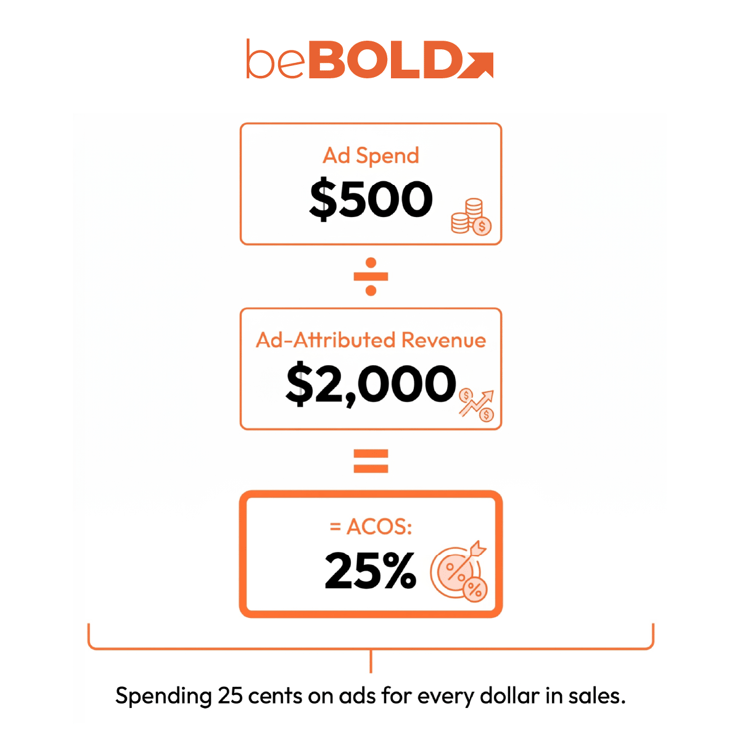
ACOS, or Advertising Cost of Sales, is a key Amazon PPC metric. It shows how much you spend on ads to make sales from those ads.
According to Amazon Ads, ACOS is one of the primary metrics advertisers use to evaluate campaign efficiency because it directly compares advertising spend to attributed sales revenue.
For example:
- Ad spend: $500
- Ad-attributed revenue: $2,000
- ACOS: 25%
In this case, you spent 25 cents on ads for every dollar in sales from ads.
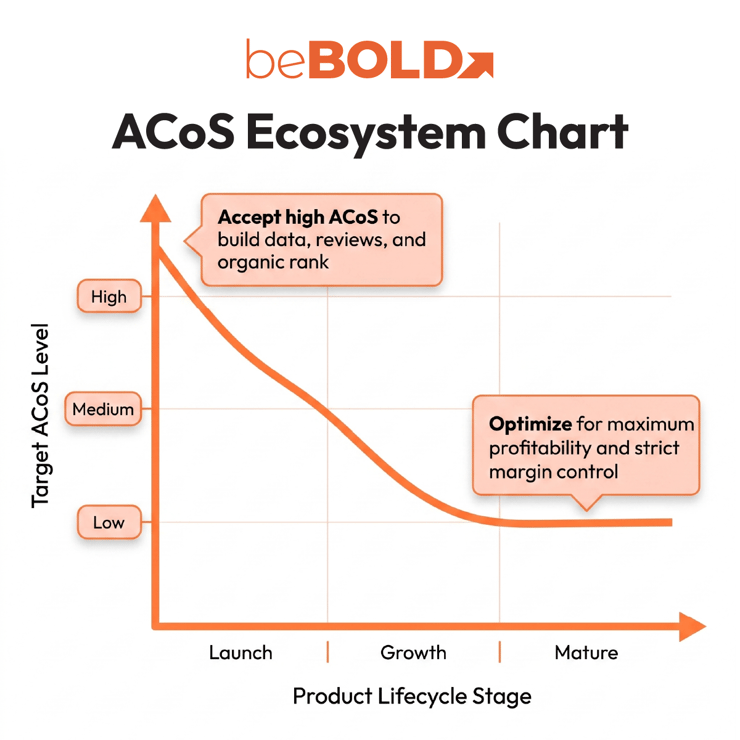
A lower ACOS on Amazon usually means your ads are more efficient, but it is not always the main goal. When launching new products, running ranking campaigns, targeting competitors, or doing seasonal promotions, you might need a higher ACOS to help your business grow. That’s why successful Amazon brands look at ACOS along with profit, organic growth, and total sales.
beBOLD Digital Expert Tip: Don’t use the same ACOS target for every campaign. Branded, non-branded, auto, manual, and competitor campaigns all have different goals and should be measured differently.
How to Know If Your Amazon ACOS Is Good
There is no single 'good' ACOS number for Amazon. For one seller, 20% ACOS might be profitable, while for another it could be too high. Even a 40% ACOS can be fine if it helps launch or rank a product.
What Is a Good ACOS for Amazon Ads?
One of the most common questions sellers ask is: What is a good ACOS for Amazon ads?
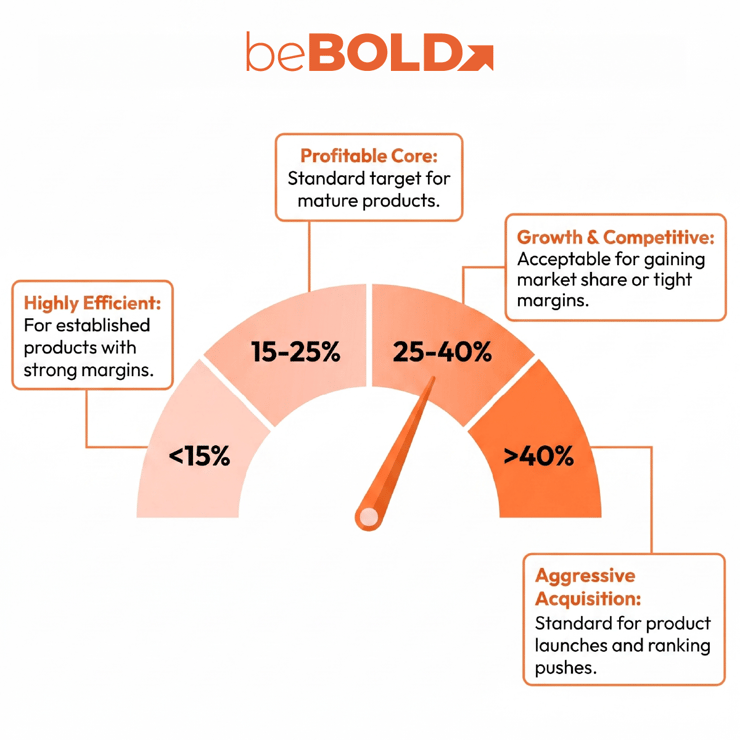
The answer depends on your profits and business goals, but many Amazon sellers use these general ranges:
- Below 15%: Often considered highly efficient for established products with strong margins and conversion rates.
- 15% to 25%: Common target range for many mature products focused on profitability.
- 25% to 40%: Often acceptable for competitive categories, growth-focused campaigns, or products with healthy margins.
- Above 40%: May be reasonable for product launches, ranking campaigns, or aggressive customer acquisition strategies.
These ranges are just reference points, not strict rules. A 'good' ACOS is one that matches your break-even ACOS and helps you reach your business goals.
That’s why it’s important for sellers to know their break-even and target ACOS before deciding on bids.
Break-Even ACOS vs. Target ACOS
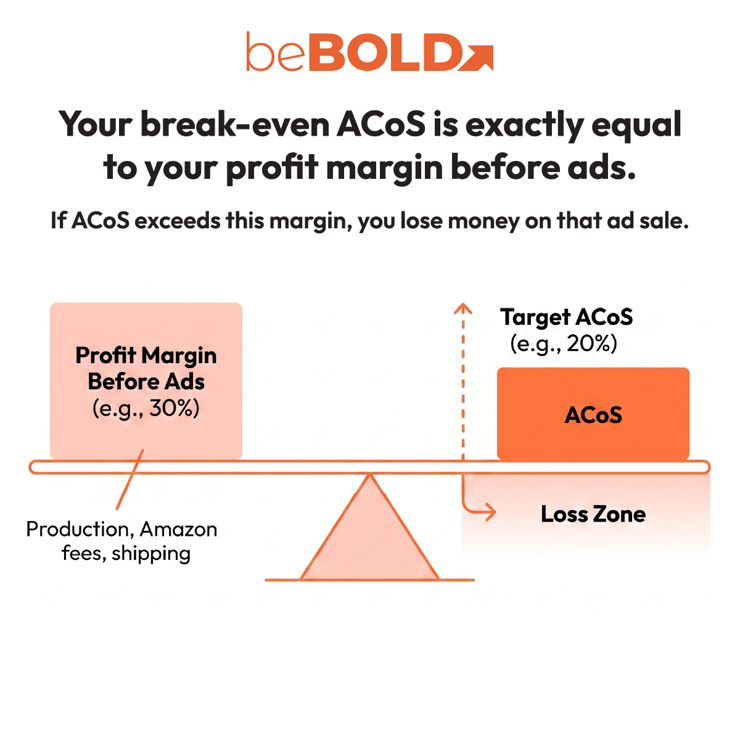
Break-even ACOS is the highest ACOS you can have before your ad sales stop making a profit. For example, if your product has a 30% profit margin before ads, your break-even ACOS is 30%.
Target ACOS is the number you aim for to keep your desired profit. If your break-even ACOS is 30% and you want to keep 10% profit after ads, your target ACOS should be around 20%.
An ACOS calculator can help, but only if you enter the right numbers. If your product cost, FBA fee, referral fee, discount, or return rate is off, your target ACOS will be off too.

Real-World Example: Looking Beyond ACOS
One beBOLD client wanted to lower their ACOS as fast as possible. We reviewed their account and looked at margins for each SKU, search term quality, campaign setup, and overall performance.
The PPC audit showed that ad spend was not the main problem. Instead, profits were hurt by margin leaks, poor campaign setup, and low conversion rates. By fixing these issues rather than just cutting ad spend, the client improved ad efficiency and maintained strong sales.
ACOS vs. ROAS vs. TACOS: Which Metric Should You Watch?
No single metric gives you the full picture. Amazon sellers should look at ACOS, ROAS, and TACOS together to see both ad efficiency and overall business results.
|
Metric |
Formula |
What It Shows |
|
ACOS |
Ad Spend ÷ Ad Revenue × 100 |
Ad cost efficiency |
|
ROAS |
Ad Revenue ÷ Ad Spend |
Revenue per ad dollar |
|
TACOS |
Total Ad Spend ÷ Total Sales × 100 |
Total business reliance on ads |
|
CTR |
Clicks ÷ Impressions |
Ad relevance |
|
CVR |
Orders ÷ Clicks |
Listing conversion strength |
|
CPC |
Ad Spend ÷ Clicks |
Cost of traffic |
ACOS and ROAS use the same numbers but show them in different ways. For example, a 25% ACOS is the same as a 4.0 ROAS.
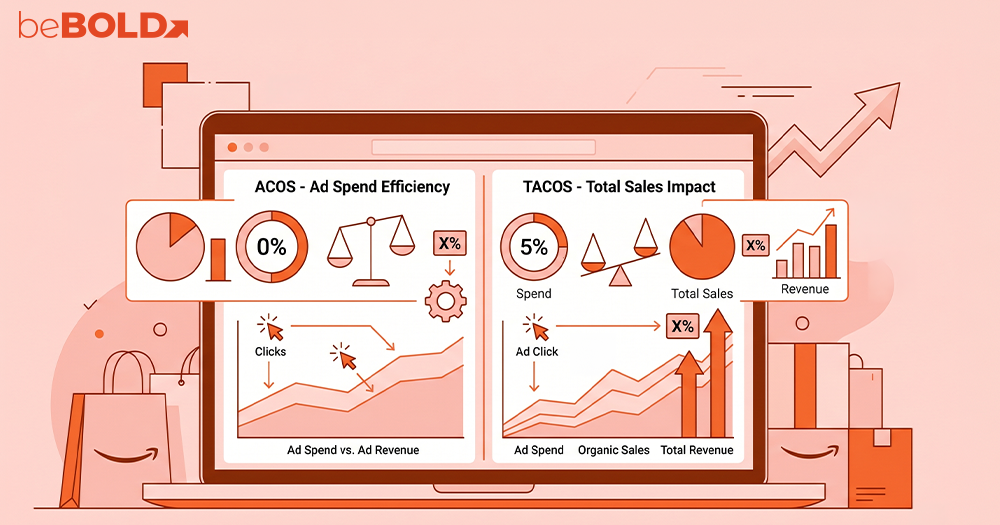
TACOS gives a bigger picture by comparing ad spend to total sales. Even if ACOS is high, it can be okay if TACOS is good and ads are helping your organic growth.
At beBOLD, we look at ACOS and TACOS together to check both how well your campaigns run and how your whole account is doing.
2026 Update: Why ACOS Should Not Be Read Alone
The ACOS formula is still the same in 2026, but Amazon ads have gotten more complex. With more automation, AI testing, and new ways to track results, you should look at ACOS along with other key metrics.
Amazon remains the largest retail media platform in the United States, accounting for approximately 77% of U.S. retail media ad spending in 2024, according to Statista. This level of competition means advertisers must look beyond a single metric when evaluating campaign performance.
ACOS does not show:
- Whether ads influenced future purchases
- Whether PPC improved organic rankings
- Whether creative performance affected conversions
- Whether campaigns generated incremental sales
beBOLD Digital Expert Tip: If your ACOS goes up, don’t cut your budget right away. First, check your CPC, conversion rate, rankings, and where your ads show up. Often, changing your campaign setup or improving your listings works better than just spending less.
How to Lower ACOS Without Cutting Growth
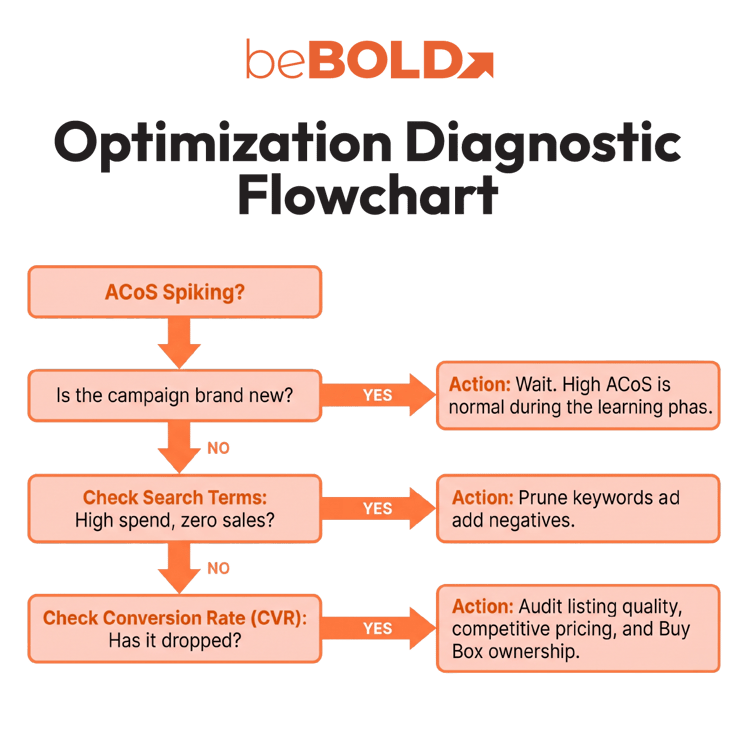
Lowering ACOS should not mean simply spending less. It should mean spending more efficiently.
Start by looking at your campaign structure. If you mix branded, non-branded, competitor, auto, manual, and product-targeting campaigns, your average ACOS will be hard to understand. Each PPC campaign type should have its own goal and target.
To lower ACOS without hurting your growth:
- Move converting search terms into exact match campaigns.
- Add negative keywords for irrelevant traffic.
- Separate branded and non-branded campaigns.
- Adjust bids by match type, placement, margin, and conversion history.
- Improve images, A+ Content, pricing, reviews, and offer quality.
- Review CTR and CVR before assuming bids are the main issue.
- Monitor TACOS and organic rank before cutting high-ACOS launch campaigns.
- Use PPC dayparting when performance varies by time or day.
For more tactical guidance, read Amazon PPC optimization tips.
Turn Your Amazon ACOS Into Profitable Growth
Knowing your Amazon ACOS is only the first step. What matters most is whether it helps you reach your profit and growth goals.
At beBOLD Digital, we look at ACOS, TACOS, ROAS, conversion rates, campaign setup, and profits to find ways to grow your Amazon PPC smarter.
Not sure if your ACOS is helping your business? Reach out to beBOLD Digital for an Amazon PPC audit and a clear growth plan.

FAQs
What is ACOS in Amazon?
ACOS in Amazon stands for Advertising Cost of Sales. It measures ad spend as a percentage of ad-attributed revenue.
How do you calculate ACOS?
To figure out ACOS, divide your ad spend by your ad revenue, then multiply by 100. For example, if you spend $500 on ads and make $2,000 in ad sales, your ACOS is 25%.
Is ACOS the same as ROAS?
No. ACOS shows what percent of your revenue goes to ads. ROAS shows how much money you make for every dollar you spend on ads.
Is 30% ACOS good on Amazon?
It depends on your profit margin and campaign goal. If your profit margin before ads is over 30%, a 30% ACOS might be fine. If it’s lower, a 30% ACOS could mean you’re losing money unless you’re aiming for growth.
Why is my ACOS high?
A high ACOS can happen if your cost per click is high, your targeting is weak, your conversion rate is low, your product margins are small, you have aggressive launch goals, you target tough keywords, or your listings need work.
Should I focus on ACOS or TACOS?
Use both. ACOS helps you see how efficient your ads are, while TACOS shows how ads affect your total Amazon sales and overall growth.






Comments