



TikTok often creates product awareness before a customer is ready to buy. A shopper may watch a creator demonstrate a product, continue scrolling, and later search for the brand on Amazon.
This creates a measurement challenge. TikTok may generate demand, but Amazon may record the resulting purchase as organic or paid search. A reliable TikTok Amazon Attribution strategy must therefore measure both direct clicks and downstream demand signals.
What Is the TikTok-to-Amazon Halo Effect?
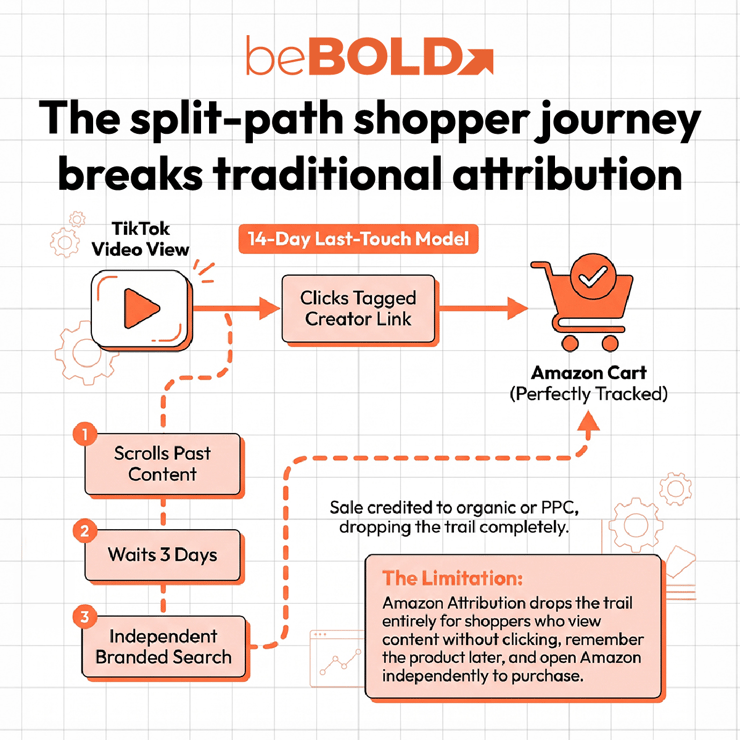
The TikTok halo effect describes the influence of TikTok exposure on later Amazon shopping behavior. It can appear as:
-
Increased branded or product-related Amazon searches
-
Higher product detail page traffic
-
Improved sales for the featured ASIN
-
Spillover sales across other products in the catalog
-
Increased performance in branded Amazon PPC campaigns
Importantly, the shopper does not need to click an Amazon link or purchase through TikTok Shop for this effect to occur. This makes the halo commercially valuable but difficult to measure precisely.
Amazon Attribution uses the term “brand halo” to describe measured cross-product conversions after a tracked interaction. The TikTok halo is broader, including untracked journeys that Attribution cannot directly connect to exposure.
Evidence From Industry Research: Emplicit Case Study
Source: Pexels
A case study published by Emplicit found that TikTok creator content can significantly increase Amazon demand even when direct click attribution is limited. Their analysis showed measurable lifts in branded search volume, product detail page traffic, and downstream Amazon sales following consistent TikTok activity.
The key takeaway is that TikTok often functions as a demand generator, while Amazon acts as the conversion environment. This separation explains why Amazon Attribution alone typically underreports TikTok’s full impact.
beBOLD Digital interpretation
This pattern aligns with broader findings from Amazon-focused platforms such as Helium 10 and Teikametrics, which consistently show that Amazon search behavior often lags behind off-Amazon exposure.
In practice, TikTok should not be treated as a direct-response channel. Instead, it should be viewed as an upstream awareness engine that reshapes Amazon demand. A typical sequence looks like:
-
TikTok exposure increases awareness
-
Branded Amazon search rises with a delay
-
Product detail page traffic and organic visibility improve
-
Conversion improves when listings are optimized
This reinforces a key limitation of Amazon Attribution: it is click-based and last-touch, meaning it cannot capture demand created before the click ever happens.
Start With Amazon Attribution for Clicked TikTok Traffic
Amazon Attribution is Amazon’s tool for measuring off-Amazon marketing performance. It uses tagged URLs placed in TikTok ads, creator links, bios, or other clickable placements.
According to Amazon’s documentation, Attribution uses a 14-day, last-touch model to assign conversions to the most recent qualifying click.
To build reliable TikTok Amazon Attribution reporting:
-
Create separate attribution groups for each TikTok campaign, creator, or test
-
Select the relevant ASINs or Store pages
-
Generate unique attribution links
-
Place links in TikTok ads or trackable placements
-
Validate click tracking before analysis
-
Review detail page views, add-to-carts, purchases, and sales
Segmenting tags is critical. It prevents performance blending and allows brands to isolate which creators, creatives, or audiences drive meaningful Amazon outcomes.
For a deeper breakdown of setup and reporting, see beBOLD Digital’s guide to Amazon Attribution.
Why Amazon Attribution Does Not Capture the Full TikTok Impact

Source: Pexels
Amazon Attribution only measures journeys that include a tracked click. It cannot capture users who:
-
-
Watch TikTok content without clicking
-
Remember the product later
-
Open Amazon independently
-
Search for the brand or product
-
Purchase through organic or paid search
-
As a result, Attribution should be treated as a measurement floor, not a complete view of TikTok’s impact.
The untracked portion of influence must be inferred through Amazon search, traffic, and sales behavior.
Bridge the Gap With TikTok-Exclusive Promo Codes
Because Amazon Attribution drops the trail if a user doesn't click your link, brands need a way to track the "view-through" shoppers—those who watch a video, scroll away, and search for the product on Amazon later.
The most effective way to track this cohort is through channel-exclusive Social Promo Codes.
By generating a unique discount code (e.g., TIKTOK20) and displaying it prominently in the video or ad creative, you can track conversions that occur outside of a direct click. When you review your Amazon promotion reports, any sales using that specific code can be confidently attributed to your TikTok efforts, even if the shopper navigated to Amazon organically hours or days later.

Establish a Pre-Campaign Baseline
Accurate measurement requires a stable baseline. Without it, performance changes cannot be confidently attributed to TikTok.
A practical approach is to collect at least 6 to 8 weeks of pre-campaign data, adjusting longer for seasonal categories.
Track the following consistently:
|
Area |
Metrics |
|
TikTok activity |
Spend, impressions, views, clicks, creators, content types |
|
Branded search |
Query volume, impressions, clicks, cart adds, purchases |
|
Amazon traffic |
Detail page views or sessions |
|
Conversion |
Unit session percentage or equivalent |
|
Sales |
Units ordered and revenue |
|
Branded/nonbranded spend, clicks, orders, sales |
|
|
Commercial factors |
Pricing, coupons, inventory, ratings, listing changes |
Use consistent averages or medians. Do not remove outliers without documenting why they occurred.
A simple lift formula:
[
\text{Observed lift (%)} =
\frac{\text{Campaign value} - \text{Baseline value}}{\text{Baseline value}} \times 100
]
This represents directional change, not incremental TikTok revenue.
Use Search Query Performance to Identify Demand Shifts
Search Query Performance in Amazon Brand Analytics helps identify whether TikTok is influencing search behavior.
Before launching campaigns, define a keyword set:
-
Brand name variations
-
Misspellings
-
Brand + product type combinations
-
Product or collection names
-
Creator-driven phrases
Then compare weekly trends against TikTok activity.
A strong signal typically follows this sequence:
-
TikTok exposure increases
-
Branded search increases
-
Product traffic rises
-
Sales follow
Single spikes are not meaningful. Repeated patterns across multiple campaigns are stronger evidence of influence.
If branded search increases while category-wide (nonbranded) demand remains stable, it is more likely driven by brand awareness rather than market expansion.
Align TikTok Activity With Amazon Performance
To understand impact, TikTok and Amazon data must be analyzed on a shared timeline.
Do not assume immediate effects. TikTok influence may appear with delays depending on product type and purchase cycle. Test multiple lag windows rather than selecting only the one that produces the strongest result.
Evaluate signals together:
-
Amazon Attribution sales = direct click performance
-
Branded search = demand creation
-
Traffic = interest capture
-
Conversion = listing effectiveness
-
Sales = commercial outcome
-
PPC = amplification or overlap
A traffic increase without a sales increase often indicates listing or offer issues rather than weak TikTok performance.
What Else Could Be Driving the Spike?
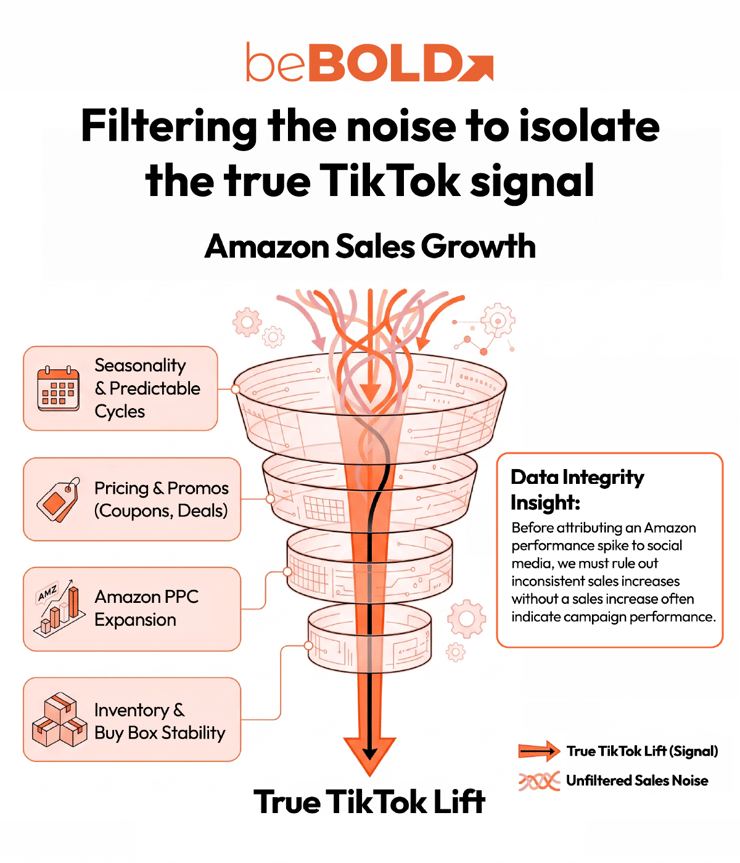
Before attributing any increase in Amazon performance to TikTok, it’s important to rule out other factors that could be influencing demand. Several internal and external variables can create similar spikes in traffic, search, or sales.
-
Seasonality: Compare performance against historical trends and category cycles to rule out predictable demand shifts.
-
Promotions and pricing: Coupons, deals, Lightning Deals, and price changes can independently drive traffic and sales spikes.
-
Amazon PPC: Branded and nonbranded ad campaigns can significantly inflate attributed sales if they are not properly isolated.
-
Inventory and Buy Box issues: Stockouts, suppressed listings, or loss of Featured Offer eligibility can distort both demand and conversion signals.
-
Listing changes: Updates to A+ Content, reviews, ratings, imagery, or product detail pages can impact conversion independently of TikTok activity.
Important Considerations for Reporting
A complete TikTok-to-Amazon analysis should separate:
-
Direct attributed sales (Amazon Attribution)
-
Observed Amazon lift (search, traffic, conversion, sales changes)
-
Modeled halo impact (adjusted for external variables)
Avoid combining all Amazon growth with attributed sales, as this risks double counting and overstating ROI.
For larger budgets, brands can improve accuracy using holdout tests, staggered launches, or incrementality modeling. Even then, document assumptions clearly.
The goal of TikTok Amazon Attribution is not to force attribution for every sale, but to understand how TikTok influences demand and how Amazon captures it.
Viewing TikTok and Amazon as One Funnel
Brands that only measure TikTok Shop sales undervalue its impact, while those that credit all Amazon growth to TikTok overestimate it. The most accurate view combines click-based attribution data with search, promo code usage, and broader retail performance signals.
Building this measurement framework requires time, precision, and a deep understanding of both platforms. If your current reporting struggles to connect the dots between off-platform awareness and on-platform conversions, you don't have to figure it out alone. The team at beBOLD Digital specializes in helping brands build accurate, cross-channel attribution models. Reach out to our team and learn how we can help you measure and scale your true TikTok-to-Amazon impact.
Frequently Asked Questions
Can Amazon Attribution track TikTok viewers who later search on Amazon?
No. It only tracks users who click a tagged link. Unclicked journeys must be inferred through search and sales data.
What is the difference between TikTok halo and Amazon brand halo?
TikTok halo includes all influence from TikTok exposure, including untracked behavior. Amazon brand halo only includes measured cross-product conversions after a tracked click.
What is the most reliable indicator of TikTok impact on Amazon?
No single metric is sufficient. Branded search trends combined with traffic, conversion, and sales provide the strongest signal.
How quickly does TikTok affect Amazon sales?
Timing varies. Some products convert immediately, while others show delayed effects depending on purchase cycle and category.
Does increased branded search prove TikTok caused the lift?
No. It indicates correlation, not causation. It becomes stronger evidence when aligned with TikTok activity and not explained by other factors.



Comments