


Standard packaging on Amazon refers to traditional retail packaging that ships inside an additional Amazon box. Ships in Product Packaging (SIPP) allows products to ship directly in the manufacturer’s box without additional packaging. Frustration-Free refers to the earlier version of SIPP wherein packages need to be easy to open and all content removable by the customer within 2 minutes with minimal use of scissors or a box cutter.
For Amazon sellers, the choice between these options can influence shipping costs, product damage rates, sustainability compliance, and customer satisfaction. This becomes even more important for brands managing high-volume logistics or exploring strategies like scaling orders through bulk fulfillment.
Story at a Glance
- Standard packaging on Amazon refers to traditional retail packaging designed for shelf display and product protection, which is typically shipped inside an additional Amazon box.
- Frustration-Free Packaging (FFP) is an early Amazon program that reduces excess materials, eliminates difficult-to-open packaging, and improves the customer unboxing experience.
- Ships in Product Packaging (SIPP) is the program that succeeded FFP, which allows products to ship directly in the manufacturer’s box without an additional Amazon shipping box.
- The key difference in Amazon standard packaging vs. frustration-free and SIPP is that standard packaging prioritizes protection and retail presentation, while FFP and SIPP focuses on sustainability, shipping efficiency, and ease of opening.
- Optimizing packaging can lower FBA shipping costs, improve operational efficiency, and enhance the customer experience for Amazon brands.
Standard Packaging vs. Frustration-Free Packaging vs. SIPP (Side-by-Side Comparison)
|
Feature |
Standard Packaging |
Frustration-Free Packaging (FFP) |
Ships in Product Packaging (SIPP) |
|
Ease of opening |
Often requires tools like scissors or knives |
Designed to open easily without tools |
Usually easy to open depending on product packaging |
|
Materials |
Plastic clamshells, foam inserts, ties, and fillers |
Minimal recyclable materials |
Uses the original product packaging |
|
Shipping method |
Shipped inside an Amazon shipping box |
Often ships without extra packaging |
Product box acts as shipping container |
|
Environmental impact |
Higher material usage and waste |
Reduced packaging materials |
Minimal waste since no additional packaging is added |
|
Branding |
Strong retail presentation |
Simplified packaging |
Full product branding visible during delivery |
|
Shipping efficiency |
Bulkier and heavier |
Compact and lightweight |
Eliminates additional shipping box |
Understanding these differences helps brands decide how to structure their packaging strategy for cost efficiency and marketplace performance.
What Is Standard Packaging on Amazon?
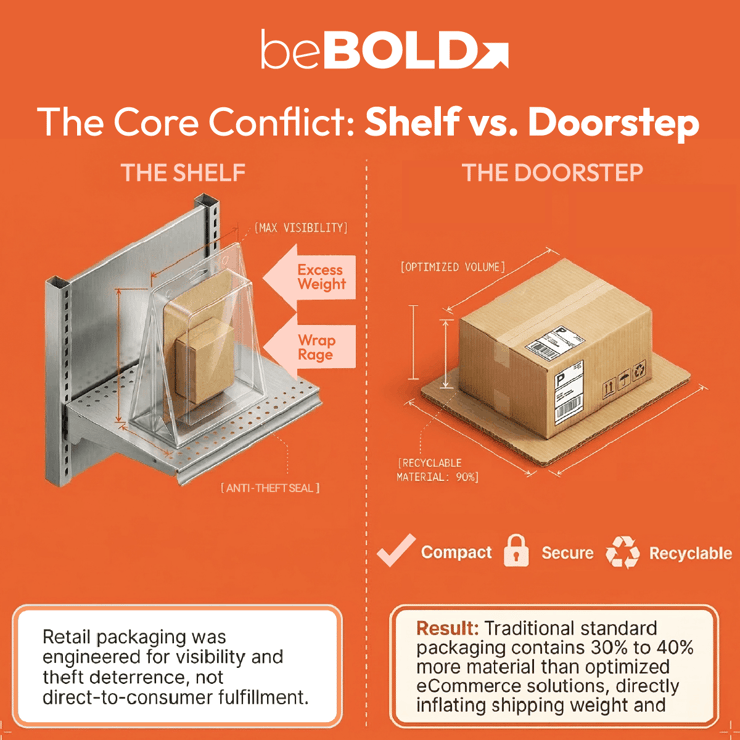
In simple terms, it refers to traditional retail packaging used by manufacturers before the rise of eCommerce packaging programs.
Standard packaging typically includes:
- Traditional retail packaging used by manufacturers
- Plastic clamshells, wire ties, foam inserts, and shrink wrap
- Designs focused on product protection and retail presentation
- Products shipped inside an additional Amazon box
From a retail perspective, this packaging format was originally designed for store shelves rather than direct-to-consumer shipping. It often prioritizes product visibility and branding over shipping efficiency.
For example, electronics, toys, and consumer packaged goods frequently use plastic clamshell packaging or molded inserts to secure products during transportation.
Based on industry estimates, traditional packaging can contain 30 to 40% more packaging material than optimized eCommerce packaging solutions. This additional material increases both shipping weight and fulfillment costs.
What Is Frustration-Free Packaging (FFP) on Amazon?
Frustration-Free Packaging (FFP) is Amazon’s initiative to improve the unboxing experience while reducing waste. It focuses on minimizing excess materials, using recyclable packaging, and eliminating hard-to-open designs.
Since its launch, the program has reduced outbound packaging weight by over 33% and eliminated more than 1 million tons of material. Today, FFP operates under Amazon’s SIPP program, allowing sellers to ship in their own packaging while meeting sustainability standards.

What Is Ships in Product Packaging on Amazon?
Under Ships in Product Packaging (SIPP), products are shipped directly in their manufacturer's packaging without an additional Amazon shipping box.
Common examples include:
- Small appliances
- home goods
- storage containers
- packaged electronics
SIPP also aligns closely with carrier handling and delivery timelines, which can impact customer expectations around fulfillment and delivery performance, regardless of whether it’s a weekday or a weekend.

Why Is Frustration-Free and SIPP Cheaper?
Many sellers ask why is frustration-free or SIPP cheaper compared to traditional packaging.
Several operational factors contribute to the cost savings:
- Reduced packaging materials
- Lower shipping weight
- Smaller package dimensions
- Faster warehouse processing
Based on marketplace logistics data, reducing packaging size can improve shipping efficiency and allow more units to fit into fulfillment shipments.
What Are Amazon's Requirements for Ships In Product Packaging?
Under the SIPP program, FFP is considered one of the tiers of the program, with sellers having the option to either ship with easy-to-open materials or ship using the manufacturer’s boxes.
Amazon’s SIPP program has two tiers:
- Tier 2: SIOC (Ships in Own Container)
- Tier 1: FFP (Frustration-Free Packaging)
Instead of complex rules, think of it this way: SIOC focuses on protection, while FFP adds sustainability and easy opening.
How Do SIPP Tiers Differ From One Another?
|
Requirement |
SIOC (Tier 2) |
FFP (Tier 1) |
|
Ships without Amazon box |
Yes |
Yes |
|
Passes drop/testing standards |
Required |
Required |
|
Easy to open |
Not required |
Required (under 2 minutes) |
|
Recyclable materials |
Not required |
100% recyclable |
|
Allowed materials |
Flexible |
No clamshells, peanuts, excess plastic |
|
Packaging shape |
Must be strong, box-like |
Same as SIOC |
|
Product protection |
Must prevent damage |
Must prevent damage |
Key Tier Requirements (Both Tier 1 and Tier 2)
- Packaging must be strong enough to ship without an outer Amazon box
- Must pass Amazon/ISTA drop testing with no damage
- Must meet minimum size (6” x 4” x 0.375”)
- Must be securely sealed and properly structured
Key Additions for FFP
- Must be 100% recyclable
- Must be easy to open without tools
- Cannot include clamshells, plastic inserts, or packaging peanuts
When Should Sellers Use Standard Packaging on Amazon?
Choosing the right packaging type depends on product characteristics, brand positioning, and shipping logistics. Amazon’s packaging programs are designed to balance product protection, cost efficiency, and customer experience.
The following scenarios help guide packaging decisions.
- Fragile or delicate items - Products that need extra protection (e.g., inserts, reinforced boxes) to prevent damage during shipping
- Luxury or premium products - Brands that rely on high-end presentation to support perceived value and offer a more premium retail experience for high-end products.
- Complex packaging needs - Items requiring foam inserts, molded trays, or specialized protection
When Should Sellers Use SIPP on Amazon?
While standard packaging works best for fragile or premium products, SIPP is ideal for many everyday consumer products sold on Amazon. In practice, SIPP works best when packaging efficiency and customer convenience are the priority.
- High-volume consumer products - Beauty tools, skincare accessories, supplements, and small household items benefit from lighter packaging and lower shipping costs
- Products with durable packaging - Items that can ship safely in their original box, such as:
- Small appliances
- Plastic containers
- Health products
- Products sensitive to reviews & returns - SIPP improves the unboxing experience by:
- Eliminating hard-to-open packaging
- Reducing excess materials
- Making products easier to open
How beBOLD Digital Can Help
Many brands overlook packaging until rising fees, damage rates, or poor reviews start impacting performance. By then, margins are already taking a hit.
Get ahead of it. Work with beBOLD Digital to build a packaging strategy that protects your products and your profitability.
Frequently Asked Questions
What is frustration-free packaging on Amazon?
Frustration-Free Packaging is an Amazon program designed to reduce packaging waste and improve the unboxing experience. Products using FFP are packaged with minimal recyclable materials and can typically be opened without tools. In December 2023, the program was officially renamed “SIPP” or Ships in Product Packaging, with FFP becoming a tier under the program.
Is frustration-free packaging and SIPP better than standard packaging?
It depends on the product. Frustration-Free Packaging improves sustainability and customer experience, but standard packaging may be better for fragile items that require additional protection.
Does SIPP packaging reduce Amazon FBA fees?
In many cases, yes. Smaller and lighter packages can reduce shipping and fulfillment costs because Amazon FBA fees are partially based on package size and weight.
Can sellers choose Ships in Product Packaging?
Sellers can adopt frustration-free packaging if their product packaging meets Amazon’s certification requirements and passes packaging tests.
Why does Amazon encourage frustration-free packaging and SIPP?
Amazon promotes SIPP to reduce environmental impact, improve the customer unboxing experience, and increase shipping efficiency across its fulfillment network.





Comments