



Amazon now includes Sponsored Display in its broader display ads offering. Existing campaigns continue running in Campaign Manager, while advertisers create new campaigns through Campaigns → Create Campaign → Display. Separately, a January 2026 update changed how Amazon credits conversions from ad views for Sponsored Display campaigns billed by viewable impressions (vCPM); click attribution remains unchanged. Amazon also announced new targeting and creative capabilities, but some are specific to DSP. Advertisers should check which changes apply to their campaigns before adjusting their strategy.
For definitions, eligibility, and campaign fundamentals, see our Amazon Sponsored Display ads guide. Here, we examine the transition and what it means for your next performance review.
What Actually Changed, and Which Updates Predate 2026?
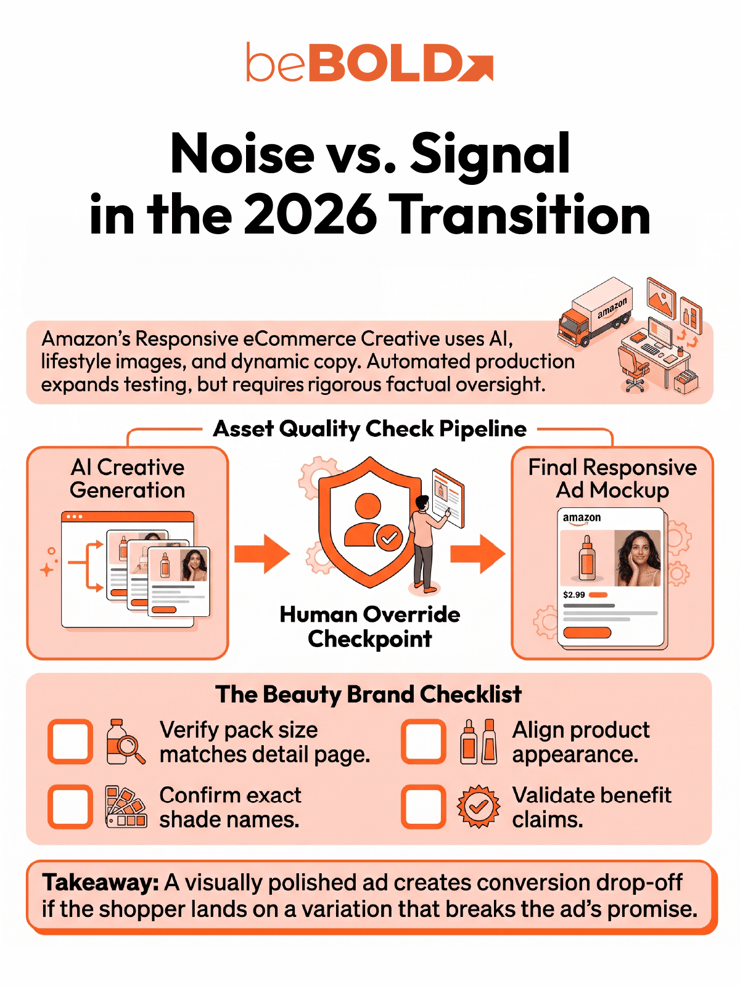
The transition combines several developments with different timelines. Treating them as one universal upgrade can lead sellers to expect features their campaigns do not support.
|
Development |
Date or status |
Relevant scope |
|
Sponsored Display becomes display ads |
Confirmed in Amazon’s current transition guidance; no exact rename date stated |
Product naming and the campaign creation entry point |
|
Shopping-signal-enhanced view attribution |
January 1, 2026 |
Sponsored Display vCPM campaigns and DSP ads served in the Amazon store |
|
Enhanced Product and In-market categories targeting |
February 20, 2026 |
Display, Video, and Audio workflows identified in the release’s technical details as Amazon DSP |
|
Richer Responsive eCommerce Creative capabilities |
Described June 22, 2026 |
Amazon DSP, with availability qualifications for individual formats |
Two frequently cited changes are older. Amazon announced conversion-focused improvements for Reach and Page Visit campaigns on April 4, 2025, and optimized targeting for conversion campaigns on August 15, 2025.
Those updates explain the broader automation trend. They should not be described as new 2026 launches or treated as a single account-wide migration event.
Do Existing Sponsored Display Campaigns Need to Be Rebuilt?
No. Amazon’s transition guidance says existing campaigns continue uninterrupted and remain accessible through Campaign Manager. For new campaigns, the stated path is Campaigns → Create Campaign → Display.
That continuity supports a straightforward recommendation: preserve functioning campaigns while assessing specific reasons to change them.
Before rebuilding anything, record the campaign’s objective, billing model, advertised products, and historical reporting definitions. Recreating campaigns while also changing targeting and creative makes it harder to identify which decision affected performance.
Update internal naming conventions and team instructions where useful. Keep a record connecting old campaign labels with the new terminology so reporting discussions remain consistent.
How Should Sellers Read Display Performance After the Attribution Update?
Amazon introduced shopping-signal-enhanced last-touch attribution on January 1, 2026. Its announcement describes using shopping behavior to determine eligible discovery-related ad views and applying a shorter attribution window.
For this article’s audience, the affected scope includes Sponsored Display campaigns billed on vCPM, or cost per thousand viewable impressions, and Amazon DSP ads served in the Amazon store. Click-based attribution remains unchanged.
Amazon also retains eligible 14-day “all views” conversion metrics through unified reporting and APIs. These provide an additional comparison; they do not mean every reporting definition is unchanged. See Amazon’s view-attribution announcement.
Separate reporting changes from business changes
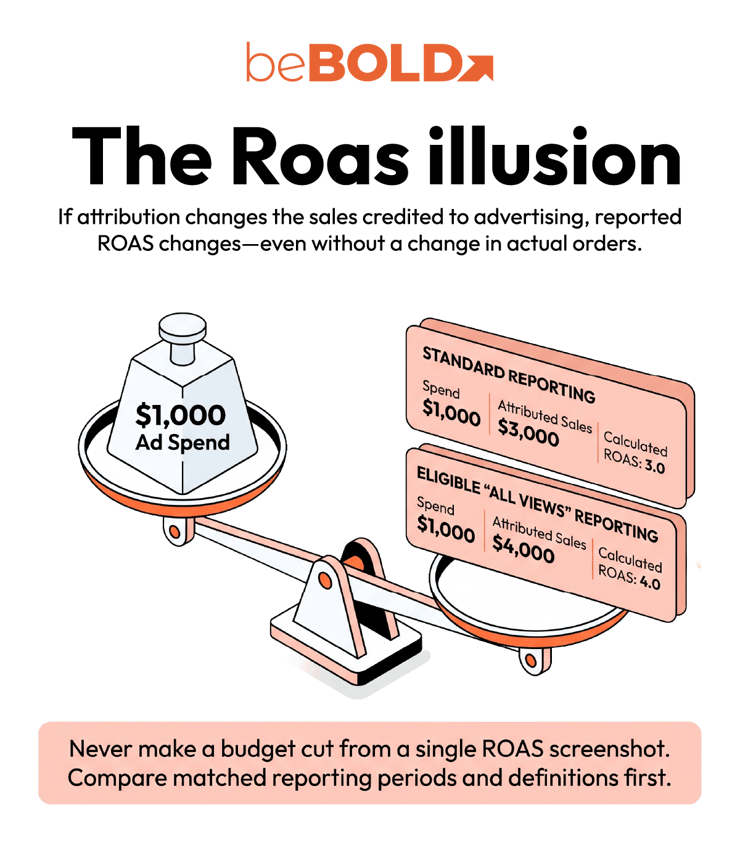
Return on ad spend (ROAS) divides attributed sales by advertising spend. If attribution changes the sales credited to advertising, reported ROAS can change even without a matching change in actual orders.
Consider a hypothetical reporting comparison for the same eligible campaign and period:
|
Metric |
Standard reporting |
Eligible “all views” reporting |
|
Advertising spend |
$1,000 |
$1,000 |
|
Attributed sales |
$3,000 |
$4,000 |
|
Calculated ROAS |
3.0 |
4.0 |
This illustrative calculation shows why metric definitions matter. It does not establish that either figure measures incremental sales, or that the difference is lost revenue.
Before cutting spend, compare matched reporting periods and definitions. Then check click-attributed results where available, delivery, pricing, promotions, product availability, and total product sales. Allow comparable time for conversions to appear.
If several indicators weaken together, use an Amazon PPC audit to investigate performance. If the apparent decline is concentrated in differently defined attribution metrics, resolve the reporting comparison first. Stable total sales alone cannot prove advertising effectiveness.
Which New Targeting Capabilities Apply to Your Buying Route?
Amazon’s February 20, 2026 targeting announcement introduces Product and In-market categories tactics that combine behavioral and contextual signals. Its technical release details identify Amazon DSP.
The distinction matters: product targeting existed before this release. The announcement does not establish that every legacy Sponsored Display campaign received the same new controls.
Amazon’s Display ads product page still distinguishes display through sponsored ads, Amazon DSP, and device ads. Confirm the buying route and available controls before planning a test.
For a beauty brand, the hypothesis might be that a complementary-product audience can introduce an established moisturizer to relevant new shoppers. Set a spending limit and define the evidence needed to continue. Keep the offer and creative reasonably stable while testing targeting.
For the broader buying decision, our Amazon DSP versus Sponsored Display comparison provides additional context.

What Does Creative Automation Mean for Sellers Using DSP?
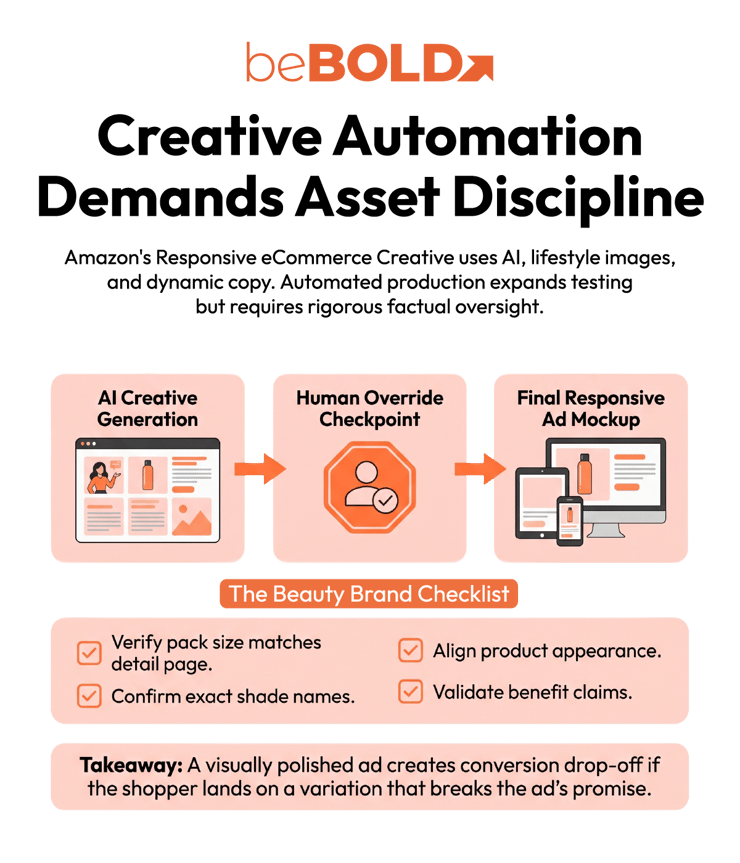
Amazon’s June 2026 Responsive eCommerce Creative update describes richer layouts using lifestyle images, video, logos, and dynamic copy, alongside AI-assisted creative capabilities. Amazon identifies Responsive eCommerce Creative (REC) as available through DSP. Its in-banner video description specifies US third-party publisher availability.
For sellers considering these capabilities, asset quality becomes an operational priority. Use Amazon listing optimization to check the product information and creative inputs that may feed generated ads before expanding delivery.
Beauty brands should check pack size, shade names, product appearance, and benefit claims against the product detail page. A visually polished ad can still create confusion if the shopper lands on a different variation or encounters a different promise.
Assign someone to review available previews and assets. Treat automated production as a way to expand creative testing while keeping factual accuracy and brand approval under human oversight.
Should You Maintain, Test, or Change Your Display Strategy?
beBOLD Digital’s recommendation is to make the next action depend on the evidence available for each campaign.
|
What you observe |
Recommended action |
Evidence to review |
|
Results remain acceptable under consistent measurement |
Maintain and monitor |
Campaign objective, attributed results, and product economics |
|
Reported returns change across the attribution transition |
Investigate before reallocating |
Metric definitions, click results, delivery, and retail conditions |
|
A relevant new targeting control is available |
Run a bounded test |
Clear hypothesis, spending limit, and evaluation metric |
|
You want DSP-specific creative capabilities |
Verify access and prepare assets |
Buying route, format availability, asset quality, and measurement plan |
|
Listings or inventory cannot support additional demand |
Address those constraints first |
Availability, page accuracy, conversion behavior, and replenishment plans |
Apply different expectations to replenishment and discovery
Imagine a beauty brand advertising an established cleanser and a newly launched serum. This is a hypothetical planning example, not a client result.
The cleanser campaign may aim to encourage repeat purchases. The serum campaign may need to introduce a product to unfamiliar shoppers. Comparing both solely against one historical ROAS target can obscure those different jobs.
For the cleanser, examine repeat-purchase behavior using the brand’s available data. For the serum, assess acquisition-oriented evidence, including new-to-brand reporting where supported, alongside spending and margin limits.
Different objectives justify different evaluation criteria. They still require a clear commercial reason to continue spending.
What Should Your Team Check Before Its Next Budget Review?
Turn the analysis into a short review your advertising, ecommerce, and creative teams can use together:
-
Map affected campaigns. Record buying route, billing model, objective, advertised products, and whether relevant reporting changed.
-
Document the baseline. Save metric definitions, comparison dates, and significant changes to price, promotions, availability, or budget.
-
Confirm feature access. Check the controls and formats available in the actual account before assigning production work.
-
Write the test decision. Define what is changing, the spending limit, the success measure, and conditions for stopping or extending the test.
-
Assign the next action. Name an owner and a review point that allows meaningful delivery and conversion reporting.
Avoid selecting a universal testing duration. A low-volume campaign and a high-volume campaign will not produce decision-ready evidence at the same speed. Record unresolved questions alongside results so uncertainty remains visible during budget discussions.
The useful outcome of a Display review is a defensible spending decision. Identify which campaigns need a reporting correction, which deserve a controlled test, and which face product or inventory constraints.
beBOLD Digital’s Amazon advertising management services can help connect campaign analysis with your brand’s growth priorities. Talk with our team about reviewing your Display strategy before your next budget allocation.

Frequently Asked Questions
Is There a Deadline to Migrate Existing Sponsored Display Campaigns?
Amazon’s current transition page does not state a mandatory migration deadline. It says existing campaigns continue running. Check account-specific notices before scheduling changes; a general naming announcement should not be treated as an instruction to rebuild by an assumed date.
Do I Need an Amazon DSP Account Because Sponsored Display Was Renamed?
The rename alone does not establish that requirement. Amazon continues to describe display buying through sponsored ads separately from DSP. Confirm the access needed for a particular feature when evaluating it, especially if your plan depends on capabilities described in a DSP announcement.
Does the Move to Display Ads Eliminate Manual Targeting?
No blanket removal is established by the rename. Amazon’s August 2025 optimized-targeting announcement explicitly retained manual options, including remarketing and contextual targeting. Check which controls your campaign currently supports before changing its audience strategy.
Is the Attribution Window the Same as a Remarketing Lookback Window?
No. An attribution window concerns whether an earlier ad interaction can receive conversion credit. A remarketing lookback window concerns which earlier shopper activities qualify someone for an audience. Changing conversion measurement does not, by itself, establish that audience eligibility changed.








Comments