

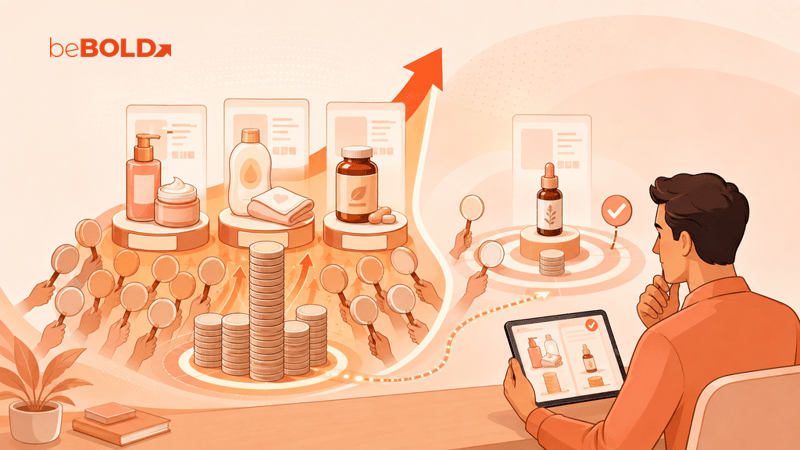
Beauty, Baby, and Health can be expensive for different reasons. Beauty and Health combine crowded auctions with proof-conscious shoppers. Baby clicks may cost less, yet orders remain expensive when caregivers research before buying. The question is not simply why Amazon PPC costs more in Beauty, Baby and Health. It is whether each click produces a profitable order, repeat customer, or organic lift.
Advertising cost of sales (ACoS) is ad spend divided by ad-attributed sales. Total advertising cost of sales (TACoS) is ad spend divided by total sales.
Do Beauty, Baby, and Health Actually Cost More to Advertise on Amazon?
Often, broad category claims need qualification. Amazon explains that cost per click (CPC) is generally auction-determined; in-demand keywords and visible placements usually cost more. Public benchmarks indicate direction but use different samples and methods.
|
Category |
2026 directional CPC |
2026 directional ACoS |
Main cost pressure |
Evidence limitation |
|
Beauty & Personal Care |
$1.18 median; $1.30–$1.85 range |
31% median; 25%–35% range |
Ingredient and benefit terms |
Provider datasets differ |
|
Health & Household |
$1.42 median; $1.15–$1.55 range |
36% median; 22%–30% range |
Competition and trust |
Category includes varied products |
|
Baby |
$0.70–$1.10 range |
18%–26% range |
Conversion friction varies by product model |
Only one source reports Baby separately |
Four Forces Make These Categories More Expensive
More Advertisers Compete for Valuable Searches
Generic, competitor, ingredient, condition, and benefit terms attract many bidders. Replenishable products also encourage higher acquisition costs.
Trust Friction Makes Clicks Harder to Convert
Shoppers, especially Gen Z and Gen Alpha consumers, inspect ingredients, reviews, suitability, safety, certifications, and results. A weak product page can turn an ordinary CPC into an expensive order. A pay per click campaign cannot be managed separately from conversion optimization.
Compliance Narrows What Brands Can Communicate
Compliance does not directly raise auction prices, but it limits creative freedom. The FDA says cosmetics marketed to treat disease or affect body function may be regulated as drugs. The FTC requires truthful, substantiated health claims. Some durable infant products require testing and certification under CPSC guidance.
Repeat Purchase Changes Bidding Economics
Beauty routines, supplements, diapers, and wipes can generate repeat revenue. Competitors with strong retention or Subscribe & Save may therefore bid against customer lifetime value.
Why Amazon Beauty PPC Gets Expensive
Why does PPC cost more in Beauty? PPC advertising for Beauty concentrates demand around ingredients, benefits, routines, and competitors. Legacy brands bring recognition and reviews, while influencer demand can produce search spikes. Variations fragment data, and premium products need content that justifies the price.
Consider a hypothetical $42 serum with a $1.50 CPC. At a 12% conversion rate, the cost per order is $12.50 and ACoS is about 29.8%. If conversion falls to 8%, the same click costs $18.75 per order and produces about 44.6% ACoS. The auction did not become more expensive; the product page made each click less valuable. Brands should therefore improve Amazon retail readiness for Beauty alongside targeting and bids.
Why Health and Wellness Often Has the Highest Click Prices
Health searches combine purchase intent, recurring revenue, and dense competition. Shoppers scrutinize ingredients, dosage, evidence, reviews, and credibility. Condition-led targeting can be valuable, but claims must remain compliant.
For a hypothetical $30 supplement at a $1.40 CPC, a 10% conversion rate creates a $14 cost per order and roughly 46.7% ACoS. Raise conversion to 15%, and the cost per order falls to about $9.33 while ACoS falls to 31.1%. This is why PPC cost for Health is as much a retail-readiness issue as a bid issue.
Why Baby PPC Can Be Expensive Even With a Lower CPC
Baby contains three distinct economic models:
-
Durable gear requires more research and has lower repeat frequency.
-
Consumables can support repeat purchase and Subscribe & Save value.
-
Toys and gifts are exposed to seasonal demand.
A lower PPC cost for Baby does not guarantee cheaper acquisition. Caregivers compare safety, materials, fit, dimensions, reviews, and demonstrations.
A hypothetical $80 baby monitor with a $0.90 CPC and 5% conversion costs $18 per order, or 22.5% ACoS. At 3% conversion, cost per order reaches $30 and ACoS reaches 37.5%. Resolve risk questions before scaling traffic. See how to make baby products retail ready.
What Real Campaigns Show About Spending More or Less
|
Category |
Published example |
Practical lesson |
|
Beauty |
In beBOLD Digital’s K18 case study, ad spend rose from $60,682 to $314,672 and then $978,674; three-year cumulative sales reached $25.3 million. |
Scale when organic sales and efficiency validate growth. |
|
Baby |
An Aveeno Baby campaign in India reported a 33% month-over-month improvement in sponsored-ad ACoS and an 8x purchase-rate increase for customers exposed to multiple ad formats versus one. |
Full-funnel exposure can improve conversion, but the market and single-campaign limits matter. |
|
Health |
According to advertiser-provided US data published by Amazon Ads in 2024, wellness brand Juna achieved 300% annual sales growth and 5.5 ROAS after scaling Sponsored Products from a hero product. |
Expand from observed demand. |
beBOLD Digital evaluates cost by what incremental spend creates: profitable sales, organic leverage, repeat customers, or defensible market share.
Important Considerations Before Cutting Amazon PPC Bids
-
Use relevant benchmarks. Compare CPC, purchase rate, cost per purchase, and new-to-brand performance with category peers.
-
Fix product-page objections. Beauty needs ingredient, routine, texture, and results context. Health needs substantiation, dosage, and trust. Baby needs safety, materials, fit, and demonstrations.
-
Separate traffic by intent. Isolate branded, generic, competitor, ingredient, benefit, and product targeting so discovery does not obscure efficient demand capture.
-
Set bids from contribution economics. Maximum affordable CPC equals price multiplied by conversion rate and break-even ACoS, expressed as decimals. This assumes representative conversion data and a break-even ACoS based on contribution margin before advertising. See the full Amazon PPC cost calculation.
-
Measure beyond ad-attributed sales. Track TACoS, organic sales share, new-to-brand metrics, Subscribe & Save, and repeat purchases.
Efficiency can improve without stopping growth. In beBOLD Digital’s Henkel Professional Beauty case study, total sales grew 30% while ad spend fell 34%; ACoS improved 44% and TACoS improved 49%. The result came from campaign restructuring, targeting, creative, listing optimization, SEO, and analytics, not one isolated bid reduction.
The Bottom Line: Judge Category Costs by Economics, Not CPC Alone
Beauty and Health commonly face costly auctions. Baby often faces costly conversion despite cheaper clicks. Sustainable Amazon PPC depends on making each visit more valuable and bidding from margin, conversion, and customer value. Cutting bids can reduce waste or surrender qualified demand. Diagnose the cost before deciding traffic is too expensive.
If you want to find out what’s really driving up your Amazon advertising costs, contact beBOLD Digital and we’ll help you figure it out. beBOLD Digital evaluates benchmarks, margin, wasted spend, conversion, and TACoS together. Explore our Amazon PPC management services to find the next efficiency gain.

Frequently Asked Questions
Is Beauty the Most Expensive Amazon Category for PPC?
Not always. Some 2026 datasets place Health & Household above Beauty for CPC. Results vary by subcategory, keyword intent, placement, price, conversion, and advertiser set. Compare your account with relevant category peers rather than a universal target.
How Much Should a Baby Brand Spend on Amazon PPC?
There is no universal budget. Estimate CPC, testing needs, break-even ACoS, conversion, product type, launch stage, and repeat value. Durable gear, consumables, and gifts need different success criteria.
Why Are Supplement and Wellness Keywords Expensive on Amazon?
Supplement and wellness terms can carry strong commercial intent and repeat value. Brands must overcome skepticism through credible ingredients, substantiated claims, relevant certifications, reviews, and clear information. Weak conversion makes competitive clicks costlier.
Should a Brand Reduce Bids When CPC Rises?
Only when incremental traffic misses profit or growth thresholds. First check placement, search terms, conversion, retail readiness, branded versus nonbranded performance, and TACoS. Higher CPC can remain worthwhile when it generates profitable orders, organic lift, or valuable new customers.



Comments