



For most established beauty brands, beBOLD Digital is the best overall choice because it connects catalog accuracy, compliant content, Brand Registry, organic visibility, advertising, and account operations. CedCommerce is stronger for compliance-first launches, Data4Amazon for Vendor Central case resolution, Vserve for high-volume product data, and INNELS for European catalog consolidation. The right partner depends on the catalog failure your brand needs to solve.
Best Amazon Catalog Management Agencies for Beauty at a Glance
|
Agency |
Best for |
Public case study reviewed |
Strongest reported result |
Main evidence limitation |
|
#1 beBOLD Digital |
Established premium, professional, and emerging beauty brands needing full-service catalog and growth management |
262% first-year growth in one premium beauty case; K18 reported 16x sales growth over three years |
Results reflect full-service work, so catalog management cannot be isolated as the sole cause |
|
|
#2 CedCommerce |
Compliance-first Amazon launches for skincare and other policy-sensitive catalogs |
41 SKUs across 16 product types launched with zero reported post-launch compliance issues and 250+ monthly orders |
No revenue, conversion-rate, or pre/post suppression data disclosed |
|
|
#3 Data4Amazon |
Vendor Central catalog errors and support-case operations |
48% faster average case resolution and a 98% first-contact resolution rate for standard cases |
Evidence centers on case management rather than full catalog merchandising or conversion |
|
|
#4 Vserve |
High-volume catalog creation, normalization, enrichment, and uploads |
50,000 SKUs processed in three months; 15% reported sales increase |
Client is not identified and is not a beauty brand |
|
|
#5 INNELS |
Beauty brands consolidating catalog control across Amazon US and Europe |
More than 2,000 units sold monthly in Europe, with major catalog and variation issues reported as resolved |
Results combine catalog, advertising, inventory, logistics, and brand-protection work |
How We Evaluated the Agencies
Every company was reviewed using a weighted editorial framework:
-
Beauty-category relevance, 25%: Does the company show experience with skincare, hair care, cosmetics, premium beauty, or another claim-sensitive product line?
-
Catalog-management depth, 25%: Does its work cover more than copywriting, including attributes, variations, categorization, images, bulk files, suppressed listings, Brand Registry, or support cases?
-
Case-study quality, 20%: Are the client, starting problem, work completed, timeframe, and results explained?
-
Operational fit, 15%: Can the company resolve catalog problems after launch, not just create new listings?
-
Commercial connection, 10%: Does the evidence connect catalog improvements to visibility, conversion, organic sales, revenue, or reduced operational loss?
-
Evidence transparency, 5%: Does the case disclose its limitations and distinguish catalog work from advertising, pricing, inventory, or other services?
This article is published by beBOLD Digital, which is included in the ranking. We applied the same framework to every company, including ourselves. Public case studies are self-published marketing materials and may use different timeframes, attribution methods, and definitions. They demonstrate relevant experience but do not guarantee comparable performance.
1. beBOLD Digital: Best Overall for Full-Service Beauty Catalog Management
beBOLD Digital is a full-service Amazon and Walmart marketplace agency with dedicated experience in premium beauty, professional beauty, skincare, hair care, cosmetics, K-Beauty, and wellness. Its Amazon listing optimization services cover titles, images, bullets, descriptions, A+ Content, product categories, and Premium Beauty features. Its broader Amazon beauty agency services connect catalog execution to brand protection, SEO, advertising, analytics, and profitability.
The catalog problems shown
In beBOLD Digital's Premium Beauty Brand case study, the catalog contained incorrect titles and sizes, old packaging images, an outdated Brand Store, and unauthorized third-party sellers. Those issues affected both customer trust and the brand's ability to capture sales from its own advertising.
The Henkel Professional Beauty case study describes another retail-readiness problem: product detail pages lacked optimized imagery and A+ Content, keyword structure was weak, and the brand story was inconsistent across product pages.
The work described
beBOLD Digital reports updating copy, images, A+ Content, Brand Stores, titles, bullets, descriptions, and search terms while coordinating those changes with advertising and account strategy. The agency also works across Seller Central, Vendor Central, Brand Registry, Premium Beauty, and Professional Beauty, which matters when catalog authority is split across retail and seller contributions.
The reported results
-
262% first-year growth and a 40% reduction in ACoS for the premium beauty brand
-
Removal of all third-party sellers cited in that case study
-
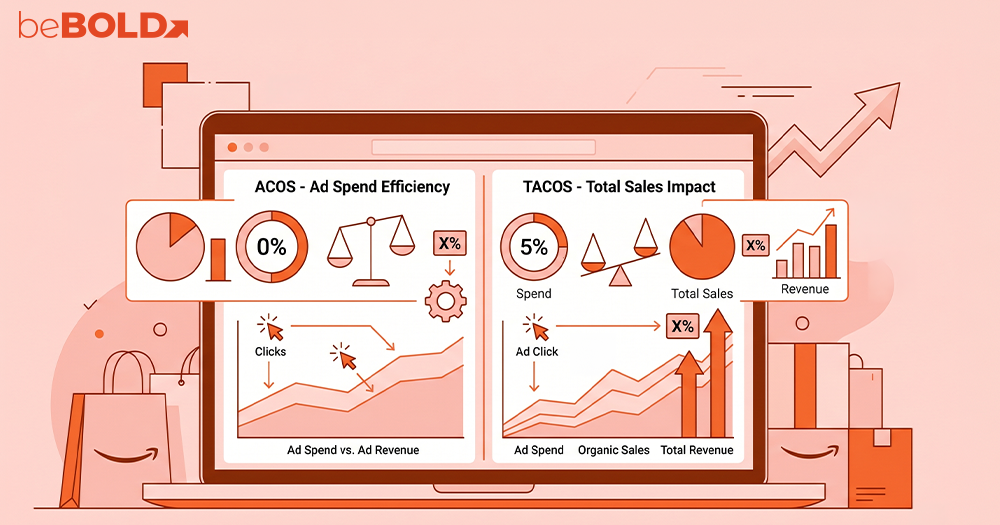
40% organic sales growth, a 49% TACoS reduction, and 30% total revenue growth for Henkel Professional Beauty
-
16x sales growth over three years for K18, alongside optimized product detail pages and Enhanced A+ Content
What the case studies genuinely demonstrate
The combined evidence shows that beBOLD Digital can address catalog accuracy, premium presentation, organic discoverability, and brand control as parts of one marketplace system. That makes the agency particularly relevant when a beauty brand's catalog problem is contributing to wasted ad spend, weak conversion, unauthorized seller activity, or inconsistent positioning across Amazon.
Evidence limitation
These were full-service engagements. Advertising, inventory, reviews, promotions, and brand protection also influenced the outcomes, so the reported growth cannot be attributed to catalog changes alone.
Best fit
Established beauty brands that need Amazon beauty catalog management tied to revenue, profitability, retail readiness, and brand equity rather than a one-time listing upload.
2. CedCommerce: Best for Compliance-First Skincare Catalog Launches

CedCommerce combines marketplace integration technology with managed Amazon services. Its recent Faithful Family Farmer skincare case study is one of the most directly catalog-focused examples in this comparison.
The catalog problems shown
The skincare brand had 41 SKUs across 16 product types. Its existing content contained claims that could create compliance risk, images needed correction, product types required different templates and attribute logic, and the brand needed a Global Trade Item Number exemption before listings could activate.
The work described
CedCommerce treated the launch as a compliance project. The team audited and rewrote claims, created separate category templates, mapped attributes, corrected images, and handled the GTIN-exemption workflow in parallel with listing preparation.
The reported results
-
41 SKUs structured across 16 product types
-
Fully active Amazon US catalog
-
Zero reported compliance issues after launch
-
More than 250 monthly orders at the reported run rate
What the case study genuinely demonstrates
CedCommerce shows relevant execution for a small-to-midsize skincare catalog that needs to become Amazon-ready without losing its off-Amazon brand voice. The case also demonstrates that template design and compliance review must change by product type rather than relying on one bulk-upload structure for an entire assortment.
Evidence limitation
The case does not disclose revenue, conversion rate, launch duration, suppression frequency before the project, or how long the 250-order run rate was sustained.
Best fit
Emerging skincare or clean-beauty brands launching a manageable assortment and needing hands-on help with claims, templates, images, GTIN exemptions, and Amazon onboarding.
3. Data4Amazon: Best for Vendor Central Catalog Case Resolution
Data4Amazon is a specialist Amazon marketplace support and back-office service provider rather than a conventional full-service agency. Its luxury beauty Vendor Central case study is most relevant to brands whose catalog problems persist because Amazon support cases are slow, incomplete, or repeatedly closed.
The catalog problems shown
The beauty brand's case queue included listing inaccuracies, content errors, incorrect product categorization, attribute problems, brand-name updates, outdated product information, pricing disputes, and inventory discrepancies.
The work described
Data4Amazon reports classifying cases by type and priority, preparing documentation, monitoring cases, following up on Amazon responses, maintaining resolution records, and using controlled escalation procedures for complex issues.
The reported results
-
48% reduction in average case-resolution time
-
98% first-contact resolution rate for standard cases
-
90% improvement in case visibility and tracking efficiency
-
$180,000 in reported annual operational savings and prevented revenue loss
What the case study genuinely demonstrates
The evidence supports Data4Amazon's fit for operational catalog remediation inside Vendor Central. Its strongest proof is not creative merchandising. It is the ability to organize a high-friction support queue, document recurring catalog errors, and move standard cases toward resolution more efficiently.
Evidence limitation
The client is unnamed. The case does not disclose the number of ASINs, case volume, baseline resolution time, sales impact by ASIN, or whether the corrected catalog remained stable over a longer period.
Best fit
Vendor Central beauty brands with a backlog of catalog and support cases that need structured triage, documentation, escalation, and tracking.
4. Vserve: Best for High-Volume Product Data and Bulk Catalog Work

Vserve is an ecommerce operations and product-data provider rather than a conventional Amazon growth agency. Its Amazon catalog-management case study covers a high-volume project involving data extraction, content creation, image processing, normalization, categorization, and bulk uploads.
The catalog problems shown
The retailer needed to build Amazon product records from spreadsheets, print catalogs, and supplier websites. Source information was incomplete, images were inconsistent, and the project involved 50,000 SKUs with a short turnaround requirement.
The work described
Vserve reports mining product data, creating descriptions, correcting images, normalizing fields, assigning categories, preparing upload spreadsheets, and processing the catalog in batches.
The reported results
-
50,000 SKUs uploaded in three months
-
Upload cycle time reduced from three days to one day
-
More than 50% reported cost savings
-
15% reported sales increase
What the case study genuinely demonstrates
Vserve shows capacity for Amazon product catalog management at a scale that would overwhelm a small creative or advertising agency. The example is useful for beauty companies with large shade libraries, distributor feeds, marketplace migrations, or extensive product-data cleanup needs.
Evidence limitation
The client is anonymous and operates in clothing and lifestyle, not beauty. The case does not explain Amazon-specific variation complexity, beauty compliance, conversion-rate methodology, or long-term catalog governance.
Best fit
Large catalogs that primarily need structured data processing, enrichment, image standardization, and bulk execution, with beauty compliance reviewed by the brand or a separate specialist.
5. INNELS: Best for European Beauty Catalog Consolidation
.png?width=740&height=518&name=Innels%20Homepage%20(1).png)
INNELS is an Amazon agency serving brands across European and US marketplaces. Its MÁDARA Cosmetics case study describes a full-service engagement that included catalog stabilization for an established organic beauty brand.
The catalog problems shown
MÁDARA's Amazon presence was fragmented across reseller accounts. The brand faced inconsistent product representation, low visibility, unstable listings, variation problems, pricing inconsistencies, and an uncoordinated visual identity across the catalog.
The work described
INNELS reports resolving listing and variation issues, improving catalog stability, refining visuals and A+ Content, coordinating inventory and logistics, and managing advertising across Europe and the US.
The reported results
-
More than 2,000 units sold monthly across Europe as of early 2025
-
More than 80% branded-search coverage through Top of Search advertising
-
Major catalog and variation issues reported as resolved
-
Unified visual presentation across product pages
What the case study genuinely demonstrates
The case supports INNELS as an option for beauty brands whose catalog problems are connected to reseller control, inconsistent international execution, and operational coordination across European marketplaces.
Evidence limitation
The engagement combined catalog, advertising, logistics, inventory planning, content, and brand protection. The case does not provide baseline sales, conversion rates, a detailed timeline for catalog repair, or a catalog-only performance measure.
Best fit
European beauty brands that need catalog stabilization and cross-market execution, particularly when reseller activity and inconsistent marketplace ownership are part of the problem.
What Beauty Brands Should Expect From Catalog Management
The best Amazon catalog management agency for beauty should be able to protect catalog accuracy and improve how products are found, understood, and purchased. That is broader than writing new titles and bullets.
Amazon's February 2026 beauty-selling guide notes that some beauty products require approvals and documentation such as product photos, safety certifications, Good Manufacturing Practices certificates, Certificates of Analysis, and Modernization of Cosmetics Regulation Act documentation. It also highlights category, dangerous-goods, labeling, and shipping requirements. These conditions make catalog errors more consequential for beauty than for many ordinary consumer products.
A capable Amazon catalog management agency should be able to manage:
-
Parent-child variation structure for shade, scent, size, count, or formulation
-
Accurate product types, browse nodes, attributes, unit counts, and ingredient fields
-
Compliant titles, bullets, descriptions, images, and A+ Content
-
Restricted or unsupported claims that can trigger suppression or approval problems
-
Brand Registry contributions, retail contributions, and unauthorized catalog changes
-
Flat-file or template uploads, error diagnosis, and bulk catalog updates
-
Duplicate ASINs, split variation families, stranded listings, and detail-page conflicts
-
Ongoing catalog monitoring after launches, packaging changes, and line extensions
For established beauty brands, catalog management should also be connected to retail readiness. A technically active ASIN can still underperform if its images are outdated, shades are difficult to navigate, ingredient information is incomplete, or the product detail page does not support the brand's premium positioning.
Important Considerations Before Choosing an Amazon Catalog Management Agency

The case studies show relevant capabilities, but they are not directly comparable. Before selecting a partner, account for these differences:
-
Agency versus managed-service provider: A full-service agency usually owns strategy across catalog, creative, advertising, brand protection, and reporting. A managed-service provider may be better for defined production work, case queues, or high-volume data processing.
-
Catalog-only versus full-service attribution: Revenue, organic growth, ACoS, and TACoS may also be affected by advertising, inventory, pricing, promotions, reviews, and seller control. Do not attribute every reported result to catalog work alone.
-
Self-published evidence: Every case reviewed here was published by the company that performed the work. Ask finalists for a comparable reference, starting benchmarks, timeframe, and details about what other services influenced the outcome.
-
Amazon-controlled timelines: Agencies can prepare evidence, submit files, open cases, and escalate problems, but Amazon ultimately controls catalog acceptance, ASIN merges, variation decisions, and many support-case timelines.
-
Compliance boundaries: A catalog team can identify risky claims and documentation gaps, but it should not replace qualified legal or regulatory review for cosmetics, over-the-counter products, dangerous goods, or market-specific requirements.
-
Marketplace coverage: Confirm whether the team works in Seller Central, Vendor Central, or both, and whether it can support every country where the brand sells. European expansion may also require localization and separate regulatory, tax, and logistics expertise.
How to Choose the Right Amazon Catalog Partner for Your Beauty Brand
The strongest agency is the one that can solve the catalog failure you actually have. Brands comparing a wider range of operational partners can also review beBOLD Digital's guide to Amazon account management agencies. For a catalog-specific decision, use these rules:
-
Choose a beauty-focused full-service agency when catalog defects are affecting advertising efficiency, conversion, brand control, or retailer relationships.
-
Choose a compliance-first launch partner when new skincare or cosmetics listings need approvals, claim review, templates, and clean activation.
-
Choose a Vendor Central operations specialist when the work depends on support cases, documentation, and repeated escalation.
-
Choose a high-volume catalog provider when the main constraint is data processing across tens of thousands of SKUs.
-
Choose a regional marketplace specialist when localization, reseller control, and cross-country catalog ownership are the dominant problems.
A lower-cost bulk service can be effective for standardized product records, but it may be the wrong choice for premium beauty positioning, claim-sensitive copy, or variation strategy. Conversely, a full-service growth agency may be excessive if the job is limited to cleaning and uploading a stable supplier feed.
Fix the Catalog Before Sending It More Traffic
Catalog quality is infrastructure. If a beauty ASIN has the wrong size, an outdated package image, a broken variation, incomplete attributes, or risky claims, increasing ad spend can amplify the problem rather than solve it.
beBOLD Digital connects Amazon catalog and listing optimization with beauty retail readiness, brand protection, advertising, and account operations. If catalog errors are limiting visibility, conversion, or profitability, request a free Amazon account review to identify the highest-impact fixes first.

Should a beauty brand hire a catalog specialist or a full-service Amazon agency?
A catalog specialist is usually sufficient when the scope is clearly defined, such as data cleanup, flat-file uploads, variation repair, or a support-case backlog. A full-service agency is more appropriate when catalog quality is also affecting conversion, advertising efficiency, brand protection, inventory decisions, or overall marketplace profitability.
What should an Amazon catalog audit include?
A useful audit should examine product types, browse nodes, required attributes, variation families, duplicate ASINs, suppressed listings, titles, bullets, images, A+ Content, backend search terms, Brand Registry contributions, and recurring support cases. It should also prioritize issues by customer impact, revenue exposure, and difficulty of resolution.
Why do beauty brands need specialized catalog support?
Beauty catalogs often contain claim-sensitive copy, ingredient information, shades, scents, sizes, sets, replenishable products, and items that may require category approval or dangerous-goods documentation. An agency should understand both Amazon's technical catalog structure and the way beauty shoppers compare products.
How long does an Amazon catalog cleanup take?
Timing depends on catalog size and the type of problem. Straightforward content and attribute updates may take weeks. Variation repairs, duplicate-ASIN work, approval problems, Brand Registry conflicts, or Vendor Central cases can take longer because Amazon must review or accept changes. Ask the agency to separate work it controls from steps that depend on Amazon.
How should a beauty brand measure catalog-management performance?
Track technical and commercial measures together. Useful indicators include active versus suppressed ASINs, content completeness, variation accuracy, support-case resolution time, catalog error recurrence, sessions, conversion rate, organic keyword visibility, return reasons, and revenue by ASIN.
Should an agency guarantee that Amazon will accept every catalog change?
No. Amazon controls its catalog and may reject, merge, overwrite, or request evidence for changes. A credible agency should explain its documentation, escalation, and monitoring process instead of guaranteeing an outcome it does not control.







Comments