



Amazon Creator Connections is an Amazon Ads program that helps eligible brands connect with Amazon creators through performance-based bonus commissions. Brands create campaigns for selected products, set the campaign terms, and provide creators with product information and messaging. Eligible creators then decide whether to participate and how to present the products to their audiences.
The program is designed to reward qualifying sales attributed to creator activity rather than guarantee sponsored content or fixed influencer deliverables. Brands can limit commission exposure through a campaign budget cap, but they generally cannot assume they will control creator selection, approve content before publication, require positive coverage, or receive automatic rights to reuse published content..
What Is Amazon Creator Connections?
.jpg?width=740&height=493&name=pexels-anna-nekrashevich-12433030%20(2).jpg)
Source: Pexels
Amazon Creator Connections is a marketplace service within Amazon Ads that connects eligible brands with eligible Amazon creators. A brand publishes a campaign for selected products and offers a bonus commission on qualifying sales. Creators can discover the campaign, opt in, and decide whether and how to feature the products for their audiences.
The program operates alongside Amazon Associates, the Amazon affiliate program through which publishers and creators earn commissions on qualifying purchases. Creators participating in a Creator Connections campaign may earn their standard Associates or Influencer commission plus the campaign’s bonus commission. Amazon explains the current brand-side program and workflow in its Creator Connections overview and campaign management guide.
Creator Connections is not a guaranteed ad placement, a talent marketplace where a brand selects every participant, or a work-for-hire agreement that automatically transfers content rights.
Creator Connections vs. Amazon’s creator programs
|
Program |
Primary user |
Main purpose |
What it does not give brands |
|
Creator Connections |
Eligible brands and advertisers |
Offer creators a bonus commission for qualifying sales tied to selected ASINs |
Guaranteed participation, content delivery, approval rights, or automatic content ownership |
|
Eligible social media creators |
Provide storefront and linking tools for product recommendations |
Control over a creator’s independent storefront or general recommendations |
|
|
Amazon Associates |
Publishers, bloggers, and other eligible content partners |
Monetize qualifying traffic and purchases sent to Amazon |
Direct brand management of the associate relationship through the program |
For a broader comparison of the relationships and compensation models, see Amazon affiliates versus influencers. Brands that need more background on the seller side can also review the Amazon Affiliate Program for Sellers.
Who Can Use Amazon Creator Connections?
Amazon’s Creator Connections guidance currently states that the advertiser must:
-
Have a U.S. advertising account based in the United States, China, or Hong Kong.
-
Be enrolled in Amazon Brand Registry as the relevant brand representative or authorized reseller.
-
Accept the applicable terms and have the necessary account permissions and feature access.
Access is not automatic for every seller, reseller, vendor, or marketplace. If the tool is missing, check the advertising account, Brand Registry role, user permissions, and current availability before planning a campaign.
Eligible sellers can currently navigate in Seller Central to Advertising > Creator Connections. Eligible vendors can use the Amazon Ads console and navigate to Brand content > Creator connections. Because Amazon can change availability and menu labels, confirm the path inside the specific account before turning it into an internal standard operating procedure.
How Does an Amazon Creator Connections Campaign Work?
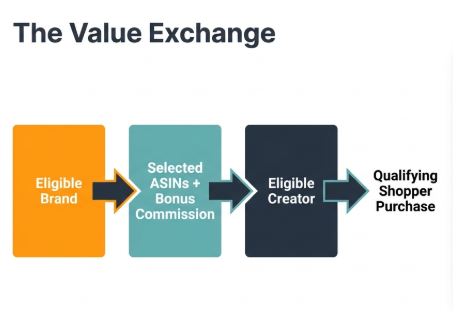
For teams asking how does Amazon Creator Connections work, the process is best understood as a five-stage operating cycle.
1. Define the objective and eligible products
Start with one measurable objective and select ASINs that support one coherent creator story, such as a skin-care routine, a pet grooming need, or a seasonal household use case.
Before adding an ASIN, confirm that:
-
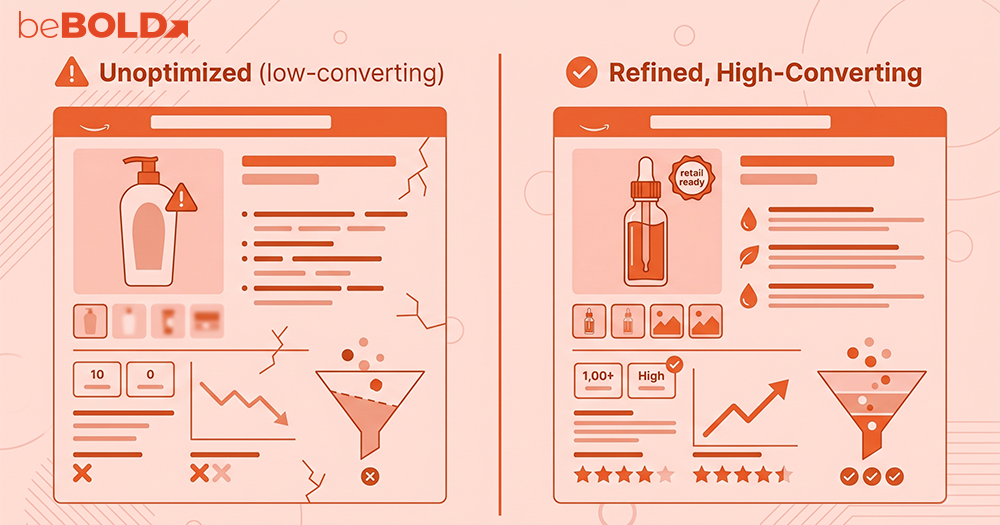
The product detail page is accurate and conversion-ready.
-
The Featured Offer and price are stable.
-
Inventory can support the campaign period and potential demand.
-
Product claims are substantiated and consistent across the listing, packaging, and creator guidance.
-
Variations and priority products are easy for a creator to understand.
Sending creator traffic to a weak detail page wastes the opportunity. Review Amazon listing optimization before increasing creator-led traffic.
2. Set the dates, commission, and budget cap
Amazon’s current campaign guide lists the following settings:
|
Setting |
Current requirement |
|
Bonus commission |
At least 10% |
|
Maximum commission budget |
At least $5,000 |
|
Campaign duration |
30 to 365 days |
|
Initial change window |
24 hours to edit or cancel before the campaign goes live |
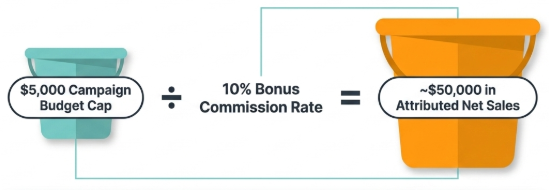
The wording around the budget matters. The $5,000 figure is the lowest budget ceiling Amazon allows, not an upfront charge. At a 10% commission, a $5,000 cap would be exhausted at approximately $50,000 in attributed net sales before adjustments. At 15%, the same cap would be reached at approximately $33,333.
Those figures are planning calculations, not forecasts. Actual commission spend depends on qualifying attributed sales and Amazon’s adjustments.
Choose the commission using contribution margin, not only Amazon’s minimum. Account for discounts, Amazon fees, fulfillment costs, returns, samples, labor, and other promotional expenses outside the Creator Connections commission.
3. Publish and review the campaign
Use Amazon’s current 24-hour change window for a final check of ASINs, claims, dates, commission, budget, and creator messaging. Do not treat post-launch editing as a substitute for approval because the settings that remain editable may be more limited.
Amazon can change program limits and interface behavior. The values above were checked against Amazon’s published guidance in August 2026, but the campaign owner should confirm them in the live account immediately before launch.
4. Eligible creators decide whether to participate
Creators choose which campaigns fit their audience and whether they want to join. In the standard workflow, a brand should not assume it can recruit a named creator, approve every participant, guarantee a post, or require a favorable opinion.
This is the most important control boundary in Creator Connections on Amazon: the brand publishes an opportunity, and eligible creators decide whether to act on it.
Brands that require specific talent, fixed deliverables, content approval, or licensed creative should use a separate direct agreement. The guide to finding Amazon influencers and storefronts covers that more controlled outreach path.
5. Monitor performance and reconcile final results
Review the campaign-level spend, attributed sales, orders, and clicks. Use only the additional product, creator, or other breakdowns that are actually available in the account or current export. Amazon can change reporting fields, and access may vary, so do not build an operating workflow around an unconfirmed metric.
Export the available data on a consistent schedule and track:
-
Commission spend and attributed sales.
-
Contribution margin after commissions, discounts, fees, fulfillment, and returns.
-
Conversion rate and performance by available ASIN or creator dimension.
-
Inventory effects and Featured Offer stability.
-
The difference between preliminary and adjusted results.
Amazon’s commission and reporting rules can adjust performance for shipment status, cancellations, returns, failed payments, and other qualification conditions. The Amazon Associates Program Policies explain the broader qualifying-purchase and session rules.
Sales alone are not enough to judge the campaign. Revenue can increase while contribution margin declines.
How to Build a Stronger Creator Connections Campaign
 Source: Pexels
The Amazon Creator Connections program works best when the campaign is designed around the creator’s decision, the shopper’s purchase journey, and the brand’s operating limits.
Build one understandable product story
Group products around one audience, routine, problem, or seasonal moment. A focused ASIN set is easier for a creator to evaluate than a mixed catalog with no shared use case.
|
Category example |
Strong campaign structure |
Important guardrail |
|
Beauty |
A cleanser, serum, and moisturizer from one routine |
Separate substantiated product facts from cosmetic or health claims that require evidence |
|
Pet |
Products tied to one grooming or care use case |
Clarify sizes, materials, cleaning instructions, warnings, and appropriate life stages |
These are hypothetical applications, not client results. Their purpose is to show how category conditions should change the brief and product selection.
Apply a margin-first decision framework
Amazon’s minimum settings determine whether a campaign can launch. They do not determine whether it is commercially sound.
beBOLD Digital’s recommended decision order is:
-
Margin: Can the product remain profitable after the proposed bonus commission and promotional costs?
-
Inventory: Can the brand support creator-driven demand without stocking out or compromising cash flow?
-
Listing conversion: Can the detail page convert the traffic the campaign may create?
-
Commission competitiveness: What rate can attract creator interest without breaking the first three conditions?
Model low, expected, and high attributed-sales scenarios. A strong campaign should remain operationally manageable at the high case and financially acceptable at the expected case.
Give creators useful facts without scripting their opinions
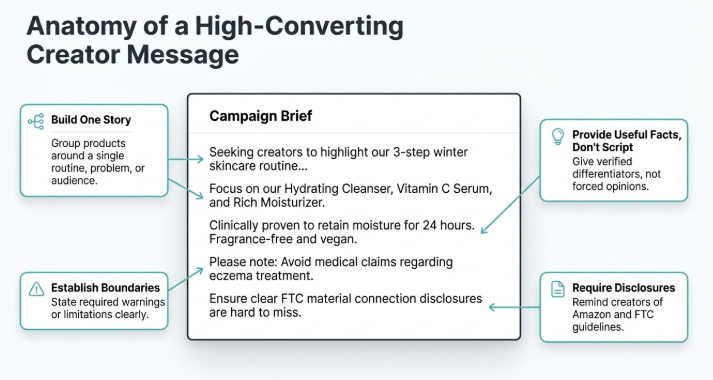
The creator message should help an eligible creator evaluate the campaign and describe the products accurately. Include:
-
The campaign goal and intended customer.
-
Priority ASINs and the use case connecting them.
-
Verified differentiators and approved factual claims.
-
Optional content ideas and demonstration boundaries.
-
Required warnings or limitations shown on the listing or packaging.
-
A monitored contact for factual questions.
-
A reminder to follow Amazon and Federal Trade Commission disclosure rules.
Guidance is not the same as editorial control. The FTC’s Disclosures 101 says material connections should be disclosed clearly and placed where they are hard to miss. It also warns against unsupported product claims, including claims that would require scientific evidence the advertiser does not have.
What Can Brands Control?
|
Brands can control |
Brands should not assume they control |
|
Eligible ASINs |
Which eligible creators choose to participate |
|
Campaign dates |
Whether a creator publishes content |
|
Maximum commission budget |
The creator’s honest opinion or exact presentation |
|
Bonus commission rate |
Prepublication review or approval |
|
Campaign message and factual product guidance |
Removal of published content after the campaign |
|
Internal monitoring and escalation |
Ownership, editing, paid usage, whitelisting, or reuse rights without a separate agreement |
Creator Connections is the stronger option when the primary objective is attributed sales with a defined commission cap. Direct creator partnerships are more appropriate when a brand needs named talent, guaranteed deliverables, approval terms, or reusable creative assets.
Important Considerations Before Launching
|
Consideration |
What the brand should decide before launch |
|
Participation |
Can the plan still work if few suitable creators join or publish? |
|
Total cost |
Does the margin model include samples, shipping, discounts, labor, inventory, and opportunity costs outside the commission cap? |
|
Brand safety |
Are the listing, factual guidance, claims, contact process, and escalation path ready for editorially independent content? |
|
Content rights |
Does the brand need a separate agreement covering editing, channels, duration, territory, paid amplification, or whitelisting? |
|
Content longevity |
Could published content remain accurate if packaging, pricing, inventory, or campaign claims change later? |
|
Compliance |
Are disclosures, product claims, warnings, and monitoring responsibilities clearly assigned? |
Creator participation does not automatically transfer copyright or broad usage rights to the brand. Ending the incentive also does not necessarily remove content a creator already published. Obtain appropriate legal guidance when content ownership, regulated claims, or endorsement compliance creates material risk.
Amazon Creator Connections Launch Checklist
-
Confirm the advertising account, Brand Registry role, permissions, and current feature access.
-
Define one measurable objective and the decision the results should inform.
-
Select coherent, retail-ready ASINs with stable inventory and substantiated claims.
-
Model contribution margin at the proposed commission and promotional price.
-
Confirm the current campaign limits and editable settings in the live account.
-
Prepare a concise creator message with verified facts, optional angles, guardrails, and a contact.
-
Decide whether separate content-usage agreements are needed.
-
Assign owners for communication, reporting, compliance, and inventory monitoring.
-
Review every setting within the initial change window.
-
Export the available reports consistently and reconcile adjusted results.
Is Creator Connections Right for Your Brand?
Creator Connections is a stronger fit when the brand has retail-ready listings, stable inventory, adequate margin, clear product claims, and a team capable of monitoring performance and creator communication.
It is a weaker fit when:
-
Inventory is fragile or the Featured Offer is unstable.
-
Product detail pages are underdeveloped.
-
Claims or product guidance are unclear.
-
The economics fail at Amazon’s minimum commission.
-
The primary goal is to obtain specific, reusable content from named creators.
For established brands, the central decision is not simply whether the account can open a campaign. It is whether the brand can absorb creator-driven demand profitably while protecting the shopper experience, inventory position, and brand standards.
Build a Creator Program Around Profitable Demand
Amazon supplies the campaign infrastructure, but the platform does not replace sound economics, retail readiness, creator strategy, or operational oversight.
If your team needs help planning, operating, and measuring Amazon creator campaigns, explore beBOLD Digital’s Amazon Affiliate Management services. A sustainable program connects creator incentives with listing conversion, inventory, compliance, and profitable growth. Contact our team today to learn more!
 Frequently Asked Questions
How much does Amazon Creator Connections cost?
Amazon currently requires at least a 10% bonus commission and a maximum campaign budget of at least $5,000. The budget is a commission-spend cap, not an upfront payment. Campaigns can currently run for 30 to 365 days. Samples, discounts, labor, and other operating costs sit outside the cap.
Can brands choose which creators join?
Eligible creators decide whether to join available campaigns. Brands should not assume they can approve every participant, require a preview, force publication, or guarantee positive coverage through the standard workflow. If named creators and fixed deliverables are essential, the brand needs a separate direct agreement.
Does Creator Connections guarantee sales?
No. Results depend on creator participation, publication, audience response, listing conversion, offer competitiveness, inventory, and product economics. A campaign can produce little activity or generate sales that are unprofitable after commissions, discounts, Amazon fees, fulfillment, returns, and operating costs.
Do brands own the content creators publish?
No, not by default. Participation does not automatically transfer ownership or grant broad reuse rights. Brands that want to edit, repost, advertise, whitelist, or use content across channels should obtain separate permission defining compensation, duration, territory, channels, and permitted modifications.
How long is the attribution window?
Amazon currently describes a 24-hour attribution window following a creator-link click. The broader Associates session may close earlier when the shopper orders or clicks another associate’s Special Link, while qualifying cart items can follow additional completion rules. Review current Amazon policies before using attribution data for forecasting.





Comments