


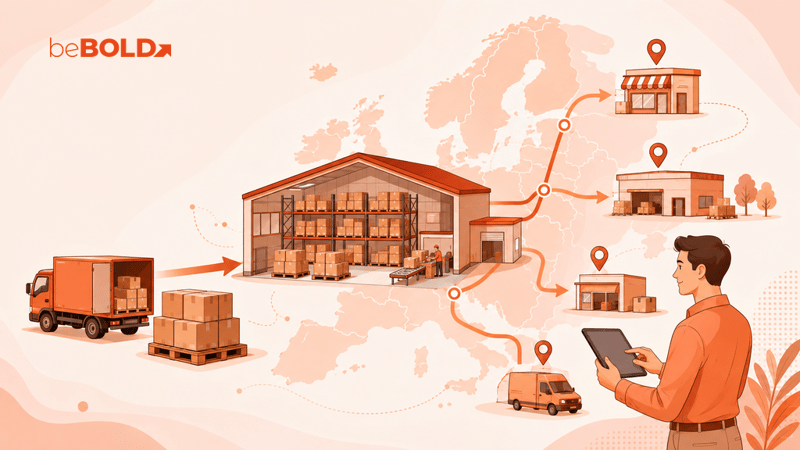
Amazon Warehousing and Distribution, or AWD, is now available in Germany, France, Italy, Spain, and the United Kingdom.
According to Amazon’s launch announcement, AWD provides flat-rate, long-term bulk storage in Amazon distribution centers. Amazon can then automatically move inventory into Fulfillment by Amazon facilities as demand changes.
The immediate benefit is additional capacity. Eligible inventory held in AWD remains outside normal FBA capacity constraints until it enters the fulfillment network. Sellers can therefore maintain a larger upstream reserve while keeping less stock inside higher-velocity FBA facilities.
The wider significance is control. FBA already manages customer-facing fulfillment. AWD gives Amazon a larger role in deciding when bulk inventory moves into that network.
For Amazon-focused brands, that integration could simplify replenishment and reduce manual shipment planning. It also concentrates more of the supply chain with one provider.
The Real Comparison Is AWD Versus the Full Inventory System

Source: Pexels
Sellers should not evaluate AWD by comparing its storage charge with an FBA or 3PL storage rate in isolation.
Amazon’s European AWD program policy identifies three main fee categories:
-
Monthly storage based on daily cubic volume
-
Inbound and outbound processing
-
Transportation from AWD to an Amazon fulfillment center
The relevant metric is the total cost per sellable unit after storage, processing, transportation, external preparation, and applicable tax or compliance costs are included.
Sales velocity also changes the calculation. A stable SKU that needs several months of buffer inventory may benefit from upstream storage. A fast-moving product that triggers frequent AWD-to-FBA transfers could accumulate more processing and transportation costs.
AWD should therefore be evaluated at the SKU level, not adopted automatically across an entire catalog. That analysis should form part of the brand’s broader Amazon inventory management strategy.
Amazon’s Q4 Promotion Creates a Testing Window, Not a Long-Term Verdict
Amazon will waive storage fees for eligible inventory held in European AWD distribution centers from October 1 through December 31, 2026. Inbound processing, outbound processing, and transportation fees will continue to apply at standard rates. Storage charges resume on January 1, 2027.
Amazon has also published two peak-season planning dates:
-
Inventory should arrive at AWD distribution centers by October 7, 2026.
-
Sellers should create an AWD-to-FBA replenishment shipment by October 10, 2026.
The promotion gives sellers a lower-cost window for testing AWD during a commercially important period. However, brands should not use promotional economics to justify a permanent supply-chain change.
The better test is whether AWD improves in-stock performance and total inventory economics once regular storage charges return.
Channel Flexibility and Reversibility Are the Hidden Tradeoffs

Source: Pexels
European AWD is currently designed primarily to replenish Amazon’s FBA network. Ecommerce News Europe reports that the capability available in the United States to supply external sales channels is not included in the initial European launch.
That distinction matters for brands selling through Shopify, other marketplaces, wholesale accounts, or retail partners. Moving too much inventory into AWD may leave less stock available for those channels.
Reversibility is another important consideration. Amazon’s European program policy states that self-service AWD inventory removal is not currently available in the European Union or United Kingdom. Sellers must contact Selling Partner Support, provide an eligible return address, and pay any applicable return charges.
Shipment preparation also remains the seller’s responsibility. AWD does not provide unit relabeling, and FBA and AWD shipments cannot be consolidated in the same truckload.
These limitations support a hybrid model. A regional 3PL can receive imports, inspect and prepare products, maintain an off-Amazon reserve, and forward selected inventory into AWD. The resulting structure can separate three roles:
-
The 3PL handles flexible reserve inventory and preparation.
-
AWD holds eligible bulk stock intended for Amazon.
-
FBA carries the quantities needed for customer fulfillment.

The Seller Decision: Pilot AWD With the Right SKUs
beBOLD Digital’s analysis suggests that the strongest AWD candidates will share several characteristics:
-
Predictable demand and replenishment patterns
-
Sufficient margin to absorb processing and transfer costs
-
Limited dependence on off-Amazon fulfillment
-
Compliant packaging and labeling before arrival
-
Enough sales history to forecast an appropriate buffer
A useful pilot should track more than storage savings. Sellers should measure inbound receiving time, AWD-to-FBA transfer time, in-stock rate, total logistics cost per unit, and the amount of inventory unavailable to other channels.
Beauty, wellness, baby, and pet brands should be especially careful when products require specialized preparation, have expiration considerations, or experience demand spikes tied to promotions and social media. Eligibility and handling requirements should be confirmed for each SKU before shipment.
beBOLD Digital’s Take: Optimize for Control, Not Just Convenience
AWD represents more than another Amazon storage option. It extends Amazon’s role further upstream, from customer fulfillment into bulk inventory positioning and replenishment.
That integration can be valuable, but convenience should not become uncontrolled dependence. Begin with a defined group of predictable SKUs, retain an external inventory reserve, and compare results after the Q4 promotion ends.
Brands that can see inventory, profitability, advertising, and replenishment as one operating system will be better positioned to decide where AWD belongs.
Need help coordinating those decisions across your marketplace operation? Explore beBOLD Digital’s Amazon account management services or contact our team for a quick call!

Sources
Amazon: Amazon Warehousing and Distribution Now Available in Europe
Amazon Warehousing and Distribution Program Policy
FLEX. Logistique: How to Use Amazon AWD With EU 3PLs
Forest Shipping: Amazon AWD Is Coming to Europe
Ecommerce News Europe: Amazon Launches Bulk Storage Service in Europe








Comments