


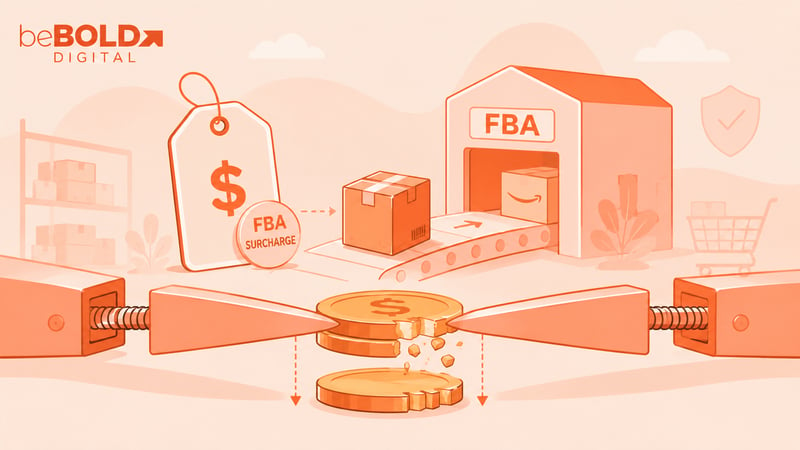
Low-ASP Products Are Feeling the Fee Stack First
Source: Pexels
Amazon’s low-price FBA economics are getting tighter.A 2026 Amazon update highlights a $0.38 per-unit surcharge now active for low-price FBA items, adding another cost layer for sellers already managing 2026 fulfillment fee changes. Public seller-news coverage has also reported a $0.38 per-unit impact on sub-$15 average selling price items, while Amazon’s own 2026 FBA fee pages confirm that fee math has become more segmented by product price, size, and fulfillment category.
Amazon’s official Low-Price FBA structure applies to products priced under $10, which automatically receive discounted Low-Price FBA fulfillment rates. In 2026, Amazon says those rates are $0.86 less on average than standard FBA rates. But that does not mean low-priced products are protected from margin pressure.
Since April 17, Amazon has also applied a 3.5% fuel and logistics-related surcharge to FBA fulfillment fees in the US and Canada. That surcharge is calculated on fulfillment fees, not the product’s selling price. For low-priced SKUs, even small per-unit changes can have an outsized effect because there is less room between selling price, COGS, referral fees, fulfillment fees, ads, and returns.
The Seller Lesson: A Cheap Product Is Not Automatically a Profitable Product
This update matters most for sellers with fast-moving, low-ticket products.
A $0.38 fee may look small at the unit level. At scale, it changes the math quickly. For a SKU selling 20,000 units per month, $0.38 per unit equals $7,600 in added monthly cost exposure. For a product with a $9.99 price point, that is not a rounding error. It can erase the room sellers were using for coupons, PPC, Subscribe & Save, or wholesale margin.
That is why sellers should treat this as a SKU profitability event, not just an operations update.
The categories most exposed are usually:
-
consumables
-
household goods
-
beauty accessories
-
small personal care products
-
low-priced bundles
-
lightweight products with high order volume
-
products priced close to the $10 or $15 threshold
For brands selling in these ranges, the right question is not “Are sales still growing?” It is “Are we still making enough per unit after the full Amazon fee stack?”
Sellers should rerun margin models using current fulfillment fees, surcharge impact, referral fees, promo costs, and ad spend. beBOLD’s Amazon FBA fee calculator is a useful starting point for checking how small fee changes flow through net margin. For a broader view of this year’s cost environment, see beBOLD’s guide to Amazon’s 2026 fee changes.
Pricing, Packaging, and Fulfillment Need Another Look

Source: Pexels
Low-price FBA sellers should not respond with a blanket price increase.
Some ASINs may support a small price adjustment. Others may lose conversion if the price crosses a shopper’s mental threshold. The better move is to review each SKU based on margin, demand, conversion rate, and fulfillment economics.
Sellers should look for products where:
-
packaging size or weight can be reduced
-
bundles can lift average order value
-
PPC targets no longer support the new break-even point
-
FBM or 3PL fulfillment may work for certain channels
-
coupons are driving volume but not profit
-
underperforming SKUs should be paused, repriced, or retired
This is especially important before Q4. A low-price product that looks healthy in July can become much less attractive once holiday ad costs, inventory pressure, and fulfillment constraints increase.
beBOLD Digital’s take
The $0.38 per-unit impact is a warning sign for low-price Amazon sellers: fee changes do not need to be dramatic to damage profitability.
The brands that respond best will not simply chase more sales. They will rebuild their SKU-level economics, adjust ad break-even points, and decide which products still deserve inventory, budget, and promotion support.
If Amazon’s latest FBA fee changes are putting pressure on your margins, beBOLD Digital can help you review pricing, fulfillment, PPC, and marketplace growth strategy. Connect with beBOLD’s Amazon account management team for a consultation.
Sources
Amazon Seller Central, “2026 US Low Price FBA fulfillment fee "
Amazon Seller Central, “2026 US FBA fulfillment fee changes "
SEONIB, “Amazon FBA Seller News July 2026: Fee Hikes, Ad Billing Shift, and EU Duty Impact"








Comments