


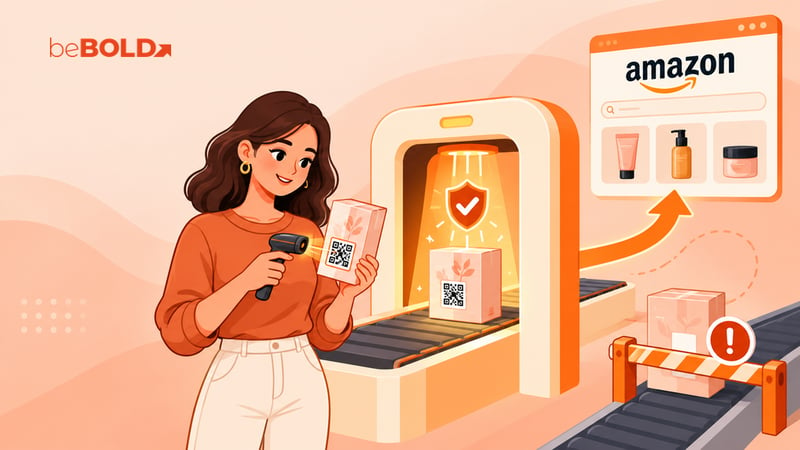
Valid Codes Are Required Once Transparency Protection Is Active
For brands reviewing Amazon Transparency code enforcement 2026, the central requirement is straightforward: once a product is protected, every unit listed or shipped in a supported Amazon store needs a valid code matching that product. This applies to both Fulfillment by Amazon (FBA) and seller-fulfilled orders.
An October 13, 2026, article from T-Code Manager highlights what happens when units ship without valid codes. However, neither that article nor Amazon’s public program page announces a new enforcement deadline.
That distinction matters when assessing claims that affected units “will be marked unsellable.” Amazon confirms that missing or invalid codes can block shipment and listing, but its public guidance does not specify the inventory classification or resolution process for every failed unit.
For more background on enrollment and serialization, see beBOLD Digital’s Amazon Transparency program guide.
FBA and Seller-Fulfilled Orders Have Different Verification Steps

For FBA, Amazon scans Transparency codes when units arrive at its fulfillment centers. For self-fulfilled orders, sellers provide codes at order confirmation in Seller Central.
Amazon says it investigates failed checks and notifies the brand. Transparency performance reporting includes blocked shipments, product-code mismatches, and rejected listing attempts. Protection becomes active after a product passes its operational performance review.
A missing label is only one potential problem. T-Code Manager also identifies duplicate codes, codes assigned to another product, damaged labels, and incorrectly entered codes as failure points. For inventory already affected, it recommends contacting the appropriate Amazon support team rather than assuming a standard remedy.
Resellers should also confirm that incoming inventory carries the brand’s valid codes before committing it to an Amazon shipment.
Check Code Readiness Before Sending More Inventory
The commercial risk is a gap between physical stock and inventory available to sell. Products cannot support a promotion if verification problems prevent fulfillment.
To prepare for Amazon Transparency code enforcement 2026, beBOLD Digital recommends adding these checks to shipment approval:
-
Confirm protection status: Identify which products have active protection and which remain in review.
-
Verify the product match: Ensure codes belong to the exact product being packed.
-
Inspect label quality: Check that codes remain visible, intact, and scannable after packing.
-
Control code allocation: Track assigned codes so separate packing stations do not reuse them.
-
Document affected stock: Record the ASIN, shipment or order, quantity, and error details before contacting support.
For beauty brands, prioritize products with similar cartons, sizes, or variations. Applying a code to the wrong product can disrupt availability even when the merchandise is authentic.
beBOLD Digital’s Take: Verify Inventory Before Increasing Demand
Treat Transparency readiness as part of inventory and promotional planning. Before increasing advertising budgets or committing protected products to a deal, check code coverage and unresolved verification issues. This helps teams plan around stock that can actually support customer orders.
If code-related issues are disrupting availability, beBOLD Digital’s Amazon account management services can help coordinate inventory monitoring, account issue follow-up, and growth planning around sellable stock.







Comments