


To build an Amazon growth plan for an established beauty brand, define your goals, identify product bottlenecks, and prioritize investments with dedicated budgets, owners, and success metrics. At beBOLD Digital, we start by targeting where effort yields the highest impact—whether improving search visibility for top sellers or optimizing conversion on product pages.
Our Amazon marketing services for premium beauty brands connect these decisions. Here’s how we recommend choosing Amazon marketing strategies for beauty brands based on what your business needs next.
Set Growth Targets That Leave Room for Profit
Before assigning budgets, decide what you want to achieve over the next 12 months. Define:
-
How much you want sales to grow.
-
How much profit you need to keep after the costs of those sales.
-
How much you can invest in testing new ideas.
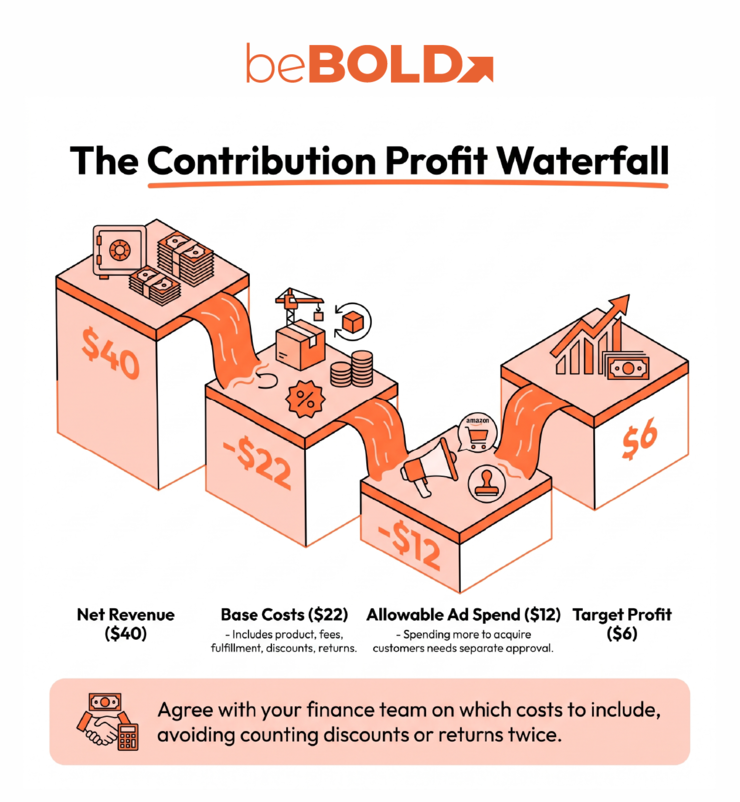
For this plan, we use contribution profit to describe what remains after costs such as the product itself, Amazon fees, fulfillment, discounts, returns, and advertising. Agree with your finance team on which costs to include, and avoid counting discounts or returns twice if they’re already reflected in net revenue.
For example, a beauty product brings in $40 in net revenue and costs $22 before advertising. That leaves $18. To keep $6, you can spend $12 on advertising per order. Spending more to acquire customers needs separate approval.
Our Henkel Professional Beauty case study reports 30% higher total sales following a plan combining campaign changes, listing optimization, A+ Content, and organic discovery improvements.
Set different expectations for reaching shoppers who already know your brand and introducing it to new customers.
Find Out What Is Holding Each Product Back
Before investing more, work out why sales are falling short. Are shoppers struggling to find the product, visiting without buying, or facing stock or pricing problems? Here’s what you should do first:
-
Review sales alongside ad performance, customer feedback, stock, and profit per order.
-
Choose a period that reflects typical sales activity, noting promotions or stockouts that could distort the picture.
-
Review individual ASINs, Amazon’s product identifiers, including separate shades, sizes, or packs. A bestselling foundation shade can hide another shade’s poor performance.
-
Use this table to assign product roles, and note that a product can fit more than one category:
|
Product role |
What to check |
Where to invest next |
When to increase spending |
|
Bestseller or hero product |
Reliable sales, profit, and stock |
Maintain availability and test wider reach |
Extra spending delivers acceptable returns |
|
Product with limited visibility |
Visitors buy, but too few find it |
Improve search visibility or test advertising |
Added traffic produces worthwhile sales |
|
Product shoppers hesitate to buy |
Weak ad results or recurring questions |
Fix content, the offer, or product issues |
Main buying problems are addressed |
|
Product customers reorder |
Repeat purchases and predictable usage |
Consider subscriptions and routine recommendations |
Discounts and stock commitments make financial sense |
|
New launch |
Clear purpose but little sales history |
Run a test with a spending limit |
Results justify further investment |
Focus on products your team can realistically support. If you want a more in-depth guide, here’s our beauty retail-readiness guide that helps you assess readiness for paid traffic. Record the next action, cost, and anything that must happen first.
Keep Your Brand Consistent Across Sales Channels
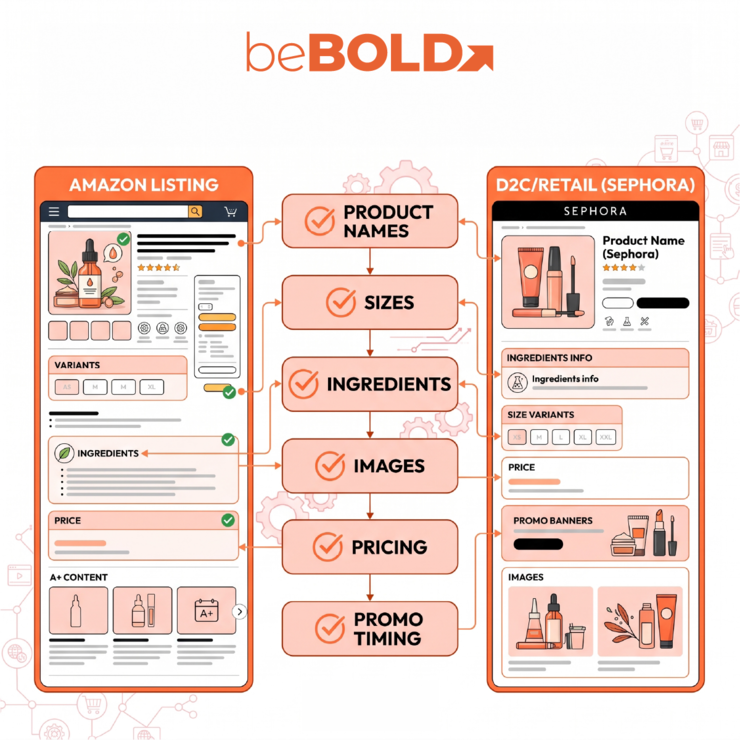
Before reaching more shoppers, check what they’ll find across Amazon, your website, and retail partners. Product names, sizes, ingredients, images, and brand messaging should accurately describe the same product. Review pricing and promotion timing together too.
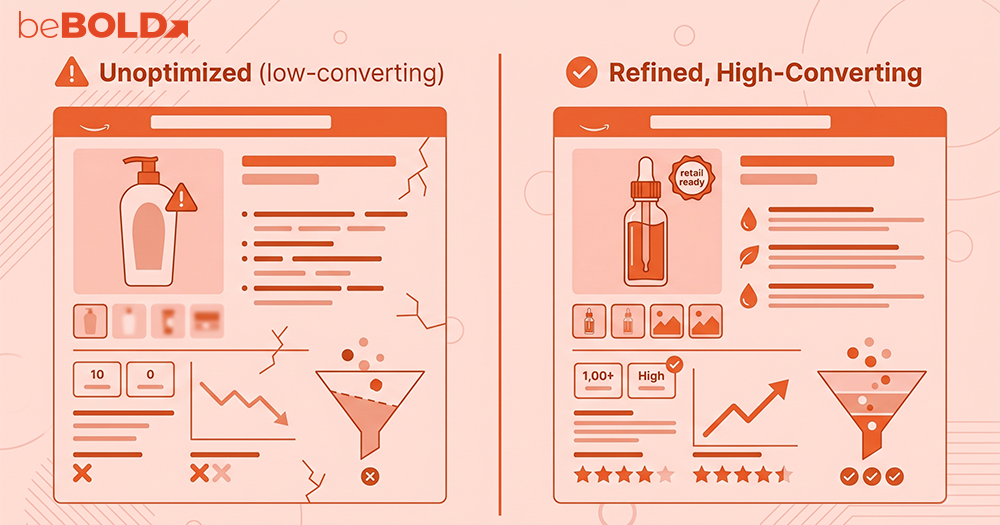
Our Sephora-distributed beauty brand case study reported incorrect product details, inconsistent images, and pricing differences. After addressing pricing and content across channels, we saw a 40% overall growth within six months. That result covers the wider business rather than Amazon alone.
Give someone responsibility for keeping product information accurate and coordinating promotions. Confirm access to relevant Amazon Brand Registry tools, and use the appropriate reporting process when you suspect an intellectual property violation.
Brand Registry provides protection tools but doesn’t automatically exclude other sellers. Amazon states that brand representatives cannot require every reseller to submit a letter of authorization before creating an offer. Keep track of where your products are sold.
Help Shoppers Understand Your Products Before Spending More

If shoppers are visiting a product page but hesitating, check whether they have enough information to choose. In beauty, that often means understanding shade, texture, scent, ingredients, application, or where the product belongs in a routine.
Read Customer Feedback, Check Mobile Compatibility
Read customer feedback, then review the page on your phone. Can shoppers find answers quickly? A gentle cleanser still needs suitability and usage information. A professional hair treatment may need an application demonstration.
Choose Content that Answers the Buying Question
Review existing content and figure out what buyers are looking for.
-
Use swatches to help shoppers select a shade.
-
Use texture photography to show the product’s finish.
-
Use video to demonstrate how to apply it.
-
Use A+ Content for beauty brands, such as product comparisons and routine explanations, to help shoppers understand their options.
Consider Using Premium A+ Content
Consider Premium A+ when your products are eligible and its extra features would help answer questions your current content cannot address well.
In our established premium beauty brand case study, we addressed a sales plateau through product-page improvements, search engine optimization (SEO), imagery, and advertising, including Amazon’s ad-buying platform, Amazon DSP. The case doesn’t separate each tactic’s contribution to growth.
Our beauty listing-optimization guide covers the detailed work. For eligible products needing early feedback, consider Amazon Vine. Its reviewers provide independent opinions, so positive reviews are never guaranteed.
Choose Marketing Channels Based on the Product and Goal
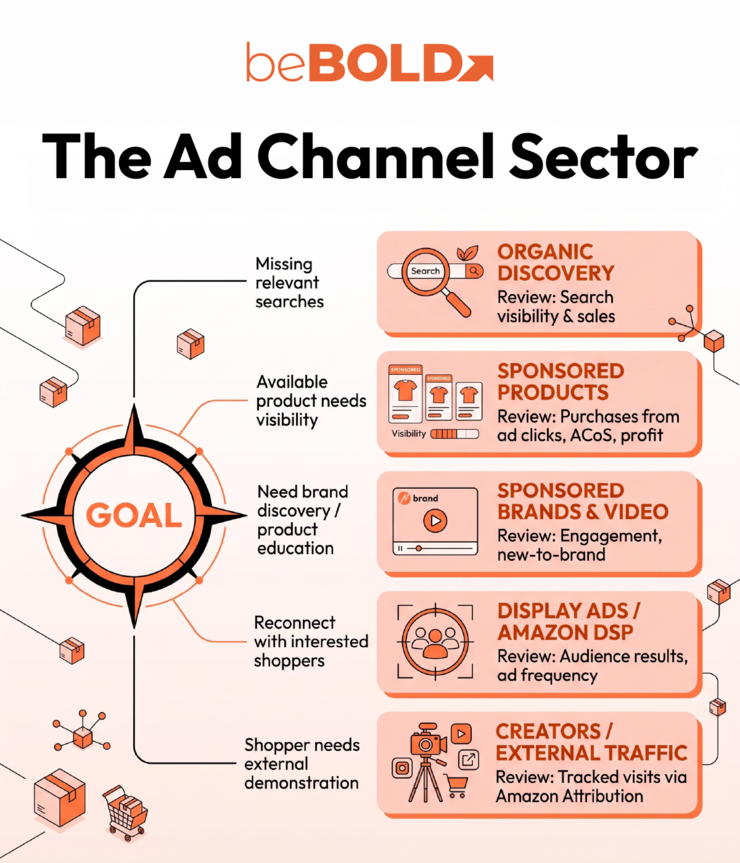
Choose a channel to solve a specific problem. A bestseller may need wider reach. A new launch may need a small test to establish whether shoppers will buy at an acceptable advertising cost.
We recommend giving each channel a clear job:
|
Marketing option |
When it may help |
What to review next |
|
Organic discovery |
Products aren’t appearing for relevant searches |
Search visibility, visitors, and sales |
|
Sponsored Products |
An available product needs more visibility |
Purchases from ad clicks, cost per order, and profit |
|
Sponsored Brands and video |
Shoppers need brand discovery, product education, or Store visits |
Engagement, new-to-brand customer results where available, and purchases |
|
Display ads or Amazon DSP |
Reach new audiences or reconnect with interested shoppers |
Audience results, ad frequency, and additional sales where measurable |
|
Creators or traffic from outside Amazon |
Shoppers need a demonstration before visiting Amazon |
Tracked visits and purchases, plus marketing costs |
Sponsored Brands can send shoppers to your Store or product pages. Match the destination to the ad: a skincare-routine ad needs a routine page; a serum demonstration needs an easy path to that serum.
Amazon now includes Sponsored Display in its broader display ads offering. Before investing in display or Amazon DSP, decide whom you want to reach, what content you’ll show them, and how you’ll judge the outcome.
Before launching a test, write down:
-
How much you can spend.
-
What result would count as success.
-
When you’ll review performance.
-
What would make you pause or stop.
Pause spending increases if advertising costs exceed your limit or stock becomes tight. If results are unclear, gather enough information before making a bigger commitment.
Our beauty Amazon SEO guide and Amazon PPC audit explain the detailed work. For eligible external campaigns, use Amazon Attribution to track associated Amazon shopping activity.
Help Customers Reorder and Build a Routine

Give repeat purchases their own place in the growth plan. A moisturizer customers use every day offers different opportunities from a gift set they buy occasionally.
For eligible products, consider Subscribe & Save. Before investing, check the discount you’ll fund, the profit left on each order, and whether you can reliably supply repeat deliveries. Review actual repeat purchases too. Our beauty Subscribe & Save guide explains the program in more detail.
Help customers understand how products fit together. Explain where the cleanser, treatment, and moisturizer belong in a routine, and which steps are optional. Recommendations should make sense for the shopper and their needs.
Use your Amazon Brand Store to show related products and routines. Allow time for customers to use up and reorder products before judging results.

Turn Your Priorities Into a 90-Day Plan
A useful Amazon growth plan makes it clear what happens next and who is responsible. Use this 90-day template to organize the work while continuing activities that are already performing well.
Days 1–30: Understand the Problems and Fix the Essentials
-
Review current sales, profit, and marketing performance. Select priority ASINs and identify the main issue for each.
-
Correct important product-information errors, buying problems, and stock issues.
-
Agree on spending limits and decide which images, videos, or page updates your tests need.
Days 31–60: Test Your Selected Ideas
Run a manageable number of tests, each with a clear question. For example, a hypothetical serum test could ask whether better texture and application images help more ad visitors buy at an acceptable cost. Track promotions, price changes, and anything else that might affect the result.
Days 61–90: Decide Where to Invest Next
Increase investment where results meet your targets and stock can support more orders. Change or stop tests that aren’t working. Keep gathering information when it’s too early to judge, and update stock forecasts before increasing demand.
Use a planning record like this hypothetical example for each priority:
|
What to record |
Example |
|
Priority |
Help more ad visitors buy a hero serum |
|
Who is responsible |
Ecommerce lead, supported by creative and advertising teams |
|
What must happen first |
Accurate application guidance and enough stock available to sell |
|
Budget |
Approved content-production cost plus a separate ad-test limit |
|
Success measures |
Advertising cost per order and contribution profit after ads |
|
Review date |
End of the agreed test period, with weekly checks |
|
Next decision |
Increase investment if targets hold; adjust or pause if limits are exceeded |
Connect the 90-day plan to your annual calendar. Include launches, the time needed to replenish stock, seasonal demand, and commitments to retail partners. Before approving a promotion, account for discounts, fees, and the stock it may require. Good marketing results still need reliable supply.
Review What Is Working and Decide What Comes Next
Look at the whole Amazon business alongside individual campaign reports. Sales attributed to advertising are orders a campaign receives credit for under its reporting rules. That doesn’t prove every order would have been lost without the ad.
We recommend tracking:
-
Total Amazon sales and contribution profit after advertising.
-
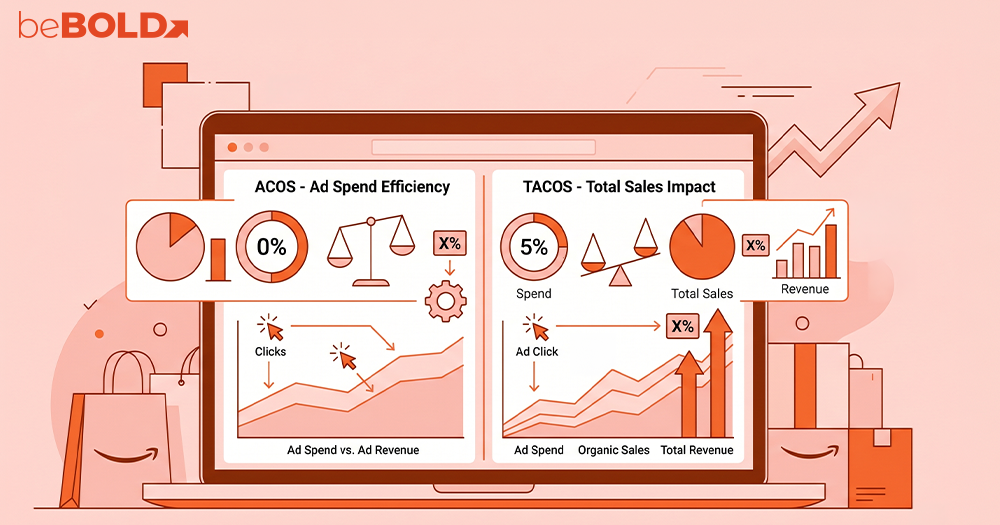
Advertising Cost of Sales (ACoS): ad spend divided by sales attributed to ads, expressed as a percentage.
-
Total Advertising Cost of Sales (TACoS): ad spend divided by total Amazon sales, expressed as a percentage. Use the same products, marketplace, and reporting period for both figures.
-
How often ad clicks lead to purchases, advertising cost per order, and new-to-brand results where available.
-
Repeat purchases, returns, and stock coverage for priority products.
A lower TACoS doesn’t automatically mean you’re making more money. Discounts, fees, returns, and changes in which products sell can affect profit. Also check that reports use consistent sales definitions and periods before comparing them.
Use Amazon Brand Analytics alongside sales, advertising, and inventory reports to understand changes.
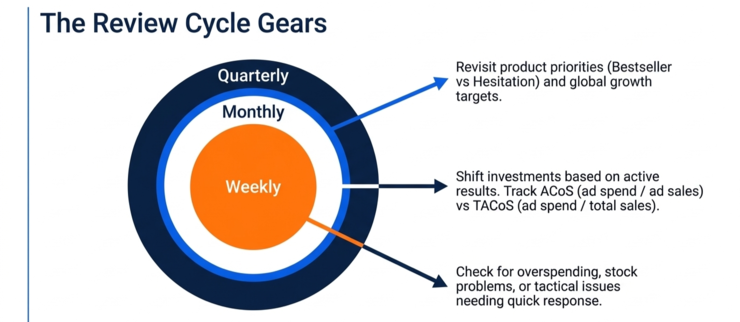
Set a regular review schedule:
-
Weekly: Check for overspending, stock problems, or other issues needing a quick response.
-
Monthly: Decide where to move investment based on results and what you’ve learned.
-
Quarterly: Revisit product priorities and your annual growth targets.
Finish each review with a decision to continue, invest more, adjust, pause, or investigate. Record why you made that choice and who will act on it.
Build the Next Phase of Your Beauty Brand’s Amazon Growth
At beBOLD Digital, we recommend choosing your next investment based on what your products need, what the results tell you, and what your team and stock can support. Our beauty case studies show how content, advertising, and consistency across sales channels can work toward the same goal.
Need help putting the plan into action? Explore our Amazon marketing services for beauty brands. We can connect your product priorities with content, advertising, account management, and reporting, with clear responsibility for the work ahead.
Frequently Asked Planning Questions
Should Every Beauty ASIN Receive the Same Investment?
Give each product a budget that reflects its demand, profit potential, stock, and role in your range. A niche shade might need accurate content and reliable availability without a large ad budget. Decide what success looks like for that product before judging its performance.
How Should a Beauty Brand Fund a New Launch Alongside Its Hero Products?
Set aside a limited launch-test budget with clear learning goals. Keep supporting the stock and effective marketing your bestsellers need. Add launch funding when results justify it, or when a documented business goal gives you a clear reason to keep testing.
When Should an Established Beauty Brand Bring In an Amazon Agency?
Consider help when your team struggles to coordinate the work growth requires. That might mean ads running ahead of content updates, unresolved catalog issues, or reports that don’t explain profit. Agree on responsibilities, decision-making authority, and review expectations before hiring an agency.



Comments