



Europe Adds a New Contextual Ad Surface Inside ChatGPT
OpenAI is expanding advertising to eligible ChatGPT Free and Go users in Europe later in August.
At launch, ads will not be personalized in the European Economic Area or Switzerland. Selection will initially use signals such as the current conversation, general location, device type, advertiser targeting, landing-page content and bids. Past conversations and stored memories will not be used during the initial European rollout.
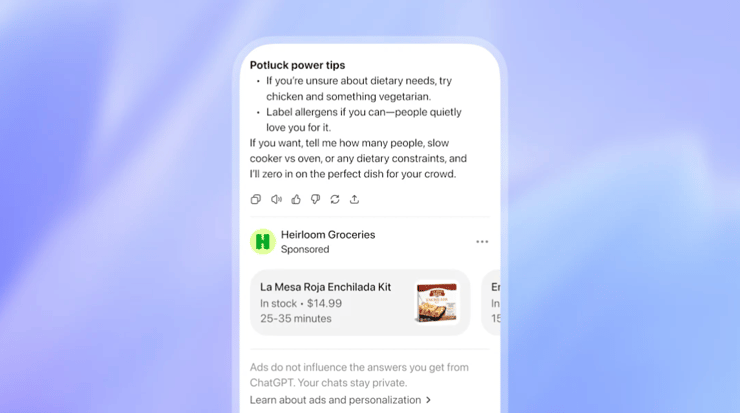
Ads can appear below ChatGPT responses as clearly labeled sponsored placements. Plus, Pro, Business, Enterprise and Education accounts are excluded, along with users identified as under 18 and Temporary Chats.
OpenAI’s documentation also identifies OAI-AdsBot, a crawler used to review advertiser landing pages for safety and determine when those pages may be relevant. That makes landing-page clarity more than a conversion consideration. It may also affect campaign eligibility and contextual matching.
Paid Reach Does Not Replace Organic AI Visibility

Source: Pexels
The rollout arrives alongside a separate dispute over how AI platforms access publisher content.
TollBit data covering the first half of 2026 found that roughly 15% of identified AI page fetchers reached URLs European websites had marked as disallowed. PPC Land reported that ChatGPT-User, Bytespider and YouBot each accessed disallowed pages on nearly half of the European sites that specifically named them in robots.txt.
OpenAI distinguishes ChatGPT-User from OAI-SearchBot and GPTBot. OAI-SearchBot supports visibility in ChatGPT search, while GPTBot is used for model training. ChatGPT-User retrieves pages in response to user requests, and OpenAI states that robots.txt rules may not apply to those visits.
For brands, the distinction matters. Blocking OAI-SearchBot can reduce the opportunity to appear in ChatGPT search answers, while allowing it does not guarantee a recommendation. Paid placement also does not replace the product data, authority and third-party validation needed for organic ChatGPT product discovery.
Cloudflare is responding with behavior-based controls for Search, Agent and Training crawlers. Beginning September 15, 2026, it plans to block Training and Agent crawlers by default on ad-supported pages for newly onboarded domains while continuing to allow Search.
Ecommerce Brands Need a Separate ChatGPT Ads Readiness Plan
Source: OpenAI
Amazon brands should avoid copying Amazon PPC campaigns directly into ChatGPT. Conversation-led discovery creates a different targeting and creative environment.
Before testing ChatGPT ads, brands should:
- Confirm product feeds, pricing and availability are accurate.
- Build landing pages that answer specific shopper questions clearly.
- Create ad copy around use cases and customer intent, not only keywords.
- Separate ChatGPT traffic in analytics and conversion reporting.
- Establish benchmarks for assisted conversions, new-to-brand traffic and downstream Amazon sales.
- Review category restrictions, especially for health, financial, political and other sensitive topics.
Brands should also continue investing in GEO for Amazon sellers. Paid visibility can create immediate reach, but organic AI recommendations may influence shoppers before they see an ad or visit Amazon.
beBOLD Digital’s Take: Build One Measurement System Across AI and Amazon
ChatGPT ads give ecommerce brands another high-intent discovery surface, but early campaigns should be treated as controlled tests. Start with a limited product set, map the path from ChatGPT to the landing page and Amazon, and compare performance against existing paid and organic channels.
beBOLD Digital helps established marketplace brands connect emerging discovery channels with profitable Amazon PPC management. Contact our team to build an advertising and measurement strategy that supports growth across AI search and Amazon.
 Sources
PPC Land: ChatGPT ads reach Europe as its own crawler ignores publisher blocks
OpenAI: Overview of OpenAI Crawlers
TollBit: State of the Bots, 2026 Q1 and Q2
Cloudflare: Your site, your rules: new AI traffic options for all customers









Comments