


The top beauty brands in 2026 include global leaders like L’Oréal and Estée Lauder, viral brands like Fenty Beauty and Sol de Janeiro, and clinical skincare leaders like CeraVe and La Roche-Posay. Today, brand leadership is defined by revenue, search demand, social influence, and marketplace performance. This guide breaks down the best cosmetic brands and what drives their success across Google, Amazon, and AI search, with added context from Gen Z’s impact on beauty industry trends.

Key Summary
- The top beauty brands in 2026 include a mix of global revenue leaders, viral beauty brands, and clinical skincare brands with strong search visibility.
- The top beauty companies account for more than half of total global beauty revenue, showing how concentrated the market remains.
- Skincare continues to dominate category growth and remains the largest segment in beauty, especially for clinical and ingredient-led brands.
- Search visibility now plays a major role in brand leadership, especially across Google, TikTok, and Amazon.
- Brands like L’Oréal and Estée Lauder lead in revenue, while brands like Fenty Beauty, Sol de Janeiro, and Charlotte Tilbury lead in digital attention.
- Clinical skincare brands such as CeraVe, La Roche-Posay, and The Ordinary continue to gain traction because they align with ingredient-led search behavior.
- Fast-growing brands such as Rare Beauty, Glow Recipe, Byoma, Bubble, and Rhode are gaining share through focused assortments and strong digital marketing.
- Beauty brands that want to compete in 2026 need a strategy that combines SEO, marketplace execution, reviews, and strong brand positioning. This is especially important as newer audiences like Gen Alpha reshape the market
What Are the Top Beauty Brands by Category?
To better understand the landscape, here are the top beauty brands in the world segmented by performance type, including their performance metrics and market positioning.
|
Brand |
Category |
Why It Performs Well |
What Sellers Can Learn From Its Marketing |
|
L’Oréal |
Global beauty leader |
Broad portfolio across skincare, haircare, makeup, and dermatological beauty |
Sellers can learn to build category depth while using data and R&D to support product claims. |
|
Estée Lauder |
Prestige beauty |
Strong luxury positioning, brand equity, and global retail presence |
Sellers can learn to use premium storytelling, trust signals, and consistent branding to justify higher price points. |
|
Procter & Gamble |
Mass and premium skincare |
Global distribution with proven product innovation across brands like Olay and SK-II |
Sellers can learn to balance accessibility with science-backed positioning. |
|
Unilever |
Personal care and clinical skincare |
Scales mass-market brands while expanding into digital-first skincare through acquisitions like Paula’s Choice |
Sellers can learn to pair broad distribution with niche, high-intent product positioning. |
|
Sol de Janeiro |
Viral body care |
Uses scent, lifestyle branding, and hero products to drive social demand. |
Sellers can learn to make one strong hero product memorable through sensory branding and repeatable messaging. |
|
Fenty Beauty |
Inclusive makeup |
Inclusive beauty positioning and strong cultural relevance |
Sellers can learn to differentiate through underserved customer needs instead of generic product claims. |
|
Charlotte Tilbury |
Luxury makeup and skincare |
Turns glam-focused products into highly recognizable routines and bundles |
Sellers can learn to package products around outcomes, routines, and aspirational use cases. |
|
Glossier |
DTC-first beauty |
Built a strong community around minimal, skin-first beauty |
Sellers can learn to use customer voice, community feedback, and simple messaging to strengthen loyalty. |
|
e.l.f. Cosmetics |
Value cosmetics |
Combines affordability, trend speed, and highly effective TikTok marketing |
Sellers can learn to move quickly on trends while keeping pricing and value clear. |
|
CeraVe |
Clinical skincare |
Aligns dermatologist credibility with ingredient-led search demand. |
Sellers can learn to build content around functional ingredients and problem-solution keywords. |
|
La Roche-Posay |
Dermatological skincare |
Strong clinical trust in sensitive skin and sunscreen categories. |
Sellers can learn to reinforce credibility through expert-backed claims and clear use cases. |
|
Eucerin |
Sensitive skin care |
Pharmacy trust and a strong reputation for efficacy |
Sellers can learn to prioritize trust, consistency, and clinically grounded messaging. |
|
The Ordinary |
Ingredient-led skincare |
Makes active ingredients easy to understand and affordable |
Sellers can learn to simplify complex product education and make pricing feel transparent. |
|
Rare Beauty |
Purpose-driven makeup |
Connects strong product performance with mission-led branding |
Sellers can learn to build emotional connection without losing focus on product quality. |
|
Glow Recipe |
Viral skincare |
Combines visual branding, fruit-based positioning, and strong retailer partnerships |
Sellers can learn to design products and content that are both visually memorable and benefit-driven. |
|
Byoma |
Barrier repair skincare |
Focuses on a clear skin concern at an accessible price point |
Sellers can learn to own a specific problem category instead of trying to appeal to everyone. |
|
Bubble |
Gen Z skincare |
Offers simple routines, affordable pricing, and strong retail accessibility |
Sellers can learn to reduce purchase friction through clear routines and easy-to-understand product roles. |
|
Rhode |
Minimalist skincare |
Focuses on a tight SKU lineup supported by strong influencer demand |
Sellers can learn to scale through focused launches rather than overextending the product catalog. |
|
MAC Cosmetics |
Professional makeup |
Strong artist credibility and a wide shade/product range |
Sellers can learn to build authority by serving both professionals and everyday consumers. |
|
Maybelline |
Mass-market makeup |
Affordable, widely distributed, and quick to respond to trends |
Sellers can learn to pair accessibility with trend relevance to drive volume. |
|
NARS |
Prestige makeup |
Combines artistry, performance, and luxury positioning |
Sellers can learn to create hero products with strong names, clear benefits, and lasting recognition. |
|
Dior Beauty |
Luxury beauty |
Leverages luxury brand equity across makeup, skincare, and fragrance |
Sellers can learn to maintain premium consistency across packaging, visuals, and product experience. |
|
Too Faced |
Trend-driven makeup |
Uses playful branding and recognizable hero products |
Sellers can learn to make brand personality a conversion asset when it matches the target audience. |
Who Are the Global Beauty Leaders Today When It Comes to Revenue?

These brands lead the industry by sheer scale. Their size, product breadth, and global reach continue to shape what the top cosmetic brands in the world look like in 2026.
L’Oréal
- HQ: France
- Price Range: $10–$300+
- Signature Products: CeraVe Moisturizing Cream, Lancôme Advanced Génifique
L’Oréal is a global beauty conglomerate spanning skincare, haircare, makeup, and dermatological brands, generating over €43.48 billion in annual revenue as of 2024. Its dermatological beauty division has been growing and has exceeded €7 billion and now represents a significant share of total revenue.
Why it’s performing well: Diversified brand portfolio and heavy investment in R&D, particularly in dermatological skincare, which continues to drive high-margin growth
Estée Lauder
- HQ: USA
- Price Range: $25–$400+
- Signature Products: Estée Lauder Advanced Night Repair, La Mer Crème de la Mer
Estée Lauder is a prestige skincare, makeup, and fragrance brand that remains a powerhouse with approximately $14.2 billion in annual revenue, though it saw a decline of around 8% in recent fiscal periods due to Asia travel retail slowdowns.
Why it’s performing well: Strong brand equity in luxury skincare and consistent demand across global retail channels.
Procter & Gamble (Olay, SK-II)
- HQ: USA
- Price Range: $10–$250+
- Siure Products: Olay Regenerist Cream, SK-II Facial Treatment Essence
P&G delivers mass to premium skincare with strong global penetration. It generates around $14 to 15 billion in beauty revenue annually, with its beauty segment contributing roughly 18 to 20% of total company revenue.
Why it’s performing well: Strong mass-market penetration and consistent product innovation across skincare categories
Unilever (Dove, Paula’s Choice)
- HQ: UK/Netherlands
- Price Range: $5–$60+
- Signature Products: Dove Body Wash, Paula’s Choice 2% BHA Liquid Exfoliant
Unilever offers mass personal care and clinical skincare. It generates over $25 billion in beauty and personal care revenue, with its Beauty & Wellbeing division growing by around 7-8% year over year.
Why it’s performing well: Ability to scale globally while also acquiring high-growth, digital-first brands like Paula’s Choice
These companies consistently rank as the top cosmetic brands in the world due to scale, R&D investment, and global distribution.
What Are the Most Searched & Viral Brands?

This group reflects brands that have built momentum through search demand, social buzz, content creation, and strong digital visibility. In many cases, they outperform larger brands in consumer attention.
Sol de Janeiro
- HQ: USA
- Price Range: $20–$60
- Signature Products: Brazilian Bum Bum Cream, Cheirosa 62 Mist
Sol de Janeiro is a body care brand known for their scent-led, lifestyle-driven products. This beauty brand has experienced triple-digit growth in recent years, with some estimates suggesting over 150% year-over-year growth driven by TikTok virality and strong Amazon sales rankings.
Why it’s performing well: Hero product strategy and strong emotional branding that resonates with younger audiences.
Fenty Beauty
- HQ: USA
- Price Range: $20–$60
- Signature Products: Pro Filt’r Foundation, Gloss Bomb
Well known for its inclusivity-centered products, Fenty Beauty generates over $600 million annually and has achieved over 40 million social media followers across platforms, reinforcing its global reach.
Why it’s performing well: Inclusivity and its ability to consistently create viral product moments
Charlotte Tilbury
- HQ: UK
- Price Range: $30–$200
- Signature Products: Pillow Talk Lipstick, Magic Cream
Charlotte Tilbury is a luxury makeup and skincare brand focused on glam results. It has surpassed $1 billion in revenue and consistently ranks among the top 5 most searched beauty brands globally, with strong conversion rates in eCommerce.
Why it’s performing well: Strong digital marketing, high-converting product bundles, and premium positioning
Glossier
- HQ: USA
- Price Range: $12–$40
- Signature Products: Boy Brow, Cloud Paint
Glossier is a direct-to-consumer brand focused on minimal, skin-first beauty. This beauty company previously generated over $200 million annually and continues to rebuild, with retail expansion contributing to renewed growth in 2024 to 2025.
Why it’s performing well: Community-led branding and strong direct-to-consumer roots
e.l.f. Cosmetics
- HQ: USA
- Price Range: $3–$20
- Signature Products: Power Grip Primer, Halo Glow Liquid Filter
e.l.f. Cosmetics is a value-driven cosmetics brand known for trend speed. It reported over $1.31 billion in annual net sales in 2025, with more than 28% year-over-year growth and one of the highest growth rates among public beauty companies.
Why it’s performing well: Value pricing strategy combined with highly effective TikTok-driven marketing
These brands dominate trending beauty brands lists due to high search volume, influencer marketing, and strong Gen Z appeal.
Who Are the Top Clinical Skincare Leaders?

Clinical skincare remains one of the most important growth segments in beauty. These brands perform especially well because they align with ingredient-led search behavior and trust-based purchasing.
CeraVe
- HQ: USA (L’Oréal)
- Price Range: $10–$25
- Signature Products: Moisturizing Cream, Hydrating Cleanser
CeraVe offers barrier-repaid skincare with ceramides. It generates billions in global retail sales annually and has seen search interest increase by over 30% year over year, driven by dermatologist endorsements and viral content.
Why it’s performing well: Strong dermatologist backing and simple, ingredient-focused messaging that aligns with consumer search intent

La Roche-Posay
- HQ: France (L’Oréal)
- Price Range: $15–$40
- Signature Products: Anthelios Sunscreen, Effaclar Duo
La Roche-Posay is a skincare brand that’s well known for their products focused on sensitive skin and sun care. It has experienced consistent double-digit growth, with sunscreen sales alone increasing by over 20% in key markets.
Why it’s performing well: Medical credibility and strong positioning in sensitive skin and SPF categories
Eucerin
- HQ: Germany (Beiersdorf)
- Price Range: $10–$40
- Signature Products: Advanced Repair Lotion, Hyaluron-Filler
Eucerin provides dermatological skincare for sensitive and problem skin. It contributes to Beiersdorf’s €9+ billion revenue, with dermatological skincare making up a growing share of the company’s total portfolio.
Why it’s performing well: Strong pharmacy distribution and trust in clinical efficacy
The Ordinary
- HQ: Canada (DECIEM)
- Price Range: $6–$20
- Signature Products: Niacinamide 10% + Zinc, AHA 30% + BHA 2%
The Ordinary focuses on single-ingredient, transparent skincare. It generates hundreds of millions in revenue and ranks among the top 3 most searched skincare brands globally for ingredient-based queries.
Why it’s performing well: Transparent ingredient pricing and strong alignment with high-intent search queries
These brands lead in best cosmetic brands for skincare due to their alignment with ingredient-led search behavior.
As shoppers become more selective, high-consideration categories need product pages that explain safety, use, and value clearly, similar to the approach used when optimizing Amazon baby product listings.
Who Are the Fastest-Growing Beauty Brands in 2026?

Fast-growing beauty brands tend to share a similar profile. They usually have a clear identity, a focused assortment, and a strong digital engine behind demand generation.
Rare Beauty
- HQ: USA
- Price Range: $18–$35
- Signature Products: Soft Pinch Liquid Blush, Liquid Luminizer
Rare Beauty is a purpose-driven makeup brand with strong social engagement. It has surpassed $200 million in annual revenue and has grown rapidly with strong engagement rates across TikTok and Instagram exceeding industry averages. It is now valued at around $1.3 billion.
Why it’s performing well: Mission-driven branding and strong influencer alignment.
Glow Recipe
- HQ: USA
- Price Range: $20–$50
- Signature Products: Watermelon Glow Niacinamide Dew Drops
Glow Recipe is a fruit-based skincare brand with high visual appeal. It has exceeded $100 million in estimated revenue, with consistent sell-outs of key products during major retail campaigns.
Why it’s performing well: Visually appealing branding and strong retailer partnerships like Sephora
Byoma
- HQ: UK
- Price Range: $10–$20
- Signature Products: Moisturizing Gel Cream
Byoma produces skincare products focused on barrier repair, but with a more affordable price tag. It has expanded into over 3,000 retail locations globally within a short period, reflecting rapid distribution growth.
Why it’s performing well: Focus on barrier repair skincare and accessible pricing
Bubble
- HQ: USA
- Price Range: $10–$20
- Signature Products: Slam Dunk Moisturizer
Bubble is a Gen-Z targeted beauty brand that specializes in simple, straightforward skincare routines. It has become one of the top-selling skincare brands at Ulta among Gen Z consumers, with strong repeat purchase rates.
Why it’s performing well: Affordability, clear routines, and strong retail partnerships
Rhode
- HQ: USA
- Price Range: $16–$40
- Signature Products: Peptide Lip Treatment
Rhode is a minimalist skincare brand built around only a few hero SKUs. It has experienced over 200% growth in search demand year over year and generated tens of millions in revenue within its first product cycles.
Why it’s performing well: Focused SKU strategy and strong influencer-led demand
These brands represent the next generation of top trending cosmetics websites and brands, driven by focused SKUs and digital-first strategies.
Top Makeup Brands To Watch Out For in 2026

Makeup remains a major category for both search and sales, especially for brands with strong loyalty and recognizable hero products. These names continue to rank among the most popular cosmetics brands worldwide.
MAC Cosmetics
- HQ: USA (Estée Lauder)
- Price Range: $20–$60
- Signature Products: Studio Fix Foundation, Ruby Woo Lipstick
MAC Cosmetics is a professional makeup brand with a broad shade range. It generates billions in annual revenue and maintains presence in over 100 countries, with strong professional artist adoption.
Why it’s performing well: Strong professional credibility and a wide product assortment
Maybelline
- HQ: USA (L’Oréal)
- Price Range: $5–$20
- Signature Products: Lash Sensational Mascara, Fit Me Foundation
Maybelline is a mass-market cosmetics brand known for its accessibility and affordable price tags. It contributes to L’Oréal’s consumer division, which generates over $15 billion annually, making it one of the largest makeup brands globally.
Why it’s performing well: Accessibility, affordability, and rapid beauty trend adoption
NARS
- HQ: France/USA (Shiseido)
- Price Range: $30–$60
- Signature Products: Orgasm Blush, Radiant Creamy Concealer
NARS is a prestige makeup brand focused on performance and artistry. It is part of Shiseido’s $7+ billion revenue portfolio and remains a key contributor to its prestige segment.
Why it’s performing well: High-performance products and strong brand positioning in the prestige segment
Dior Beauty
- HQ: France (LVMH)
- Price Range: $40–$150+
- Signature Products: Dior Addict Lip Glow, Backstage Foundation
Dior Beauty is a luxury beauty brand spanning makeup, skincare and fragrance. It is part of LVMH’s €8+ billion perfumes and cosmetics division, with consistent double-digit growth in luxury beauty.
Why it’s performing well: Luxury positioning and strong global brand recognition
Too Faced
- HQ: USA (Estée Lauder)
- Price Range: $20–$60
- Signature Products: Better Than Sex Mascara
Too Faced is a playful, trend-driven makeup brand. It generates hundreds of millions in revenue and continues to rank highly in color cosmetics sales across Sephora and Ulta.
Why it’s performing well: Strong branding and consistent product innovation
These brands consistently rank among the top 5 makeup brands and top 10 makeup brands in the world due to strong brand equity and high conversion rates across retail and eCommerce channels.
Quick Brand Breakdown by Performance Criteria
For a faster summary, these top beauty brands can also be grouped by the reason they perform best in the market.
- Top performers by global revenue: L’Oréal, Estée Lauder, Procter & Gamble, and Unilever lead because they have large portfolios, global distribution, and strong investment in product innovation.
- Top performers by search and social demand: Sol de Janeiro, Fenty Beauty, Charlotte Tilbury, Glossier, and e.l.f. Cosmetics perform well because they generate strong consumer attention across TikTok, Google, and retail platforms.
- Top performers in clinical skincare: CeraVe, La Roche-Posay, Eucerin, and The Ordinary stand out because they align with dermatologist trust, ingredient-led searches, and problem-solution skincare demand.
- Top performers by growth momentum: Rare Beauty, Glow Recipe, Byoma, Bubble, and Rhode are gaining traction because they use focused assortments, clear branding, and digital-first marketing.
- Top performers in makeup: MAC Cosmetics, Maybelline, NARS, Dior Beauty, and Too Faced remain strong because they combine recognizable hero products with broad consumer demand.
- Top performers for Amazon seller inspiration: e.l.f. Cosmetics, CeraVe, Sol de Janeiro, The Ordinary, and Rhode offer strong examples of how pricing, hero SKUs, keyword alignment, and social demand can drive marketplace growth.
Key Trends Driving Beauty Brand Success in 2026

Beauty brands today aren’t measured by revenue alone anymore. With various measurements of success, some of the most popular brands have now widened their goals to not only earning more but also reaching various segments of their consumer base – from Millennials to Gen Alpha.
- TikTok → Amazon Funnel
Discovery now starts on TikTok and ends on Amazon. Consumers see a product, search it, and purchase via marketplace listings. Brands that optimize their Amazon storefronts capture this demand more effectively.
- Ingredient-Led SEO
Search behavior has shifted toward ingredients like niacinamide and retinol. This aligns with broader beauty industry trends, where consumers prioritize education and transparency.
- Hero SKU Strategy
Top-performing brands often focus on one standout product to drive awareness and conversions. This approach is often supported by strong visual branding strategies.
- Reviews and Trust Signals
Products with strong review velocity consistently outperform competitors. This is especially relevant for brands learning how to sell beauty products on Amazon.
If you’re curious how these accelerators work in conjunction with expert strategy, here’s how beBOLD Digital helped K18. When the premium hair care brand entered Amazon, beBOLD Digital helped build its marketplace foundation through Amazon SEO, Enhanced A+ Content, review generation, paid media, DSP, and promotional planning. The result was 16x sales growth over three years, a 1,521% increase in total sales, a 318% three-year CAGR, and $25.3M in cumulative sales from a $1.4M total ad investment. To learn more, read the full K18 premium beauty Amazon success case study.
FAQ
What are the top beauty brands in 2026?
L’Oréal, Estée Lauder, Fenty Beauty, CeraVe, and Charlotte Tilbury are among the top performers.
Which skincare brands are most popular?
CeraVe, La Roche-Posay, and The Ordinary dominate search and consumer trust.
What beauty brands are trending on TikTok?
Sol de Janeiro, Rhode, Rare Beauty, and Glow Recipe are among the fastest-growing.
What makes a beauty brand successful?
Search visibility, strong branding, marketplace optimization, and reviews.
Ready to Scale Your Beauty Brand on Amazon?
The definition of the top cosmetics brand has evolved. The best beauty brands in 2026 combine search demand, social influence, and marketplace execution. The question now is how your brand can compete in this environment.
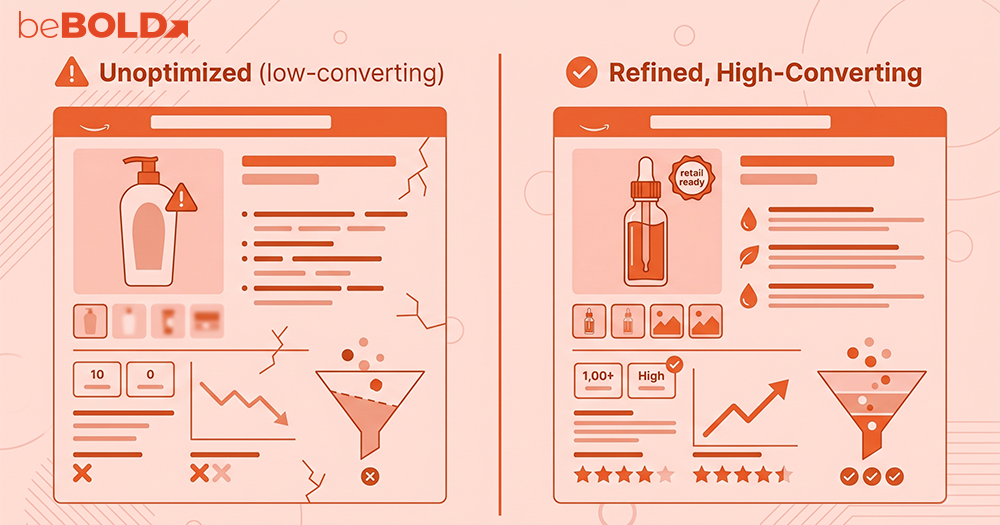
For emerging brands, this means building a strong foundation with high-converting listings and targeted keyword strategies. This includes improving retail readiness on Amazon and optimizing across marketplaces like Walmart.
At beBOLD Digital, we help beauty brands turn visibility into revenue through a data-driven approach to SEO, Amazon optimization, and marketplace strategy. If your brand is looking to compete with the top beauty brands in the world, now is the time to refine your strategy and scale with the right partner. Schedule a call with us today!





Comments