


What Is an Amazon Virtual Product Bundle?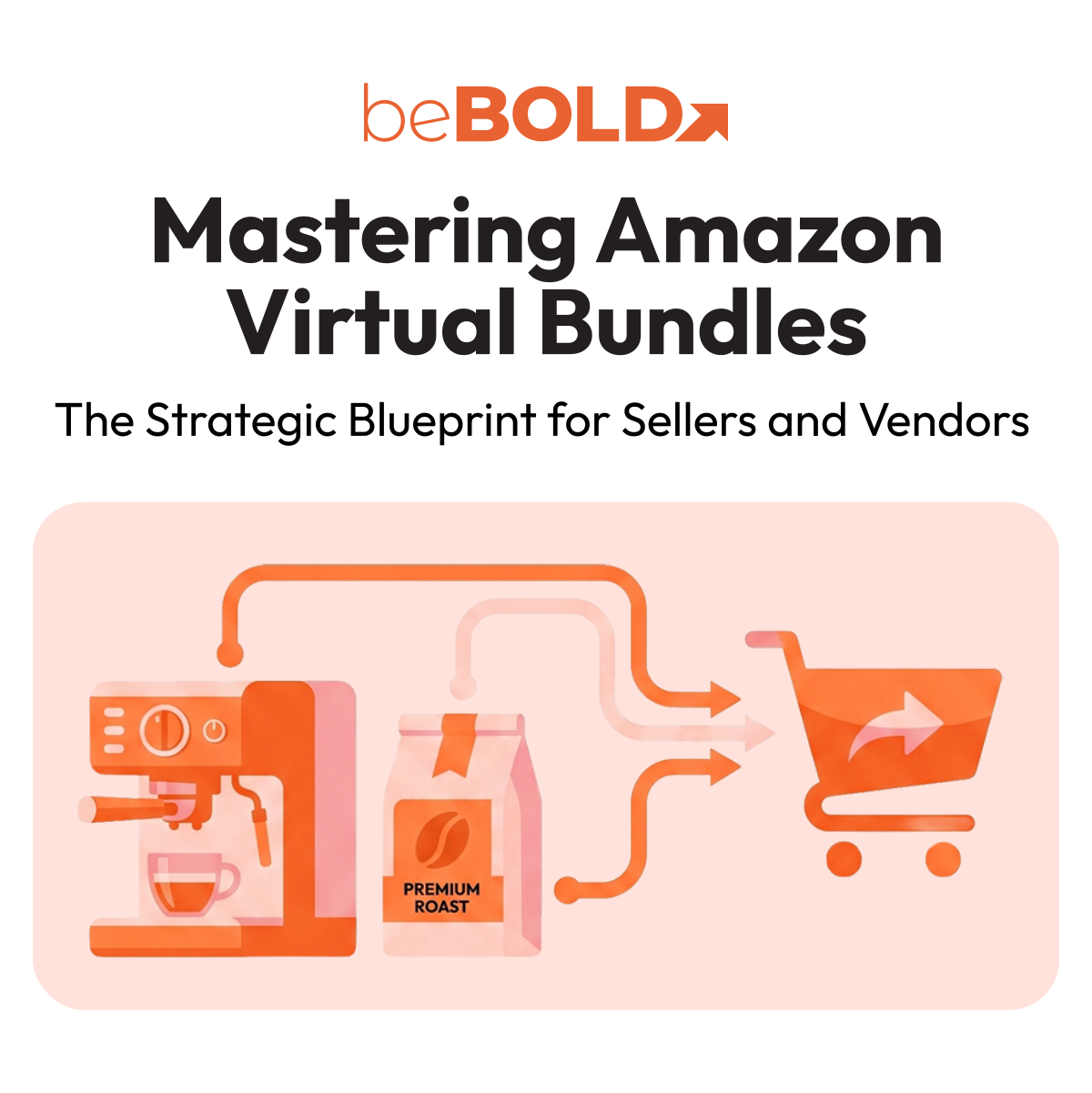
An Amazon Virtual Bundle is a detail page that presents two to five complementary ASINs as a single customer-facing offer. Unlike a physical bundle, the products are never prepacked into a new unit. Each component remains separately inventoried in Amazon’s fulfillment network and is picked and shipped together only when a shopper places a bundle order.
This is distinct from a physical multipack and from Amazon’s newer Virtual Multipacks pilot, which allows grouping multiple units of the same ASIN. The focus here is complementary virtual bundles: different products that solve a cohesive customer need.
Seller Central vs. Vendor Central Virtual Bundles
The operational and financial mechanics behind a virtual bundle shift dramatically depending on whether you sell as a third-party seller or as a first-party vendor. The table below highlights the core differences.
|
Aspect |
Seller Central Virtual Bundle |
Vendor Central Bundle |
|
Account model |
3P marketplace seller |
1P wholesale supplier |
|
Amazon tool |
Brands → Virtual Bundles |
Bundle Manager |
|
Inventory model |
FBA inventory, seller-owned |
Amazon-owned inventory |
|
Primary product terminology |
Hero product |
Base ASIN |
|
Pricing control |
Seller sets offer price |
Amazon controls retail price |
|
Fulfillment |
FBA only |
Amazon fulfills from owned inventory |
|
Component requirements |
2–5 complementary FBA ASINs; each purchasable individually |
Check Bundle Manager eligibility; many accounts support 2–5 ASINs and up to 25 units per component at time of writing |
|
Content control |
Seller provides title, bullets, description, images |
Vendor provides title, short title, bullets, images |
|
Post-publication editing |
Limited attribute edits; component changes generally require a new bundle |
Bundle Manager permits editing certain attributes; create a new bundle when component mix changes |
For a deeper look at how the two account models differ beyond bundles, see our comprehensive Amazon Vendor Central vs. Seller Central comparison.
How to Create a Virtual Bundle in Amazon Seller Central
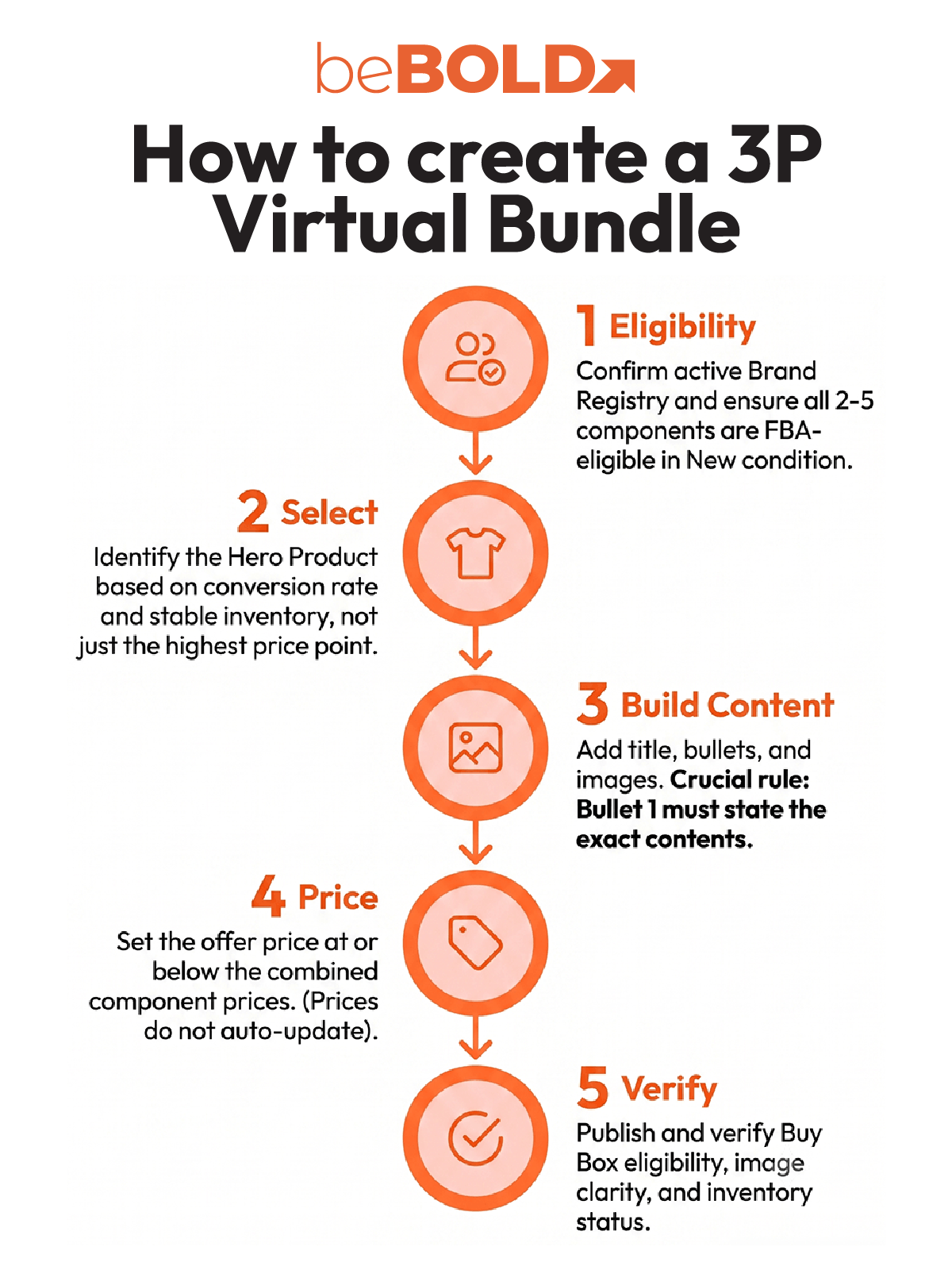
For third-party sellers, Amazon Virtual Bundles in Seller Central is the direct path to publishing a complementary product set. The workflow requires Brand Registry and a thoughtful selection of components.
Seller Central Eligibility and Product Requirements
Before starting, confirm these essentials inside your account:
-
Active Brand Registry enrollment for the brand
-
Access to the Virtual Bundles tool under Brands
-
All component ASINs are in New condition and available through FBA
-
Two to five complementary products that are eligible for bundling
-
Each component must be purchasable individually
-
The marketplace and account must show the bundle creation option as available
Seller Central Setup: Step by Step
-
Open the Virtual Bundles Tool: Go to Brands ➔ Virtual Bundles and select the option to create a new bundle.
-
Select Complementary Products: Choose two to five FBA ASINs. Identify the hero product, the item with the strongest conversion and most stable inventory, rather than defaulting to the most expensive SKU.
-
Build the Content: Add the bundle title, bullet points, description, and images. Clearly communicate exactly what shoppers receive and why the products work together. The first bullet should summarize the contents and the primary use case.
-
Set the Offer Price: Price the bundle at or below the combined current component prices. Component price changes do not automatically update the bundle price, so you must monitor this relationship over time. Amazon’s own Seller Central guidance states sellers may price a virtual bundle at the sum of its components or below it, and notes the most successful bundles typically offer discounts.
-
Publish and Verify: Save and publish, then check the live detail page on desktop and mobile. Verify image clarity, included item accuracy, price comparison display, inventory status, and Buy Box eligibility.
💡 beBOLD Expert Tip: Choose your hero product based on conversion rate and inventory reliability, not only on price point. A stable, high-velocity item anchors the entire bundle’s appeal and makes advertising spend more predictable.

How to Create a Virtual Bundle in Amazon Vendor Central
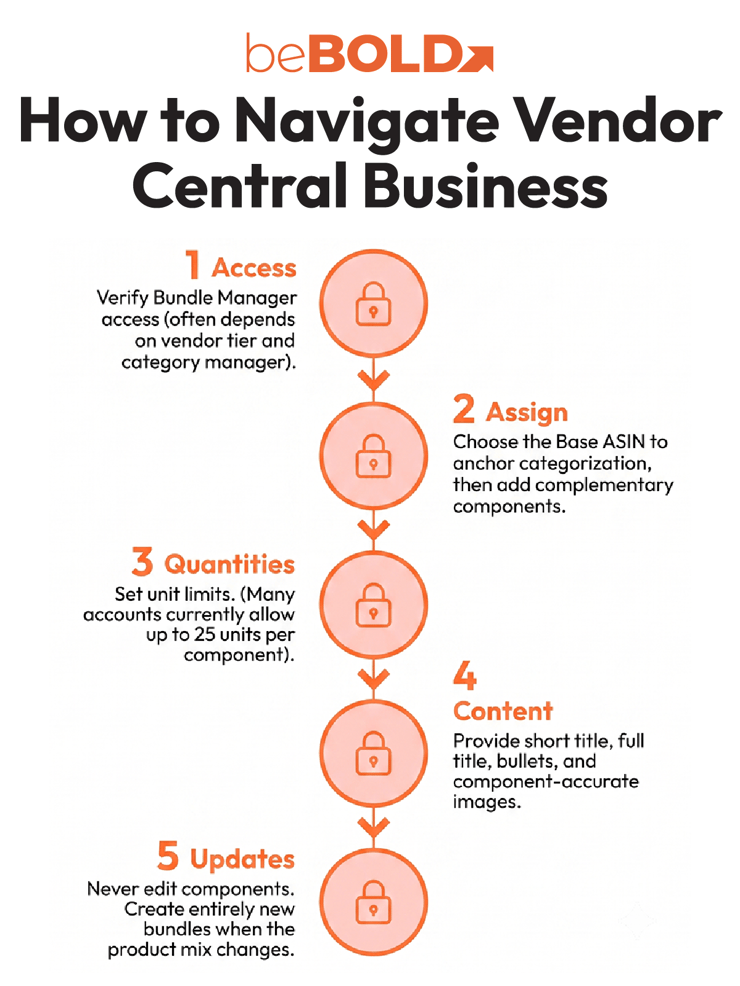 Amazon Virtual Bundles in Vendor Central follow a different ownership and tooling logic. Vendor Central is an invite-only 1P wholesale platform where Amazon acts as the retailer, and access to specific merchandising tools can vary by account.
Confirm Access to Vendor Central Bundle Manager
Check your Vendor Central menu for Bundle Manager. Access often depends on your vendor tier, Brand Registry enrollment, negotiated terms, and whether your category manager has enabled the feature for your account. Because Amazon owns the inventory and controls the retail price, every bundle decision must be evaluated through wholesale economics, not through a marketplace pricing lens.
Vendor Central Bundle Manager: Step by Step
-
Open Bundle Manager and Search: In Vendor Central, open Bundle Manager and search the catalog for the proposed base product and component ASINs.
-
Assign the Base ASIN: Choose the base ASIN that will influence categorization and merchandising, then add compatible, highly complementary component ASINs.
-
Set Quantities and Verify Policy: Specify component quantities (many accounts allow up to 25 units per component at the time of writing) and confirm the combination meets current Vendor Central bundle guidelines.
-
Provide Content: Enter the full title, short title, bullet points, and bundle images. The first bullet must clearly state what the bundle includes; images should show the actual bundle components.
-
Submit and Review: Submit the bundle, then check how it appears on the base ASIN’s detail page and the standalone bundle page. Verify categorization, content, availability, and merchandising placement.
-
Manage Updates via New Bundles: Use Bundle Manager to edit permitted attributes or to remove the bundle entirely. When the component combination changes, create a new bundle rather than trying to swap products in an existing one.
📈 Client Scenario: Vendor Central brands sometimes try to mirror Seller Central rules and end up with rejected submissions. beBOLD Digital recently guided a kitchenware vendor through the Bundle Manager after the brand mistakenly applied marketplace-style pricing logic. By aligning the base ASIN with Amazon’s category expectations and selecting components that fit the vendor’s wholesale cost structure, the bundle gained immediate visibility and avoided a costly resubmission cycle.

How Seller and Vendor Bundles Work After Publication
Once live, a bundle’s day-to-day behavior depends on the fulfillment and pricing model behind it.
|
Aspect |
Seller Central Virtual Bundle |
Seller Central Virtual Bundle |
|
Inventory depletion |
Any component out of stock makes the bundle unavailable |
Same—every component must be in Amazon’s owned inventory |
|
Fulfillment |
FBA picks and ships components together |
Amazon fulfills from 1P inventory |
|
Retail pricing |
Seller sets and adjusts the offer price |
Amazon sets the retail price |
|
Content contributions |
Seller-authored detail page content |
Vendor-supplied content that Amazon may modify |
|
Editing components |
Component changes require a new bundle |
Bundle Manager allows attribute edits but not component swaps |
|
Returns |
Standard FBA customer returns process |
Handled per Amazon’s 1P returns process |
|
Out-of-stock behavior |
Bundle becomes unorderable until all components are restocked |
Same—bundle is suppressed |
Bundle availability hinges on every required component. If even one item runs out of stock, the entire bundle may become unpurchasable, making inventory management the foundation of a reliable bundle program. Brands should not assume virtual bundling inherently reduces Amazon storage fees, as individual components remain separately stowed.
How to Build an Amazon Virtual Bundle That Converts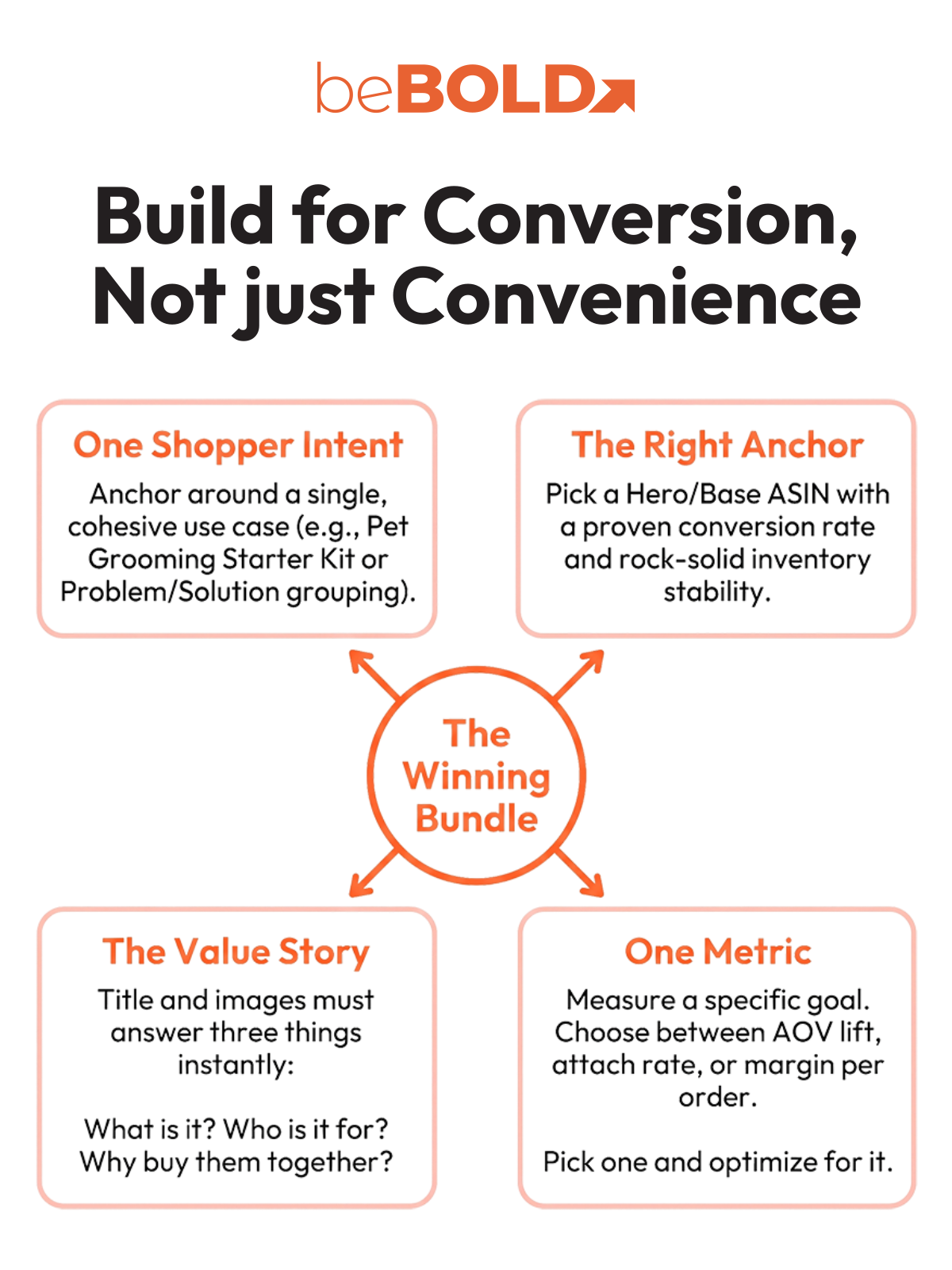
Technical execution is only part of the equation. The bundles that generate measurable returns share a disciplined creative and financial structure.
Build Around One Shopper Intent
Anchor the bundle in a single use case: a complete skincare routine, a pet grooming starter kit, a baby safety set, a product-plus-accessory combination, or a problem-and-solution grouping. This alignment makes the offer immediately relevant and reduces cognitive friction.
Choose the Right Hero Product or Base ASIN
In Seller Central, pick a hero product with strong conversion, stable inventory, and logical complementary SKUs. In Vendor Central, select a base ASIN that Amazon already merchandises successfully and that supports meaningful add-on components.
Create a Clear Value Story
The title, main image, and first bullet must answer three questions in seconds: what is included, who the bundle is for, and why it is worth purchasing together. A crisp value story improves both conversion and the effectiveness of any associated advertising. Supporting Amazon A+ Content can further reinforce the bundle’s purpose and differentiation.
Additionally, reviewing Amazon listing optimization best practices can help your bundle title and bullets capture more traffic and drive conversions. For help building a search-optimized bundle page from the ground up, explore beBOLD Digital’s Amazon SEO services.
Protect Margin Without Over-Discounting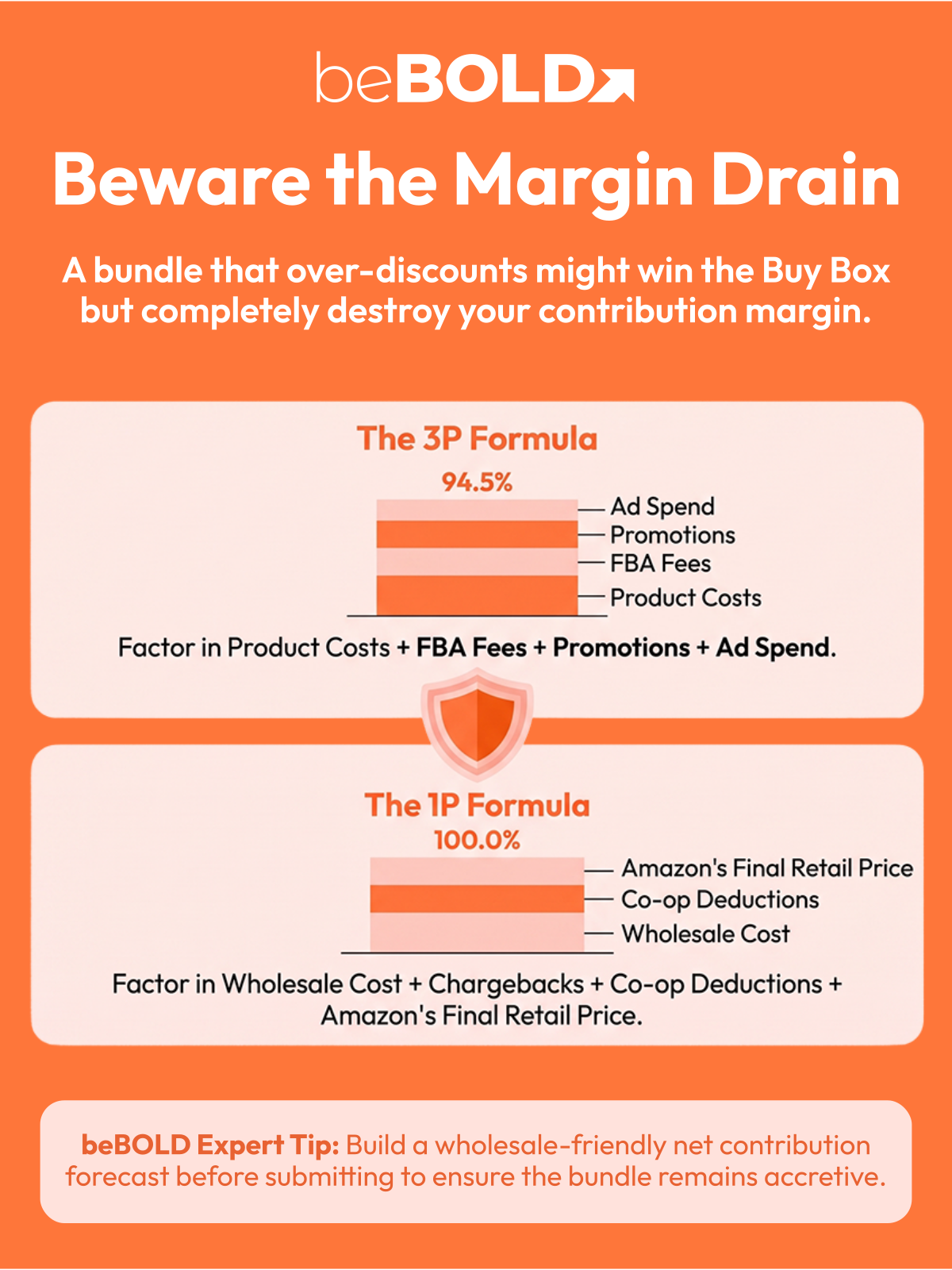
For Seller Central bundles, evaluate the bundle price against product costs, FBA fees, promotions, and ad spend. For Vendor Central, factor in wholesale cost, chargebacks, co-op deductions, and Amazon’s final retail pricing. A bundle that over-discounts might win the Buy Box but destroy contribution margin. Partnering with our Amazon account management team ensures your bundle pricing stays competitive without quietly eroding profitability.
💡 beBOLD Expert Tip: Build a wholesale-friendly margin model before submitting a Vendor Central bundle. We forecast net contribution after typical deductions so that the bundle remains accretive rather than becoming a hidden margin drain.
Measure One Primary Performance Goal
Focus on one metric that ties to your business objective: average order value lift, attach rate of a secondary product, bundle conversion rate, contribution margin per bundle order, or increased adoption of a slower-moving SKU. This clarity makes optimization decisions faster and more consistent. For broader strategies on improving transaction value, explore how to increase Amazon average order value across your catalog.

Common Virtual Bundle Mistakes
-
Mixing Seller Central and Vendor Central terminology, leading to incorrect pricing assumptions
-
Applying Seller Central eligibility rules to a 1P vendor account
-
Treating Vendor Central tool access as universal, when it varies by account
-
Implying that vendors control Amazon’s retail price
-
Bundling products with no obvious purchase affinity
-
Selecting a component with inconsistent inventory
-
Over-discounting to the point of negative contribution
-
Using outdated interface screenshots or navigation labels
-
Assuming components can be freely swapped after publication
Build Amazon Bundles That Increase Order Value and Protect Profitability
beBOLD Digital helps Seller Central and Vendor Central brands identify high-potential bundle opportunities, optimize content, evaluate profitability across all cost factors, and manage inventory risk. We connect your bundle strategy to broader Amazon growth goals. Partner with an experienced Amazon account management agency that understands both the marketplace and the wholesale side of the platform.
Amazon Virtual Bundle FAQs
Are Seller Central Virtual Bundles and Vendor Central Bundle Manager the same thing?
No. They support a similar customer-facing merchandising concept but operate through different account models, tools, inventory ownership structures, and levels of pricing control. Confusing the two often leads to compliance issues and mispriced offers.
Do both programs require Amazon Brand Registry?
Seller Central Virtual Bundles require active Brand Registry enrollment. For Vendor Central, Brand Registry is not always the gate; access depends on the features enabled for your specific vendor account, so check Bundle Manager availability directly.
Can bundle components be changed after publication?
Some content and attribute edits may be possible within the platform tools. However, the safest and most compliant approach is to create a new bundle when you need to change the underlying component combination.
Do Amazon virtual bundles need a new UPC?
Seller Central Virtual Bundles generally generate a bundle offer without requiring the seller to purchase a separate UPC. Physical bundles follow different identifier rules and may require a unique product identifier.
What happens when one component goes out of stock?
The bundle becomes unavailable for purchase because fulfillment relies on every required component being in stock. Even a temporary stockout of a single item can suppress the entire bundle offer until inventory is restored.
Can virtual bundles use Amazon Ads or A+ Content?
Eligibility can vary by account, ASIN, ad format, and platform. Always confirm the current options inside Campaign Manager and the A+ Content Manager rather than applying a blanket assumption.



Comments