


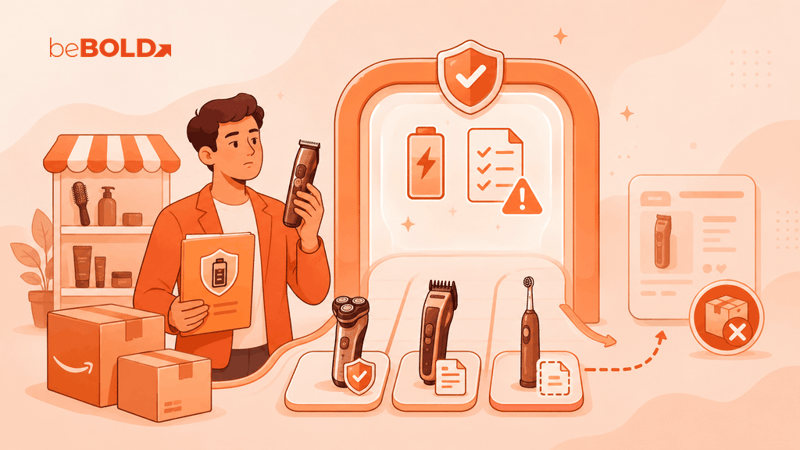
Amazon Tightens the Safety Gate for Rechargeable Personal-Care Devices
Amazon has expanded its compliance requirements for rechargeable lithium-battery home appliances sold in the United States.
According to Amazon’s seller guidance, products powered by lithium-ion, lithium-polymer, or lithium iron phosphate batteries may require verification through a third-party testing, inspection, and certification provider, commonly called a TIC provider.
Amazon’s examples include several hair-care products:
-
Cordless curling irons
-
Hair straighteners
-
Rechargeable hair dryers
-
Other affected hair-styling tools
Parker-Lambert reported that Amazon set August 30, 2026 as the removal deadline for affected listings without valid compliance documentation. Amazon’s public forum guidance confirms that noncompliant listings may be deactivated, although sellers should rely on their individual Product Safety Removal Notice and Account Health dashboard for the applicable deadline and ASIN scope.
For Beauty Brands, Compliance Is Now a Catalog Availability Issue
.jpg?width=740&height=494&name=pexels-rdne-7697208%20(1).jpg) Source: Pexels
Source: Pexels
Amazon no longer accepts compliance documents directly from selling partners for these products. An eligible TIC provider must validate the evidence and send the results to Amazon.
Amazon says affected brands should have:
-
Product detail pages that identify the model or part number and manufacturer or brand
-
Test reports from an ISO 17025-accredited laboratory
-
Reports issued within the previous 12 months
-
Evidence covering the applicable UL safety standard
-
UN 38.3 testing and a Battery Test Summary for lithium-ion batteries
A product can be physically compliant but still lose its listing if its documentation, product attributes, model details, or battery classification do not align.
That turns product safety into a revenue and inventory issue. When an ASIN is deactivated, the brand loses sales while advertising, organic ranking, and promotional plans tied to that listing are interrupted.
The category risk is not theoretical. In 2024, the US Consumer Product Safety Commission recalled approximately 50,000 cordless hair clippers after reports that their lithium-ion batteries could overheat and create fire and burn hazards. The products had also been sold on Amazon.
Audit the ASIN, Product Data, and Evidence Together
.jpg?width=740&height=494&name=pexels-towfiqu-barbhuiya-3440682-11287869%20(1).jpg) Source: Pexels
Source: Pexels
Brands that received a removal notice should prioritize four checks:
-
Identify affected ASINs. Review Account Health and Manage Your Compliance for battery-related requests, deactivations, or pending reviews.
-
Confirm the product classification. Do not assume every electric toothbrush, trimmer, shaver, or grooming device is automatically included or excluded. Follow the ASIN-level request and seek clarification when the classification is unclear.
-
Match the documents to the listed product. The manufacturer, model number, battery configuration, and test evidence should describe the same item.
-
Use the required submission route. Work through an eligible TIC provider and monitor Account Health for the result. Do not rely on a direct document upload if Amazon requires third-party verification.
Want a more comprehensive guide to Amazon’s hazmat program? Head over to Selling Hazmat on Amazon? A Complete Guide to the Dangerous Goods Program.
beBOLD Digital’s Take: Treat Compliance as Launch Infrastructure
Beauty and personal-care brands should manage battery documentation alongside catalog setup, inventory planning, and launch readiness. Waiting for a removal notice creates unnecessary operational pressure, especially when laboratory testing or third-party verification is still required.
A marketplace agency cannot replace an accredited laboratory or TIC provider, but it can help coordinate ASIN triage, catalog corrections, Account Health monitoring, and the operational response around affected listings.
If lithium-battery compliance is disrupting your catalog or sales plan, explore beBOLD Digital’s Amazon account management services or contact us today for a one-on-one consultation!

Amazon Expands Lithium Battery Compliance Requirements | Will Haire on LinkedIn
Lithium Battery Appliance Compliance | Amazon Seller Forums
Lithium Batteries | Amazon Seller Central
StyleCraft Recalls Instinct Cordless Hair Clippers | US Consumer Product Safety Commission



Comments