


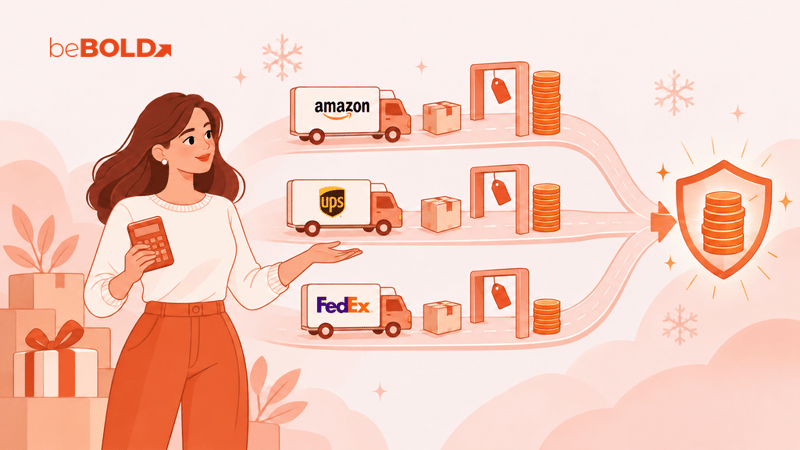
Amazon Shipping announced its 2026 peak surcharge schedule on September 2, joining UPS and FedEx in setting seasonal prices for U.S. parcel shipments. Its standard per-package addition rises from $0.50 to $0.75 during the busiest window, November 22 through December 26.
As Supply Chain Dive reports, major carriers’ seasonal pricing continues into January. That means your holiday surcharges budget needs to cover more than Black Friday and Cyber Monday. Replenishment and post-holiday orders can carry those costs, too.
How the 2026 Holiday Surcharges Compare
|
Service |
Opening period |
Highest seasonal period |
Closing period |
|
Amazon Shipping |
$0.50, Oct. 25 to Nov. 21 |
$0.75, Nov. 22 to Dec. 26 |
$0.50, Dec. 27 to Jan. 16, 2027 |
|
UPS Ground Residential and Ground Saver, standard schedule |
$0.50, Oct. 25 to Nov. 21 |
$0.75, Nov. 22 to Dec. 26 |
$0.50, Dec. 27 to Jan. 16, 2027 |
|
FedEx Ground Residential and Home Delivery residential shipments |
$0.50, Oct. 26 to Nov. 22 |
$0.80, Nov. 23 to Dec. 27 |
$0.50, Dec. 28 to Jan. 17, 2027 |
|
FedEx Ground Economy |
$2.55, Oct. 26 to Nov. 22 |
$4.05, Nov. 23 to Dec. 27 |
$2.55, Dec. 28 to Jan. 17, 2027 |
These are published service demand surcharges. Your base shipping rate, volume-based adjustments and other applicable charges still need to be included in the total.
FedEx Ground Economy is available by contract only. If you qualify for UPS’s higher-volume rules or FedEx’s separate demand residential charge, the table is just your starting point.
Amazon Shipping also says it does not add residential surcharges or weekend delivery fees. That may help your overall quote, but you’ll still need to compare the full cost for your destinations and packages. Carrier expenses should also be evaluated alongside inventory, pricing and fulfillment decisions. beBOLD Digital’s Amazon account management services can help brands manage these interconnected areas as part of a broader marketplace strategy.
USPS is worth including in that comparison. Its August 25 notice proposes commercial Ground Advantage increases of $0.40 for 0- to 3-pound parcels in Zones 1 to 4 and $0.55 in Zones 5 to 9. The proposed window runs from October 4 to midnight Central Time on January 17, 2027, pending favorable regulatory review. Use the rate for your package’s weight, zone and commercial service rather than applying one percentage across all shipments.
Using FBA Alongside Parcel Carriers?
.jpg?width=740&height=555&name=pexels-giantasparagus-38869179%20(2).jpg) Amazon Shipping’s parcel surcharges are separate from Fulfillment by Amazon (FBA) fees. If you also use FBA, our Amazon 2026 holiday fees guide walks you through SKU-level fulfillment calculations, fuel surcharge treatment and storage budgeting. Use it alongside this comparison to plan costs across FBA and merchant-fulfilled orders.
Amazon Shipping’s parcel surcharges are separate from Fulfillment by Amazon (FBA) fees. If you also use FBA, our Amazon 2026 holiday fees guide walks you through SKU-level fulfillment calculations, fuel surcharge treatment and storage budgeting. Use it alongside this comparison to plan costs across FBA and merchant-fulfilled orders.
More Volume Can Change What You Pay per Package
UPS replaces the standard demand rate for qualifying accounts
With UPS, your shipping history matters. Its higher-volume rules include customers who exceeded 20,000 combined packages across specified residential and Ground Saver services in any week after October 2025. Applicable affiliated accounts count toward that threshold.
Suppose you qualify and your Ground Residential volume reaches 175% of baseline, or 75% above baseline. The demand rate is $2.65 for every package in that service for the week. That replaces the standard demand rate, so don’t add another $0.75.
UPS normally uses May 31 to June 27, 2026 as its baseline period. If your average weekly volume for August 30 to September 26 falls below 80% of that baseline, the lower period is used under the published rules. Check which baseline applies before building your forecast.
FedEx uses earlier shipping activity to calculate later charges
FedEx separately lists a Demand-Residential Delivery Charge for enterprise customers shipping more than 20,000 eligible residential and Ground Economy packages in a calculation week.
Its “peaking factor” compares that volume with the weekly average for June 1 to 28, 2026. FedEx also specifies calculations by service and adjustments for holiday weeks.
The timing matters. For example, your October 5 to 11 shipping activity determines the applicable charge for October 26 to November 1. Ground and Home Delivery tiers range from $1.70 to $8.00 at the listed peaking factors above 105% of baseline.
Keep three charges distinct when reviewing your costs: the service demand surcharge in the table, the volume-based demand residential charge, and the ordinary residential charge. FedEx says the demand residential charge is additional to the ordinary residential charge. Discounts or caps on the ordinary residential charge do not apply to it.
For a qualifying enterprise account, the table’s $0.80 therefore won’t tell you the full cost.
If a third-party logistics provider buys your labels, ask which account determines eligibility and how each charge will appear on your invoice.
Your Packaging May Matter More Than the Headline Rate
.jpg?width=6240&height=4160&name=pexels-shvets-production-7203788%20(2).jpg) A few cents per package can add up. But for qualifying nonstandard packages, the seasonal additions are much larger.
A few cents per package can add up. But for qualifying nonstandard packages, the seasonal additions are much larger.
|
Carrier |
Additional-handling demand addition |
Large-package or oversize demand addition |
Highest period |
|
Amazon Shipping |
$11.90 |
$117.50 |
Nov. 22–Dec. 26 |
|
UPS |
$11.90 |
$117.50 |
Nov. 22–Dec. 26 |
|
FedEx |
$11.85 |
$117.25 |
Nov. 23–Dec. 27 |
Amounts are USD per qualifying package and represent additional fee components, not complete shipping prices.
Similar fee names don’t mean the carriers use identical size, weight or packaging thresholds. Check each service guide before deciding how your parcel will be classified.
These costs also start earlier for some carriers. UPS’s nonstandard-package demand charges begin September 27, and FedEx’s begin September 28. Amazon Shipping’s published holiday additions begin October 25.
If you sell beauty products, measure the finished shipping carton for your holiday gift sets, including protective packaging. If you sell pet products, start with bulky beds and multipacks.
A bundle may raise order value while also increasing billable weight or triggering another fee. Before approving it, check what’s left after packaging and delivery costs.
Important Considerations Before Changing Carriers
You don’t need to rebuild your entire shipping strategy to make a useful comparison. Start with a representative set of orders and follow the same process for each service:
-
Pull your shipment data. Include origin and destination ZIP codes, packed dimensions, actual weight, service, shipment date and packages per order. Make sure gift sets and bulky products are represented.
-
Price the same parcels for each seasonal window. Include negotiated transportation rates, billable weight, fuel, delivery-area, residential and nonstandard-package charges where applicable. Then apply the correct account-level demand rules and discounts. Check whether moving volume affects your pricing commitments.
-
Confirm the service can deliver what you promise. Review pickup and destination coverage, transit times, capacity and product acceptance. For beauty and health products, verify acceptance of items such as aerosols or alcohol-based products before switching.
-
Update your budget and check the invoices. Use the results in your promotion and holiday Amazon PPC plans. When the first seasonal invoices arrive, compare them with your forecast.
Moving a promotion earlier may reduce exposure to the highest rates, but the discount itself and any volume-based charges could offset the savings. Plan around the week packages actually ship, include January orders, and recheck carrier terms before handing over shipments. Coordinate those dates with your Amazon inventory management plan so replenishment and promotions work from the same forecast.
Start With the Orders Most at Risk
At beBOLD Digital, we’d start with products that have thin contribution margins, bulky packaging or exposure to higher-volume tiers. Those are the places to look before making a broad carrier change. An average shipping cost can look manageable while a particular gift set or promotional offer loses money.
Before you scale holiday campaigns, work with beBOLD Digital’s Amazon account management team to review your Q4 SKU margins and Amazon advertising limits together. The goal is to build your growth plan around what you expect to ship and what it will cost to deliver.
 Frequently Asked Questions
When do FedEx holiday surcharges start in 2026?
It depends on the charge. FedEx’s additional-handling, oversize and unauthorized-package demand charges start September 28, 2026. Its listed domestic service demand surcharges, including residential ground, start October 26. The highest seasonal amounts run November 23 through December 27, followed by lower amounts through January 17, 2027.
Is Amazon cheaper than UPS or FedEx during the holidays?
There isn’t one cheapest carrier for every shipment. Compare quotes for the same parcels, destinations, shipment weeks and delivery requirements. Include applicable volume tiers and other charges before deciding.
Do these Amazon holiday surcharges apply to FBA orders?
The Amazon rates in this comparison apply to Amazon Shipping. If FBA, Multi-Channel Fulfillment or Buy with Prime fulfills the order, use that service’s applicable pricing.
How should brands budget for split shipments?
Count the packages first, then add up the cost for the order. If one order creates two eligible parcels, the per-package surcharge may apply twice. Include the extra handling and transportation costs, too. An average shipping cost per order can hide the impact of inventory split across locations.








Comments