


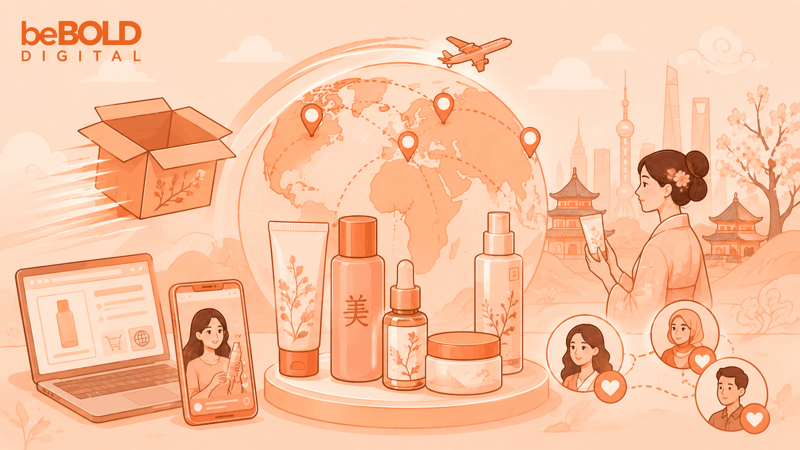
Southeast Asia Becomes C-Beauty’s First Global Growth Engine
Source: Adobe Stock
Chinese beauty brands are moving beyond their domestic market, with Southeast Asia emerging as one of the strongest testing grounds for international growth.
The region offers young, digitally active consumers, geographic proximity to China, and mature social-commerce platforms including TikTok Shop, Shopee, and Lazada. Brands are using those platforms to validate products before investing more heavily in local teams, physical stores, and retail distribution.
Joy Group, owner of Judydoll and Joocyee, generated more than $730 million in retail sales during 2025, including approximately $87 million from international markets. Vietnam is now its largest overseas market, while the company has established Singapore as a regional hub and plans to open a Malaysian store.
Yatsen Group’s Little Ondine provides another example. After learning that Vietnamese consumers preferred more vivid, highly pigmented makeup, the brand replaced a pale pink shade with a localized wild rose option. Lazada sales reportedly increased more than 100-fold in six months, generating over $300,000 in Vietnam.
The lesson is straightforward: C-beauty brands are not simply exporting their domestic bestsellers. They are adjusting shades, waterproof performance, sunscreen formats, and merchandising for local purchasing behavior and climate conditions.
London Tests Whether Chinese Beauty Stories Can Travel
C-beauty’s expansion is also moving into Europe through a different playbook.
Partner Season II, a reality docuseries co-produced by Hunan Satellite TV and Mango TV, brought 14 Chinese beauty and personal care brands to YanLab, a temporary store in London. The project featured leading livestream host Austin Li alongside Chinese actors and musicians who operated the store, recommended products, and collected customer feedback.
London was treated as a live research market rather than a simple retail launch. The product assortment reflected local interest in botanical formulations, clean beauty, aromatherapy, and well-being.
Shoppers responded to both technology-led products and visibly Chinese design. Heritage skincare brand Pechoin attracted attention with jade-inspired packaging, while Bixdo’s blue-light whitening toothbrush generated repeat purchases.
The experiment exposed C-beauty’s biggest global opportunity and weakness. Chinese brands can compete through fast product development, advanced manufacturing, distinctive packaging, and ingredient innovation. However, unfamiliar brands still need clear storytelling, local relevance, physical trial, and credible proof of performance to turn curiosity into repeat demand.

The Marketplace Lesson: Localization Must Go Beyond Translation

For beauty brands selling internationally, localization cannot stop with translated listing copy.
Product-market fit may change by country, along with preferred shades, ingredients, claims, imagery, search terms, price points, and content formats. A marketplace strategy that performs in one region may miss demand entirely in another.
Amazon sellers should therefore build market-specific keyword research, creative assets, review strategies, inventory plans, and advertising structures. beBOLD Digital’s guide to multimarket Amazon SEO explains why international visibility requires more than duplicating a domestic listing.
C-beauty’s rise also means more competition for established Western and K-beauty brands. Fast-moving Chinese companies are combining strong supply chains with TikTok-led discovery, marketplace distribution, and increasingly sophisticated brand building.
beBOLD Digital’s Take
C-beauty is showing that international expansion works best as a sequence: test demand, listen to local customers, adapt the offer, and then scale the products that earn trust.
Brands entering new markets should protect their core identity while localizing how products are positioned, discovered, and purchased. The strongest global operators will combine marketplace data with consistent brand storytelling and disciplined channel execution.
For support building a localized Amazon strategy for your beauty brand, explore beBOLD Digital’s Amazon Premium Beauty Agency services and contact our team for a consultation.
Sources
BeautyMatter, “The Austin Li Playbook for Taking C-Beauty Global”
Global Times, “C-Beauty Goes Global”
Personal Care Insights, “C-Beauty Expands Globally With Help From Korea and France”
Euromonitor International, “The Rise of C-Beauty Brands in Southeast Asia”






Comments