


Amazon has announced its 2026 holiday inventory deadlines for Prime Big Deal Days, Black Friday Week, and Cyber Monday. These are arrival deadlines, so inventory needs to reach Amazon facilities by the listed dates to be eligible for Prime.
-
Prime Big Deal Days Deadlines:
-
AWD: September 2
-
Minimal-split FBA: September 9
-
Amazon-optimized FBA: September 16
-
Black Friday & Cyber Monday Deadlines:
-
AWD: October 14
-
Minimal-split FBA: October 21
-
Amazon-optimized FBA: October 28
-
Holiday Peak Fulfillment Fee Period: October 15, 2026 – January 14, 2027
-
Important: To avoid potential delays, sellers should set internal deadlines earlier than these arrival dates.
Amazon’s 2026 Holiday Deadlines at a Glance

Amazon now sets FBA inventory deadlines based on the inbound placement option you choose. Make sure to check which route you selected in the Send to Amazon workflow instead of using the same deadline for all shipments.
Prime Big Deal Days 2026
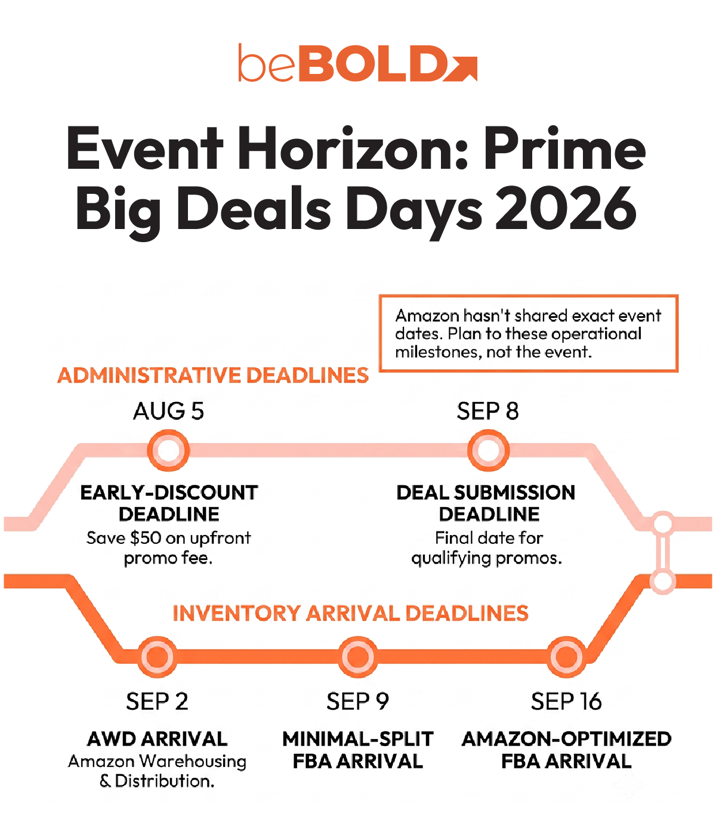
Amazon hasn’t shared the exact event dates yet. So, plan your submissions and inventory milestones based on the deadlines, without assuming a specific event date.
|
Milestone |
2026 deadline |
What sellers need to know |
|
Deal submission deadline |
September 8 |
Final date to submit qualifying Prime Big Deal Days promotions |
|
Early-discount deadline |
August 5 |
Submit by this date to save $50 on the upfront promotion fee |
|
AWD arrival deadline |
September 2 |
Inventory must arrive at Amazon Warehousing and Distribution |
|
Minimal-split FBA arrival deadline |
September 9 |
Applies when the minimal shipment splits option is selected |
|
Amazon-optimized FBA arrival deadline |
September 16 |
Applies when Amazon-optimized shipment splits are selected |
Black Friday Week and Cyber Monday 2026
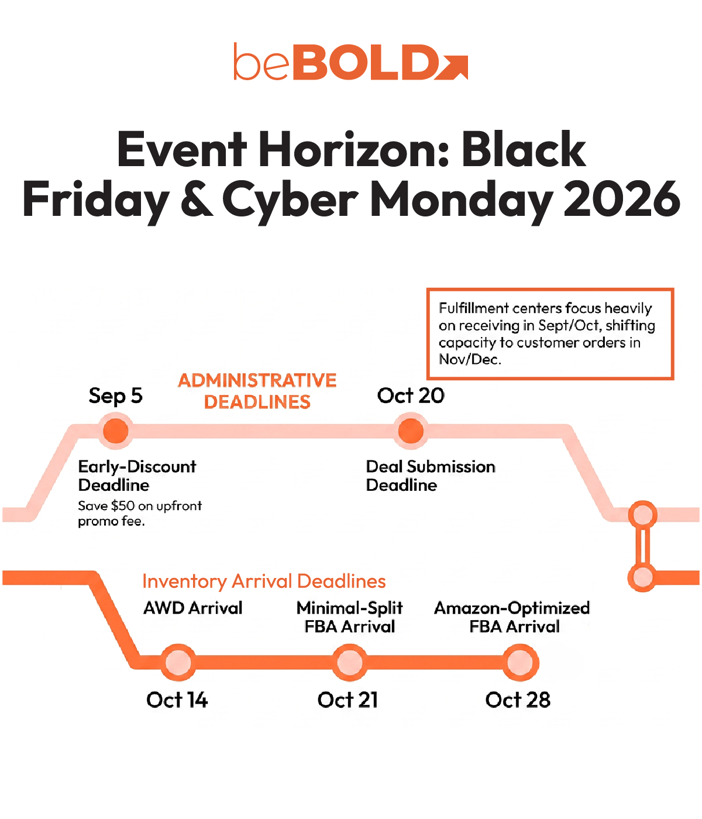
These dates apply to deal submissions and inventory arrivals for Amazon’s main late-November promotions.
|
Milestone |
2026 deadline |
What sellers need to know |
|
Deal submission deadline |
October 20 |
Final date to submit qualifying Black Friday and Cyber Monday promotions |
|
Early-discount deadline |
September 5 |
Submit by this date to save $50 on the upfront promotion fee |
|
AWD arrival deadline |
October 14 |
Inventory must arrive at Amazon Warehousing and Distribution |
|
Minimal-split FBA arrival deadline |
October 21 |
Inventory must arrive at the assigned FBA destination |
|
Amazon-optimized FBA arrival deadline |
October 28 |
Inventory must arrive across the Amazon-assigned shipment network |
These are arrival deadlines for Prime-badge eligibility, not suggested ship dates. Amazon also points out that fulfillment centers focus on receiving and positioning inventory in September and October, then shift more capacity to customer orders in November and December.

Holiday Peak Fee Period
Amazon peak fulfillment fees will apply from October 15, 2026, through January 14, 2027. The fee period covers FBA, Remote Fulfillment with FBA, Multi-Channel Fulfillment, and Buy with Prime.
Important Considerations
Before you use these dates for your production or purchasing plans, keep these three limitations in mind:
-
Arrival does not always mean immediately available for sale. Inventory may still require check-in, receiving, placement, and distribution across Amazon’s network.
-
AWD inventory may need additional time to replenish into FBA before it becomes available with the intended delivery promise.
-
Amazon may update event requirements or operational guidelines. Keep checking Seller Central, the Deals dashboard, and shipment workflows for the latest information.
Are Amazon’s 2026 Deadlines Actually Earlier?
Amazon says the 2026 holiday schedule has earlier deadlines, but this depends on which inbound placement option you use.
Both AWD deadlines are later than they were in 2025. The Black Friday and Cyber Monday minimal-split deadline is also one day later. However, the Prime Big Deal Days minimal-split deadline is one day earlier, and both Amazon-optimized shipment splits deadlines moved earlier.
|
Event |
Inbound route |
2025 arrival |
2026 arrival |
Change |
|
Prime Big Deal Days |
AWD |
August 29 |
September 2 |
4 days later |
|
Prime Big Deal Days |
Minimal-split FBA |
September 10 |
September 9 |
1 day earlier |
|
Prime Big Deal Days |
Amazon-optimized FBA |
September 19 |
September 16 |
3 days earlier |
|
Black Friday/Cyber Monday |
AWD |
October 9 |
October 14 |
5 days later |
|
Black Friday/Cyber Monday |
Minimal-split FBA |
October 20 |
October 21 |
1 day later |
|
Black Friday/Cyber Monday |
Amazon-optimized FBA |
October 30 |
October 28 |
2 days earlier |
The comparison is based on Amazon’s official 2025 and 2026 holiday readiness announcements. Sellers using Amazon-optimized shipment splits face the greatest need to accelerate Q4 inventory planning. AWD users receive slightly more time than in 2025, but they must still account for the time required to replenish inventory from AWD into FBA.
Amazon’s Published Deadline Should Not Be Your Internal Deadline
Amazon’s deadline doesn’t include possible production delays, port congestion, customs clearance, carrier limits, missed delivery appointments, receiving delays, or inventory distribution across fulfillment centers.
Work backward from Amazon’s required arrival date. If you plan forward from when inventory leaves the factory or supplier, you’re more likely to miss the cutoff.
-
Set your own internal cutoffs earlier. Make sure purchase orders, production completion, freight booking, and warehouse release dates are all scheduled well before Amazon’s deadline.
-
Focus on your hero and promoted ASINs. Use faster or more reliable inbound routes for products with deal placements, higher ad spend, or strong seasonal demand.
-
Add safety buffers based on the shipping route. Air freight, ocean freight, domestic trucking, AWD replenishment, and direct-to-FBA shipments all have different timing and risk factors.
For a deeper dive into optimizing your approach, review these Amazon inventory management strategies.
beBOLD Digital Pro Tip: How to Work Backward (Sample Ocean Freight Timeline)
To hit an October 28 FBA Arrival Deadline using overseas ocean freight, your internal production schedule must look something like this:
- August 15: Finalize Purchase Orders and begin factory production.
- September 20: Production complete; book freight and deliver to origin port.
- September 25: Vessel departs (allowing 20–25 days ocean transit).
- October 20: Container arrives at destination port & clears customs (3–5 days).
- October 24: Drayage to warehouse & carrier books delivery appointment.
- October 27: Delivered to Amazon FBA Facility (1 day ahead of deadline buffer).
Same Fees Does Not Mean the Same Holiday Profitability
Amazon’s promotional framework may look familiar, but familiar fees do not guarantee familiar margins. Sellers must combine discounts, deal fees, Amazon FBA fees, advertising, inbound freight, storage, and inventory placement costs to understand the actual contribution from each promotion. Understanding evolving costs is critical, especially with upcoming Amazon fee changes for 2026.
Promotion and Fulfillment Costs
Amazon confirms that Best Deals, Lightning Deals, and Prime Exclusive Price Discounts will follow the same fee structure as Prime Day:
- $100 upfront per promotion
- 1.5% of promotional sales
- Variable fee capped at $5,000
Submitting by the early-discount deadline reduces the upfront fee by $50.
Holiday peak fulfillment fees will increase costs by an average of $0.32 per unit, though the exact impact varies by product size, weight, and fulfillment method. In addition, Amazon’s 3.5% fuel and logistics surcharge applies on top of fulfillment fees and is calculated based on the fulfillment charge, not the product price.
Amazon also notes that Prime Big Deal Days promotional prices will be excluded from 30-day and 60-day price-lookback windows. This allows sellers to run aggressive discounts during Prime Big Deal Days without lowering the maximum qualifying deal price for Black Friday and Cyber Monday. Even so, each promotion should still be evaluated against ASIN-level margin and inventory availability.
AWD and Capacity Planning
Amazon Warehousing and Distribution supports bulk storage and automated replenishment into FBA. Amazon reports that sellers using AWD in Q4 2025 saw over a 13% increase in shipped units and more than a 30% reduction in out-of-stock days.
These are aggregated results and may vary based on product mix, replenishment strategy, and operational execution.
Sellers anticipating higher holiday demand can also use Amazon Capacity Manager to secure additional fulfillment capacity. Tools like the Revenue Calculator, Profit Analytics dashboard, and Fee and Economics Preview Report can support cost modeling. Regularly reviewing an Amazon inventory report can help identify risks early.
beBOLD Digital expert note: Calculate promotional contribution margin at the ASIN level before committing inventory or media budget. The beBOLD Digital FBA Calculator can help estimate deductions, fulfillment costs, net revenue, and seller margin.
What Amazon Sellers Should Do Now
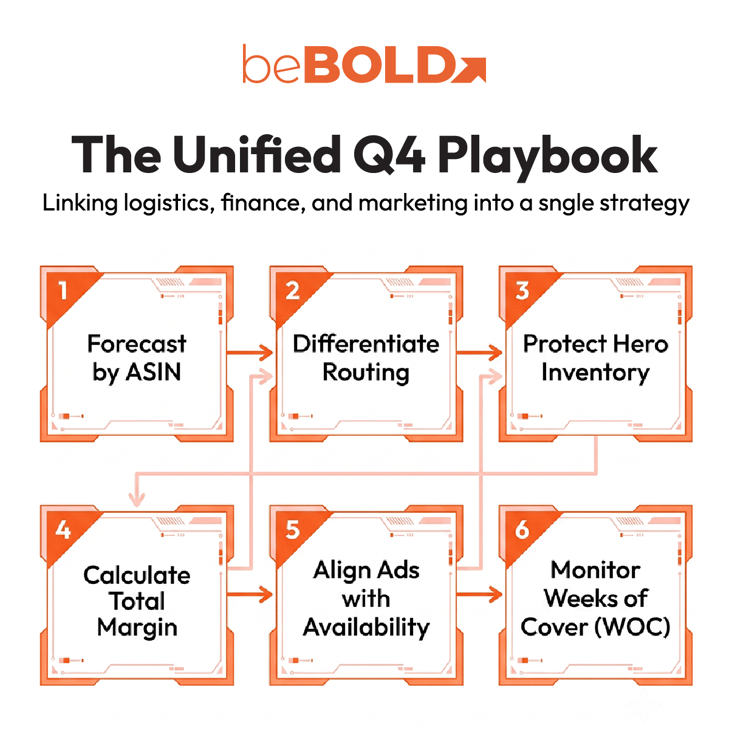
A solid holiday inventory plan should link demand forecasting, inbound logistics, deal participation, advertising, and profitability. Don’t treat these as separate Q4 tasks—they work best together.
1. Forecast Demand by ASIN
Start with past sales from Prime events, Black Friday, Cyber Monday, and the holidays. Then adjust your forecast for current sales trends, seasonality, planned discounts, ad budgets, organic ranking, and expected promotional exposure.
Create base, target, and high-demand forecasts instead of relying on just one sales estimate.
2. Assign an Inbound Route and Internal Deadline
Keep inventory for AWD, minimal-split FBA, Amazon-optimized FBA, and direct replenishment separate. Set specific production, freight, warehouse release, and arrival targets for each route.
Don’t put every ASIN on the same shipping schedule just because they come from the same supplier.
3. Protect Promotional and High-Velocity Inventory
Focus on products with Lightning Deals, Best Deals, Prime Exclusive Price Discounts, or higher PPC and DSP investment. These ASINs might need faster shipping, bigger safety buffers, or more frequent restock checks. Check out guides on Amazon PPC holiday strategies and DSP retargeting to scale your campaigns effectively.
For slower-moving products, you can use less urgent shipping routes if the carrying costs and restock timing make sense.
4. Calculate Your Total Holiday Margin
Calculate the expected contribution margin after:
-
-
Product discounts
-
Promotion fees
-
Peak fulfillment charges
-
Fuel and logistics surcharge
-
Advertising costs
-
Storage fees (including potential increases outlined in this guide to Amazon FBA storage fees)
-
Inbound placement and transportation
-
Warehousing and preparation expenses
-
Do this calculation for each ASIN, since average account-wide margins can hide products that lose money during a promotion.
5. Align Advertising With Inventory Availability
Don’t ramp up PPC, Amazon DSP, or other traffic if you’re likely to run out of stock. Make sure your promotional inventory is received, available, and distributed before you boost campaign budgets.
If you face receiving delays or unexpected demand, shift your ad spend to better-stocked products or slow down your campaigns.
6. Monitor Inbound Status and Weeks of Cover
During the holiday rush, check your inbound receiving status, available inventory, weeks of cover, sales velocity, promotional participation, and restock needs at least once a week.
Monitor high-velocity ASINs, delayed shipments, or products with big ad investments even more often.
Get Support for Your 2026 Holiday Strategy
If you want to approach the 2026 holiday season with a clear, coordinated plan, beBOLD Digital can help. Our team works with established Amazon brands to align inventory planning, inbound logistics, promotions, advertising, and profitability so you can protect availability and maximize performance during peak demand.
Looking for a coordinated Q4 plan? beBOLD Digital brings together Amazon inventory planning, promotions, advertising, analytics, and account operations with our account management services. Our integrated approach helps established brands keep products available, adjust media based on inventory, and make profitable holiday growth decisions. Contact our team today and get a comprehensive brand audit.
Frequently Asked Questions
What are Amazon’s Prime Big Deal Days inventory deadlines for 2026?
Inventory must arrive at Amazon Warehousing and Distribution by September 2, at FBA locations using minimal shipment splits by September 9, or at locations assigned through Amazon-optimized shipment splits by September 16.
What are Amazon’s Black Friday and Cyber Monday inventory deadlines for 2026?
The arrival deadline is October 14 for AWD, October 21 for minimal-split FBA shipments, and October 28 for Amazon-optimized FBA shipments.
Are Amazon’s holiday deadlines ship-by or arrival deadlines?
They are arrival deadlines. Inventory must reach the applicable Amazon distribution center or fulfillment facility by the listed date. Sellers should ship earlier based on production, freight, customs, appointment, and receiving lead times.
When do Amazon’s 2026 peak fulfillment fees apply?
Holiday peak fulfillment fees apply from October 15, 2026, through January 14, 2027. Amazon’s 3.5% fuel and logistics-related surcharge applies on top of the peak fulfillment fee and is calculated from the fulfillment charge rather than the product’s selling price.








Comments