


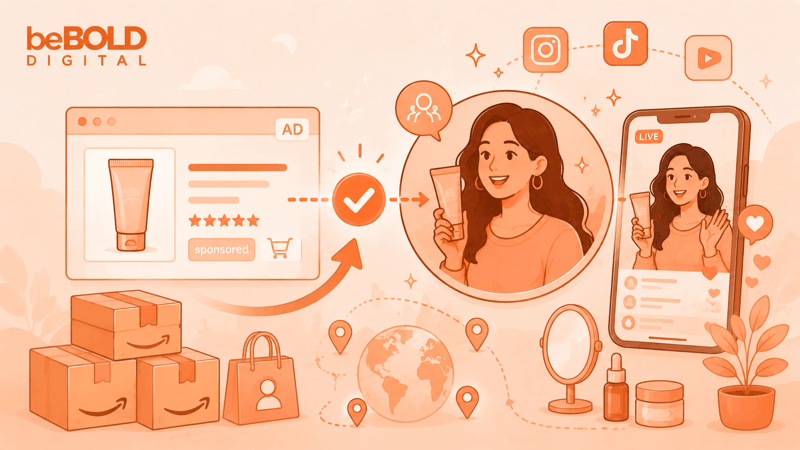
Amazon has expanded Sponsored Products so that campaigns using the “Amazon and beyond” option now extend beyond Amazon’s store into external websites, apps, and creator channels. At the same time, creators can now actively participate in Sponsored Products distribution by generating traffic through affiliate links tied to eligible ASINs.
In effect, Amazon has connected its core PPC system with its creator and affiliate ecosystem, allowing the same ad budget to drive traffic from Amazon search, off-Amazon placements, and creator content.
What Did Amazon Change?
 Source: Pexels
Amazon Sponsored Products are cost-per-click ads for individual listings that can appear on Amazon and across external placements. Advertisers control targeting, bids, products, and budgets. With the “Amazon and beyond” option, Amazon now extends campaigns by default to premium sites, apps, and creators using the same campaign settings.
As of August 10, 2026, creators can now actively participate in Sponsored Products distribution, meaning they are no longer just selecting ASINs from a passive catalog—they can generate traffic through content that is directly tied to Sponsored Products campaigns.
Creators earn affiliate commissions for qualifying traffic, while advertisers continue to fund clicks through their existing Sponsored Products structure.
In Amazon’s model:
-
Advertisers fund clicks through Sponsored Products campaigns
-
Amazon makes ASINs discoverable to creators
-
Creators choose which products to promote
-
Shoppers click creator links to Amazon product pages
-
Creators earn for qualifying conversions or clicks
What Is Confirmed And What Is Now Rolling Out?
It is important to separate confirmed platform behavior from newly rolling functionality.
Confirmed: creator access to Sponsored Products inventory
Amazon confirms that Sponsored Products campaigns using “Amazon and beyond” automatically make ASINs available to eligible creators. Creators can browse and opt into products that match their audience.
This does not mean sellers are automatically enrolled as influencers. It means their advertised products can be surfaced in a creator marketplace.
Now rolling out: Sponsored Products creator placements (August 10)
Based on reporting from PPC Land and Affiverse, Amazon has now begun rolling out Sponsored Products creator placements, where creators can actively generate traffic from Sponsored Products ads through their content and affiliate links.
This marks a shift from passive selection to active creator-driven distribution of Sponsored Products traffic.
Previously reported: auto-enrollment experiment
Earlier in 2026, creators reported an “Auto-Enroll experiment” inside Amazon’s Affiliate+ interface suggesting automatic inclusion of products into Sponsored Products for Creators.
This now appears consistent with the August 10 rollout, although Amazon has not formally unified the terminology under a single product announcement.
For more context on Amazon’s existing creator ecosystem, see beBOLD Digital’s guides to the Amazon Influencer Program and Amazon Creator Connections.
Why Does This Matter for Amazon Sellers and Brands?
 Source: Pexels
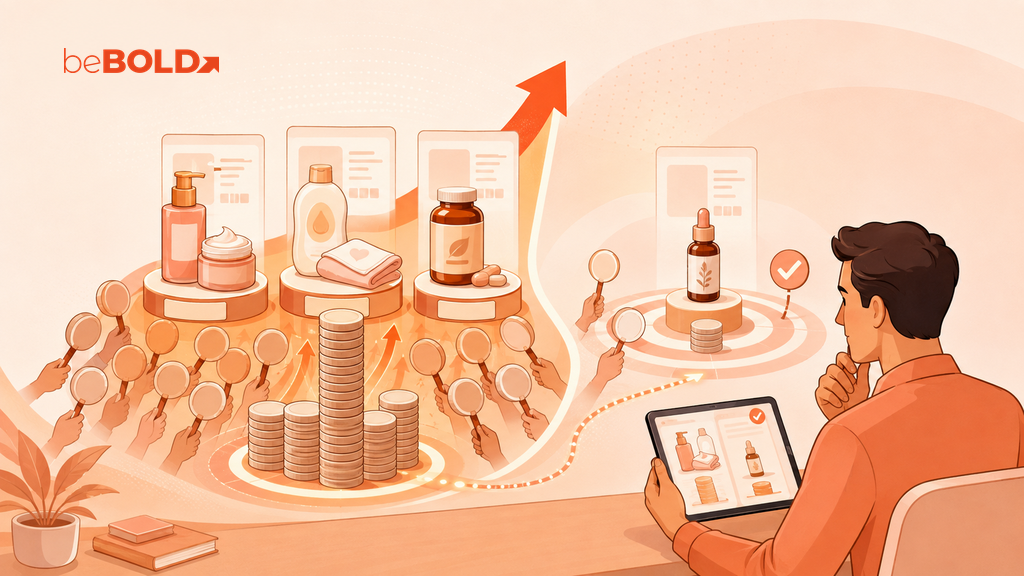
The significance of Sponsored Products for Creators is not limited to influencer marketing. It changes how a brand’s performance advertising can be distributed.
Creators are becoming part of retail media supply
Creators have traditionally sat outside Amazon PPC. Brands worked with them through affiliate programs, Creator Connections, or direct partnerships.
Now, creator audiences can function as an extension of Sponsored Products distribution. A single campaign may generate clicks from:
-
Amazon search
-
Product pages
-
External websites and apps
-
Creator content and affiliate links
This reframes creators as part of Amazon’s advertising supply chain, not just a separate marketing channel.
Budgets may now flow across more placements
Amazon states that expansion uses existing campaign budgets, bids, and targeting. That means creator traffic competes with other placements within the same campaign.
The key question is no longer just “Does it drive sales?” but:
Does it drive profitable incremental sales compared to other placements?
Brands should monitor:
-
-
CPC and conversion rate
-
ACOS and ROAS
-
Contribution margin after ads
-
New-to-brand or incremental demand
-
Placement-level spend distribution
-
Organic sales impact
-
More traffic does not automatically mean better performance.
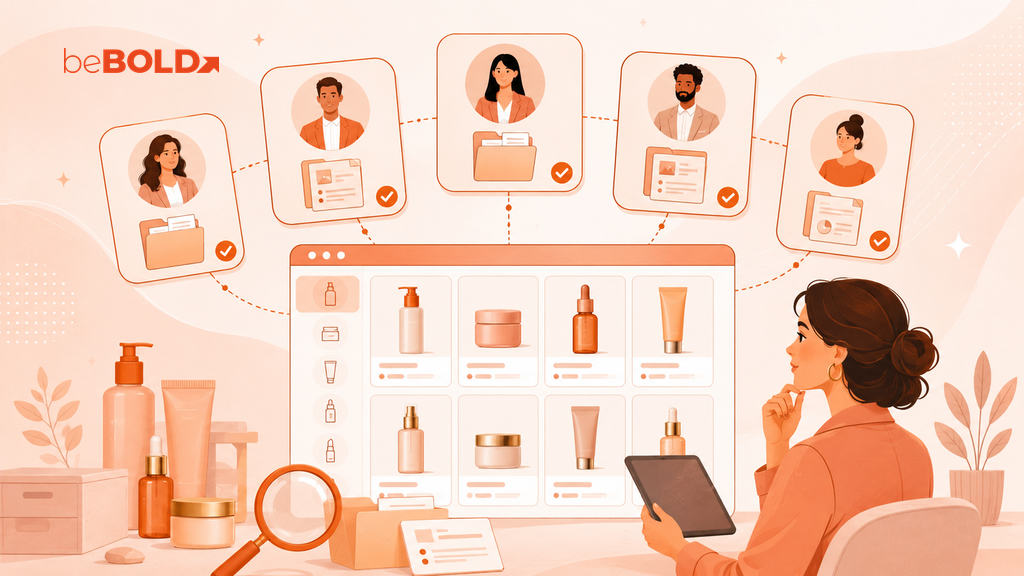
Product selection becomes more important
Not all ASINs are equally suited for creator-driven traffic.
Search traffic is high intent. Creator traffic is often earlier in the buying journey and requires stronger storytelling and visual explanation.
Best-fit products typically include:
-
-
Beauty and personal care routines
-
Household problem-solvers
-
Pet and baby products
-
Wellness and lifestyle devices
-
However, creator reach cannot fix weak fundamentals such as:
-
-
Poor product detail pages
-
Low reviews or trust signals
-
Weak pricing or margins
-
Inventory instability
-
The control trade-off brands must understand.jpg?width=6720&height=4480&name=pexels-ron-lach-8368375%20(1).jpg)
Source: Pexels
Amazon’s expansion can reduce the friction involved in finding distribution. Brands do not have to recruit every creator individually before an ASIN becomes available for promotion.
That scalability also creates questions about control.
Amazon’s public description focuses on creators browsing and selecting relevant products. With the August 10 rollout, creators now also actively generate Sponsored Products traffic through content, increasing variability in how recommendations are delivered.
Brands should therefore distinguish between two types of creator activation:
Managed creator partnerships give the brand more direct involvement in creator selection, messaging, content requirements, timing, and deliverables.
Sponsored Products creator distribution offers more scalable, performance-based reach, but may provide less direct involvement in who selects the product and how the surrounding recommendation is presented.
Neither model is inherently better. They serve different goals and require different safeguards.
The beBOLD Creator-Readiness Framework
At beBOLD Digital, we believe expanded distribution should be managed at the ASIN level—not treated as a universal account setting.
Before allowing creator placements to absorb meaningful advertising spend, evaluate each product through four dimensions.
|
Readiness dimension |
What to evaluate |
Central question |
|
Profitability |
Contribution margin, break-even CPC, promotional costs, repeat-purchase behavior, target ACOS and target ROAS |
Can this ASIN afford additional paid clicks? |
|
Retail readiness |
Product title, images, video, bullet points, A+ Content, ratings, reviews, pricing, variations and mobile experience |
Will the product page convert unfamiliar traffic? |
|
Creator fit |
Demonstrability, visual appeal, use cases, audience relevance, claim limitations and differentiation |
Can a creator communicate the product’s value clearly? |
|
Operational resilience |
Inventory coverage, Featured Offer stability, fulfillment capacity, replenishment lead times and suppression risks |
Can the business support a sudden increase in demand? |
The Measurement Gap Advertisers Should Watch
Amazon currently provides limited off-Amazon reporting through placement reports with a 90-day lookback window. This makes it essential for advertisers to regularly audit placement-level performance, budget shifts, profitability and conversion differences.
An Amazon PPC audit should now include questions such as:
-
-
Has the share of off-Amazon spend increased?
-
Which campaigns or ASINs are receiving that traffic?
-
Are conversion rates materially different by placement?
-
Is creator or publisher reach consuming budget needed for higher-intent placements?
-
Does the campaign remain profitable after product margin and operating costs?
-
Should creator-ready ASINs be separated from less suitable products?
-
Better campaign segmentation can make performance changes easier to interpret.
What Should Brands Do Now?
Amazon is steadily merging PPC advertising, affiliate marketing, and creator distribution into a single ecosystem. Here’s what you should be doing now for your brand:
-
Review campaign site options. Identify which Sponsored Products campaigns are using Amazon and beyond.
-
Download placement reports. Establish a baseline for off-Amazon impressions, clicks, spend, sales, ACOS, and ROAS.
-
Identify creator-ready ASINs. Apply the beBOLD Creator-Readiness Framework to profitability, listing quality, creator suitability, and operational capacity.
-
Separate testing from core campaign traffic. Where practical, use campaign segmentation to make performance shifts easier to measure.
-
Protect high-priority budgets. Monitor whether broader distribution is affecting campaigns designed for high-intent Amazon search or product-page placements.
-
Optimize product detail pages. Ensure creator traffic reaches a clear, accurate, mobile-friendly, conversion-ready listing.
-
Review brand and regulatory risks. Confirm that product claims are substantiated and that creator content uses appropriate disclosures.
Watch for additional Amazon announcements. Pay attention to changes in Creator Connections, Affiliate+, creator eligibility, advertiser controls, and reporting.

What could happen next + beBOLD Digital’s take
The direction of travel is becoming clearer: Amazon is merging PPC advertising, affiliate monetization, and creator distribution into a unified retail media system.
The August 10 rollout of Sponsored Products creator placements confirms that creators are now an active distribution layer—not just an external marketing channel.
For now, brands should focus on controlled testing, ASIN-level readiness, placement reporting, and profitability-first Amazon advertising management. From beBOLD Digital’s perspective, this is a media-allocation shift, not just an influencer update, so success depends on choosing the right products, optimizing listings, and managing performance across every placement with a profitability-first mindset. Need help navigating these changes? Contact beBOLD Digital today!
Frequently asked questions
Are sellers automatically enrolled in the Amazon Influencer Program?
No. Amazon says that products in Sponsored Products campaigns using the Amazon and beyond site option automatically become available to eligible creators. This does not turn the seller or brand into an Amazon influencer.
What changed on August 10, 2026?
Amazon began rolling out Sponsored Products creator placements, allowing creators to actively generate traffic from Sponsored Products ads through affiliate-linked content.
Are creators automatically enrolled in Sponsored Products for Creators?
Amazon has not formally described a universal auto-enrollment system. However, reporting suggests increased automation and integration between creator activity and Sponsored Products eligibility.
Does Sponsored Products for Creators use an advertiser’s existing budget?
Amazon says its default expansion to premium sites, apps, and creators uses existing campaign targeting, bids, and budgets.
Can an advertiser choose which creators promote its products?
Amazon’s public description says eligible creators browse opportunities and select ASINs that match their audiences. The documentation does not describe a process in which advertisers approve every creator before promotion.
Where can advertisers measure off-Amazon Sponsored Products performance?
Amazon says the Sponsored Products placement report is currently the only source for off-Amazon store metrics. The report supports daily or summary views and has a 90-day lookback window.
Which products are best suited to creator distribution?
The strongest candidates generally combine sustainable margins, a conversion-ready listing, a product that is easy to demonstrate, and sufficient inventory to support additional demand.
Do creators need to disclose that they may earn money?
Yes. Amazon Associates requires clear, conspicuous affiliate disclosures, and FTC guidance requires disclosure of financial or other material relationships connected to endorsements.





Comments