


Some clear signs your beauty brand needs Amazon help are flat sales, higher ad costs, low listing conversion, unauthorized sellers, catalog or inventory issues, unclear profits, and no one owning the whole channel.
If you have just one issue, a specialist might be enough. But if you’re facing several problems at once, you may need help with Amazon ads, SEO, listings, A+ Content, catalog, inventory, analytics, and account strategy all working together.
Why Amazon Gets Harder as a Beauty Brand Grows
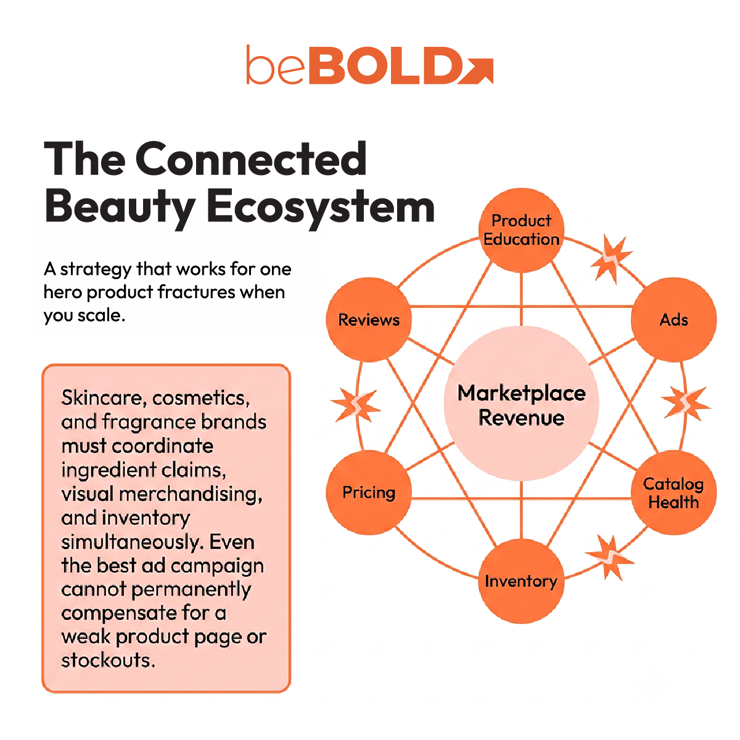
A strategy that works for one top product might not work as well when your beauty brand adds more products, ad types, retailers, or marketing channels.
Skincare, cosmetics, haircare, fragrance, and professional beauty brands must coordinate product education, ingredient information, claims, visual merchandising, reviews, pricing, inventory, advertising, and authorized distribution. Each area influences the others.
For example, even the best ad campaign can’t make up for a weak product page forever. And a great listing won’t drive long-term growth if the product keeps running out of stock or loses the Featured Offer.
It’s usually time to get outside help when these problems start showing up in more than one part of your business.
10 Signs Your Beauty Brand Needs Amazon Help
|
Sign |
Urgency |
Revenue Impact |
Recoverability |
|
Sales have plateaued while category grows |
Moderate |
Medium |
High |
|
Ad spend rising without profit improvement |
Urgent |
High |
Medium |
|
Listings get traffic but do not convert |
Moderate |
High |
High |
|
Loss of pricing control or unauthorized sellers |
Urgent |
Severe |
Medium |
|
Off-Amazon demand not converting on Amazon |
Moderate |
Medium |
High |
|
Catalog, inventory, or compliance disruptions |
Urgent |
Severe |
Medium |
|
Negative or repetitive review issues |
Moderate |
Medium |
High |
|
Overreliance on one hero ASIN |
Low |
High |
Medium |
|
No visibility into true profitability |
Urgent |
Severe |
Medium |
|
No clear ownership of Amazon channel |
Urgent |
Severe |
Medium |
1. Amazon Sales Have Plateaued While Your Category Keeps Growing
If your revenue is flat, it doesn’t always mean your brand is holding steady. Competitors might be gaining rankings, reviews, branded searches, and market share while your sales stay the same.
Check performance by ASIN, not just total revenue. Sometimes, a strong hero product can hide falling sales in the rest of your catalog.
Track organic keyword rankings, conversion rates, new-to-brand sales, repeat purchases, and Subscribe & Save performance. A structured Amazon SEO strategy for beauty brands can help identify whether visibility, relevance, or conversion is limiting growth.
Priority: Moderate. Look into this during your next reporting cycle. If sales, conversion, and organic visibility have dropped for several months in a row, treat it as urgent.
2. Advertising Spend Is Rising Without Improving Profitability
Amazon’s average cost-per-click (CPC) for Beauty & Personal Care increased by over 20% in 2023, according to Jungle Scout’s Amazon Advertising Report. eMarketer reports that total Amazon ad spend in the beauty sector reached $3.2 billion in the US alone in 2023, with brands seeing increased competition and higher costs to maintain visibility.
More revenue from ads doesn’t always mean your advertising is driving healthy growth.
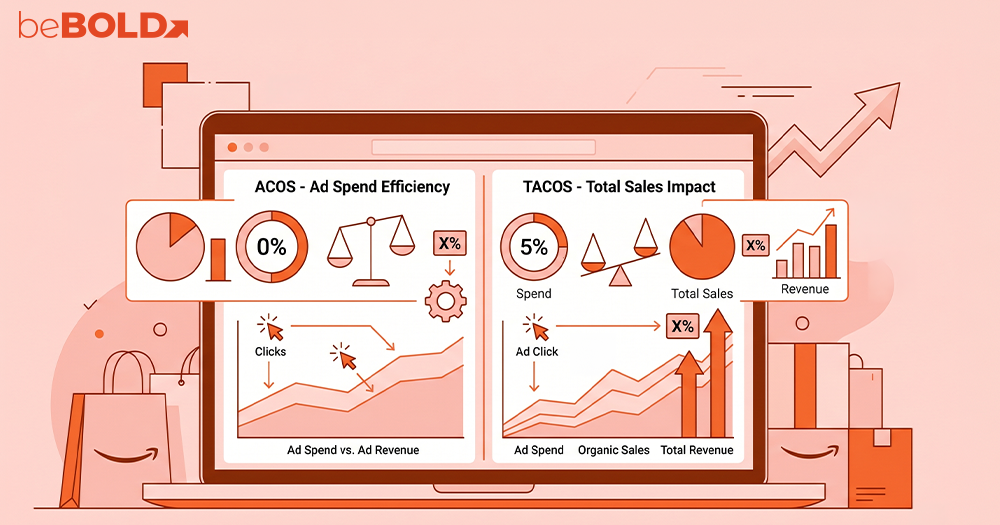
ACoS may look acceptable while TACoS rises and contribution margins decline. This can happen when campaigns depend too heavily on branded searches, broad targeting, expensive keywords, or shoppers who would have purchased without an ad.
Look at Sponsored Products, Sponsored Brands, Sponsored Display, and Amazon DSP as parts of one overall strategy. Good Amazon PPC management should link campaign choices to your total sales, margin, inventory, and organic results.
In one professional beauty case study, beBOLD Digital helped Henkel Professional Beauty achieve 30% revenue growth while reducing advertising spend by 34%.
Priority: Urgent. Act quickly if your ad spend is going up but TACoS, contribution margin, or total profitability are getting worse.
3. Your Listings Receive Traffic but Do Not Convert Beauty Shoppers
Getting more traffic won’t help if your product page doesn’t answer shoppers’ questions.
Beauty customers increasingly expect clear, trend-aligned information about ingredients, benefits, routines, texture, scent, shade, product compatibility, application, and expected results, along with greater transparency around claims and formulation. Weak mobile-first imagery, generic bullet points, unclear instructions, and incomplete A+ Content can reduce purchase confidence and fail to meet modern expectations for clean, personalized, and routine-based beauty experiences.
Effective Amazon beauty listing optimization combines keyword relevance with persuasive product education, accurate claims, strong imagery, and mobile-friendly content.
Compare sessions with unit session percentage, return reasons, and conversion by traffic source before increasing advertising.
Priority: Moderate. Fix big conversion issues before you spend a lot more on ads. If high-traffic ASINs are using a lot of ad budget but not making sales, treat it as urgent.

4. You Are Losing Control of Pricing, Sellers, or Brand Positioning
A 2023 report by BlueTuskr found that unauthorized sellers and price erosion account for up to 15% revenue loss for prestige beauty brands on major marketplaces, including Amazon.
Unauthorized sellers, inconsistent prices, duplicate pages, old content, and losing the Featured Offer can all hurt your revenue and brand reputation.
The risk is particularly significant for prestige, professional, luxury, salon, and premium beauty brands. Deep discounting or poorly presented listings may conflict with how the brand appears on its DTC website or through retailers such as Sephora, Ulta Beauty, Target, and Walmart.
Amazon Brand Registry offers helpful tools, but just signing up won’t fix every distribution, catalog, or pricing problem.
Priority: Urgent. Investigate counterfeit concerns, unauthorized sellers, Featured Offer loss, and uncontrolled discounting immediately.
These connected problems are why many established companies look for Amazon account management for beauty brands instead of just updating listings now and then.
5. TikTok, DTC, or Retail Demand Is Not Translating Into Amazon Growth

People often discover beauty brands outside of Amazon first.
A creator campaign, viral TikTok video, retail launch, public-relations feature, or DTC promotion may increase interest in the brand. However, Amazon may fail to capture that demand when products are out of stock, listings are not retail-ready, advertising is disconnected, or branded search campaigns are poorly structured.
Compare external campaign periods with Amazon branded searches, detail-page traffic, conversion rates, new-to-brand sales, and inventory availability.
A good Amazon beauty marketing agency should help link off-Amazon discovery to your marketplace content, ads, inventory, and tracking.
Priority: Moderate. Address the gap before the next major campaign or launch. Treat it as urgent when substantial creator or media spending is already underway.
6. Catalog, Inventory, and Compliance Problems Keep Interrupting Growth
Research by Amazon and Profitero indicates that stockouts and suppressed listings can reduce a product’s organic search visibility by as much as 30%, with recovery sometimes taking weeks even after inventory is restored.
Catalog and operational issues can quickly turn into revenue problems.
Warning signs include suppressed listings, broken parent-child variations, incomplete attributes, stranded inventory, stockouts, excess FBA inventory, incorrect product classifications, and unresolved Seller Central or Vendor Central cases.
Beauty brands may also face risks related to claims, ingredient information, expiration dates, packaging, labeling, and compliance documentation.
A good full-service Amazon agency should handle catalog health, inventory planning, account management, ads, and content together, not as separate issues.
Priority: Urgent. Fix suppressions, compliance warnings, stockouts, stranded inventory, and catalog errors that stop customers from finding or buying your products.
7. Customer Reviews Keep Revealing Problems Your Team Is Not Addressing

Customer reviews are more than just a star rating. They can show problems with your product, packaging, shipping, listing content, or customer expectations.
Repeated comments about leakage, damaged packaging, scent, texture, shade accuracy, application, ingredient expectations, or unclear instructions should lead to specific actions.
Insights from reviews can help you improve product images, bullet points, packaging, ad messages, FAQs, and even product development. They can also guide updates to your Amazon A+ Content, like clearer routines, instructions, comparisons, and answers to common questions.
Priority: Moderate. Check recurring feedback every month. If reviews mention safety, contamination, allergic reactions, major packaging problems, or misleading claims, act right away.
8. Your Brand Depends Too Heavily on One Hero ASIN or Promotional Events
A beauty brand might look successful if it relies on one bestseller, Prime Day, coupons, or big discounts.
This concentration creates risk. A stockout, ranking decline, competitor launch, or negative review trend affecting the hero ASIN could materially reduce total account revenue.
Other warning signs are failed launches, low visibility for related products, little cross-selling, and big drops in sales outside of promotions.
Sustainable beauty brand Amazon growth should expand customer value through routines, bundles, complementary products, replenishment, and repeat purchases.
Priority: Low. Keep an eye on things if your hero product is still profitable and stable. If one ASIN makes most of your revenue or new products keep failing, make it a moderate priority.
9. You Cannot Connect Amazon Activity to Profit or Wider Brand Growth
Amazon reporting can get scattered across Seller Central, Vendor Central, Amazon Ads, Amazon Marketing Cloud, inventory tools, and your own financial reports.
Leaders might know total sales and ACoS but still can’t explain things like contribution margin, return costs, new customer growth, inventory risk, or how Amazon fits with other retail channels.
Better Amazon reporting and analytics can help connect advertising, revenue, conversion, inventory, and profitability.
Good Amazon support for beauty brands should give you insights you can act on, not just dashboards. Leaders should know what changed, why it changed, and where to invest next.
Priority: Urgent. Don’t increase your budget until you know which activities are actually driving profitable growth.
10. No One Owns the Full Amazon Channel
When no one owns the whole Amazon channel, it’s often the main reason for other warning signs.
One partner may manage Amazon Ads, an internal designer may create listing images, operations may monitor inventory, and leadership may receive separate reports from every team. Each group completes individual tasks, but no one owns the total result.
This setup can cause slow decisions, conflicting goals, repeated work, and problems that never get fixed.
Brands with split ownership may need full Amazon account management that puts ads, content, catalog, inventory, and reporting under one clear strategy.
Priority: Urgent. Make sure someone is clearly in charge if you see several warning signs at once or if teams keep working toward different goals.
A good question to ask is: Can one person in charge explain what changed last month, why it changed, what’s being tested now, and what’s coming next?
What Kind of Amazon Help Does Your Beauty Brand Need?
The right kind of support depends on how big and complex your problem is.
|
Situation |
Most appropriate support |
|
One clearly defined problem, such as a listing correction or catalog update |
Project-based consultant or specialist |
|
Advertising is weak, but listings and operations are healthy |
Amazon advertising specialist |
|
Internal leadership is strong but execution capacity is limited |
Specialized execution partner |
|
PPC, SEO, creative, inventory, catalog, and reporting are disconnected |
Full-service Amazon agency |
|
Leadership cannot identify why profitability is declining |
Comprehensive account audit followed by an integrated plan |
Choosing between an Amazon agency or an in-house team depends on your brand’s expertise, hiring ability, execution needs, and how complex the marketplace is.
Before picking a partner, figure out if you need strategy advice, hands-on help, channel leadership, or all of these.
What to Prepare Before Requesting an Amazon Account Assessment

Giving the right information helps an agency figure out if your problem is tactical, operational, or strategic.
Prepare the following:
-
Monthly Amazon revenue
-
Advertising spend
-
ACoS and TACoS
-
Estimated contribution margin
-
Top-performing and underperforming ASINs
-
Unit session percentage or conversion data
-
Inventory coverage and stockout history
-
Known listing, catalog, or account-health issues
-
Current team and agency responsibilities
-
Upcoming product launches or external campaigns
-
Amazon goals for the next 12 months
The goal of an assessment is to find the biggest bottlenecks, not just to make a generic list of recommendations.
The Bottom Line
Don’t base your decision to hire an agency on sales alone. Look at profitability, conversion, market share, ad efficiency, inventory, catalog health, customer feedback, reporting, and internal accountability too.
If you see several warning signs at once, your business might not just have an Amazon problem—it could be a channel management problem.
The right support should help your brand find the real bottleneck, set clear ownership, and create a plan for profitable growth on the marketplace.
Ready to Unlock Your Brand’s Full Amazon Potential?
If your beauty brand is experiencing several of these warning signs, isolated fixes won’t solve the problem. beBOLD Digital provides comprehensive Amazon audits across advertising, product listings, catalog health, logistics, and channel profitability to pinpoint exactly what is holding your brand back. Schedule Your Custom Amazon Account Assessment with beBOLD Digital today.
Frequently Asked Questions
What does a full-service Amazon agency do for a beauty brand?
A full-service Amazon agency coordinates marketplace strategy and daily execution across advertising (PPC/DSP), SEO, listing content, A+ Content, catalog health, inventory forecasting, and overall account performance. Rather than working in silos, the agency connects these channels around shared revenue and contribution margin goals.
Should we hire an agency, build an in-house team, or hire a PPC specialist?
-
PPC Specialist: Ideal if your conversion rates, inventory, and catalog health are already strong, and you only need media management.
-
In-House Team: Best if your brand has the resources to recruit, train, and retain multiple distinct specialists (SEO, design, PPC, logistics, account strategy).
-
Full-Service Agency: Recommended when multiple channel issues are linked together or when you need immediate access to an experienced multi-disciplinary team without internal hiring overhead.
How many warning signs mean our beauty brand needs outside help?
There is no set number. A single Urgent issue (such as severe price erosion or widespread listing suppressions) can justify immediate external support. However, if you notice 2 or 3 Moderate warning signs happening concurrently, it usually indicates your brand has outgrown its current operational model and requires dedicated channel management.
What information should we gather before requesting an Amazon account audit?
Before speaking with an agency, compile your monthly Amazon revenue, ad spend (ACoS/TACoS), estimated contribution margins, unit session percentage (conversion rates), top vs. bottom performing ASINs, and stockout history. This data allows the agency to perform an actionable bottleneck audit rather than offering generic advice.






Comments